

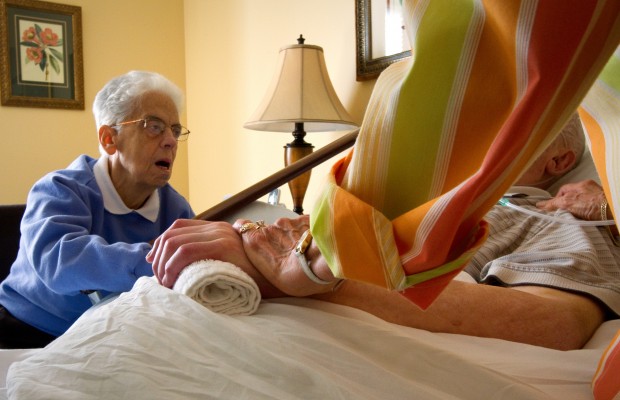
WASHINGTON (CNS) — The National Palliative Care Research Center estimates that 90 million Americans are living with serious or life-threatening illnesses and the number is expected to double over the next 25 years.
People nearing the end of life and their families often are confused about the options available to them in terms of pain control and about whether they have an obligation to use all of the life-prolonging technology available to them. These discussions are particularly lively among Catholics and in the West Coast states where physician-assisted suicide is a legal option.
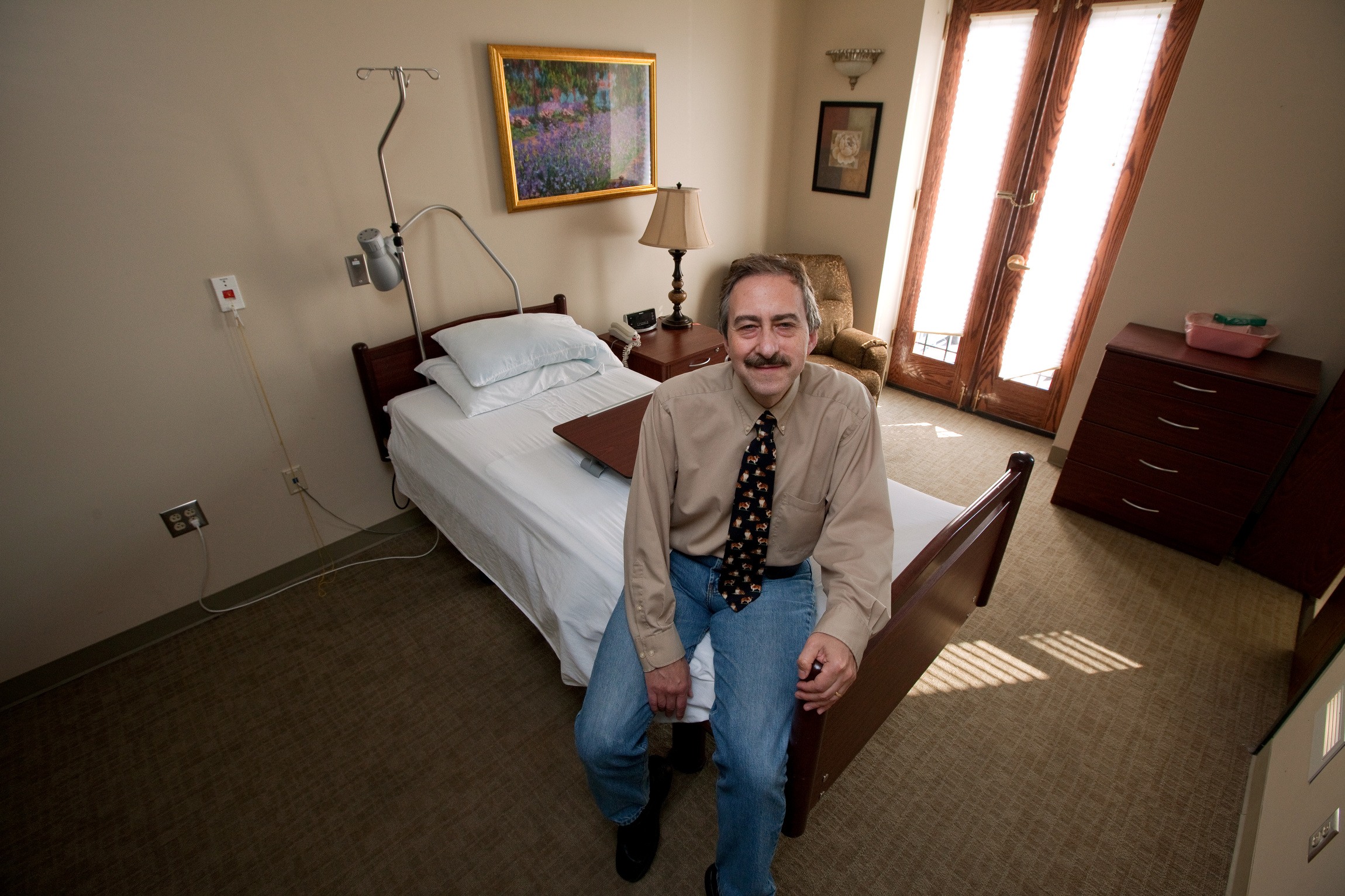
Dr. Myles Zuckerman is pictured in one of the 12 patient rooms at the Center for Compassionate Care in the Mount Lebanon area of Pittsburgh. He's been working in palliative and hospice care for six years. (CNS photo/Nancy Phelan Wiechec)
In Washington, the latest state to legalize assisted suicide, Providence Sacred Heart Medical Center in Spokane offers an alternative way of dying. It provides “comfort care suites” that allow family members to stay with their dying relative in a homelike environment.
Music thanatologists specially trained to soothe the seriously ill with their voices or the playing of harps are on staff. Health care professionals participate in education programs on palliative medicine and the ethical, moral and legal issues involved in end-of-life care. A meditation garden outside the hospital is open 24 hours a day and gives family members and patients who are well enough an opportunity to experience a peaceful area of waterfalls, streams and walking paths.
At TrinityKids Care, a pediatric hospice program in Torrance, Calif., teams made up of a pediatrician, a registered nurse, a clinical social worker, a chaplain, a home health aide and specially trained volunteers help dying children and their families make the most of their last days, whether at home or in a hospital or nursing home setting. Anything from household chores to looking after siblings can be part of the hospice program, and the team also offers family counseling and grief and bereavement services when needed.
[hotblock]
These kinds of programs are duplicated throughout the country, but too few people know about them when the time comes for them to use them.
“Most palliative care patients come in late,” said Dr. Scott Miller, team physician at the Center for Compassionate Care in Pittsburgh. On average, his patients come in three weeks before their deaths, when they could have been receiving pain management, symptom control and comfort care for many months.
Tina Picchi, executive director of the Supportive Care Coalition in Hillsboro, Ore., believes that a big part of the problem comes from the misperception that “palliative care equals hospice and is only for the end stages of life.”
Palliative care “is appropriate for anyone living with a serious illness, regardless of the prognosis,” she said. “It does not require people to limit their treatment options or to give up.”
The Supportive Care Coalition is made up of 22 Catholic health care member organizations, with more than 450 hospitals, nearly 300 long-term care facilities and numerous clinics, home health care services and hospices providing palliative care in 43 states.
“Our goal is to ensure that every Catholic health ministry has palliative care as a part of its core services — so that we are known as much for palliative care as for our concern for the poor and vulnerable,” it says on the organization’s website.
The coalition was founded by three Catholic health systems in 1994 because, Picchi says, palliative care is a natural extension of the work of Catholic health care.
“At our very roots we have a very strong belief that life is sacred, every person is truly a treasure,” she said. “From the very beginning of Catholic health care, this is the kind of health care that the religious sponsors modeled.
“The first thing that they did was to go out to the homes of people who were dying and provide very whole-person care — physical, spiritual and emotional,” Picchi said. “Palliative care is not just focused on the whole person, but the whole in terms of they and their loved ones together as a family unit. It really ought to be something that Catholic health care is taking a lead in.”
Ron Hamel, senior director of ethics at the Catholic Health Association in St. Louis, says palliative care might provide a welcome relief to a health care approach that has become too focused on what technology can do than on what a patient needs.
“Palliative care really in a sense is a return to those days when we didn’t have the technology to try to cure patients and were limited to providing relief of symptoms and companionship,” he said. “We are so technologically driven today that it is difficult to step back from the technological imperative and see that there is another way to deal with those who are critically ill and dying.”
He places some blame on the way physicians are educated, but also believes that many patients have “an inability to deal with their own finitude” and would benefit from a “more positive statement about dying within a Christian context” from Church leaders, followed by a parish-based educational effort.
Hamel also blames “both the extreme right and the extreme left” for “fostering misunderstanding about Church teaching and tradition” about the end of life.
In contrast to the position that a patient must be kept alive “at all costs,” he said, “at the heart of the Catholic approach is to neither hasten death nor prolong life endlessly.” Patients and their loved ones must weigh the benefits and burdens of a particular treatment and are not morally required to continue treatment that is “excessively burdensome or without benefit,” he added.
In some ways, Hamel said, palliative care is “nothing new.”
“It’s a return to the kind of care that was provided to the critically ill prior to all this technology,” he said. “It’s a return to our roots in the life and teaching of Jesus and in the early Christian community, which was marked by its care for the sick.”

While the availability of palliative care is growing in the U.S., fewer than a quarter of Americans are familiar with it. (CNS graphic/Emily Lockley)
PREVIOUS: Nashville Diocese, others file suit to stop HHS contraceptive mandate
NEXT: Teachings on baptism, Trinity make Mormons different from Protestants
In many Hospice Care situations, patients no longer go to the hospital for treatment and do not receive food and/or hydration (IV if necessary) before they are diagnosed in last stages. The hospice employed for my 87 yr. old mother said she was receiving palliative care. She needed a catheter for urine retention and unsuccessful efforts to insert this at home were painful and did not work. She was eating and drinking only little bits at a time. She was bedridden from weakness and needed attention for a bed sore and urinary tract infection. We dismissed the hospice and sent her to the hospital where the catheter was inserted without any problem and she received IV fluids and meds. She was not suffering from any major illness, just wearing out from age. She did feel better after this stay. However, hospice talked the family into placing Mom in their unit in the hospital. She never came out as they asked her how her pain level was. Mom said on a scale of 10, it was 9. They began to administer something IV. After several hours, she began to slip into a deep sleep, her heart rate soared. Her breathing became labored. After several hours, she was hardly responsive and a nurse came into the room, in total silence, adminstered a med into the IV line and left. I was so naive, not even realizing what could be happening. No one came to explain anything to me. A woman came to talk to me about Mom and her life. I thought how nice that was. I left the hospital hours later, Mom still in a deep sleep, hardly squeezing my hand. Five hours later, my sister received a call from the hospital that Mom was in a coma and the family should come to the hospital. She died less than 24 hrs. after entering this unit. How would this palliative care be any different in my mother’s case?
It’s called terminal sedation, the legal alternative to assisted suicide. Just came across this term but knew that it acturally happened when patients are in the end stages of cancer or other illnesses. It appears to be merciful but fails to respect life until natural death. Often the administration of such powerful pain medication as morphine will result in labored breathing. Hardly palliative care as far as I’m concerned and something to consider when creating a living will or appointing a health care proxy.
What palliative care options are available in the Philadelphia area? I’d like to make it known on our parish website.