

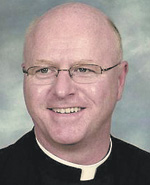
Msgr. Joseph Prior
(See the readings for the 32nd Sunday in Ordinary Time, Nov. 11)
Christmas was near and the parish school children were putting on a Nativity play. The director of the show urged the children “don’t worry if you do not get the words exactly right, just put your heart into the performance.”
The night of the play arrived and the children were all excited. A little boy was playing the innkeeper. When Joseph asked for a room, the boy replied “There is no room in the inn.” Then thinking of the director’s instruction he called out, “Joseph, wait, there is no room in the inn but you can have mine!”
In today’s Gospel passage, Jesus reminds us of the importance of charitable giving. A contrast is drawn between the hypocrisy of the scribes and the generosity of the poor widow. In the first part of the passage the scribes are described in terms of external symbols of power or prestige: seats of honor, greetings in the marketplace, and long robes.
The superficiality of this quest is heightened when the Lord says: “they devour the houses of widows.” Being widowed in the ancient world left a woman and her family in a precarious situation. Without a husband to provide for the family, the widow and her children were at the mercy of other people’s generosity for survival.
Jesus continues his teaching after observing many rich people putting in large sums of money into the treasury and a poor widow putting in “two small coins worth a few cents.” He tells his disciples: “Amen, I say to you, this poor widow put in more than all the other contributors to the treasury. For they have all contributed from their surplus wealth, but she, from her poverty, has contributed all she had, her whole livelihood.”
Thus the rich people who put in large sums were not giving of themselves, only from their excess. In other words their generosity, despite the large sum, is seen as superficial whereas the widow’s generosity is seen as genuine and true.
The first reading from the First Book of Kings has a similar theme. Here the prophet Elijah approaches a widow who was out gathering sticks for the fire. He asks for some water. She responds that she only has a handful of flour and a little oil. Clearly the widow is in a desperate situation as she says: “Just now I was collecting a couple of sticks, to go in an prepare something for myself and my son; when we have eaten it, we shall die.”
There was nothing left for them to eat. They were at the end of their supplies. As mentioned already the widow in the ancient world was left to depend on the generosity of others. Elijah reassures her, “Do not be afraid. Go and do as you propose. But first make me a little cake and bring it to me. Then you can prepare something for yourself and your son.”
She does as he instructs. In other words, in a double act of faith and generosity she goes and takes the last bit of flour and oil and prepares Elijah some food. She gave all she had. Her generosity was rewarded for as the author tells us: “She was able to eat for a year, and her son as well; the jar of flour did not go empty, nor the jug of oil run dry.” The source of her sustenance was her faith in the Lord.
When we look at these passages and consider generosity we must consider the generosity of the Lord Himself. Jesus in “laying down” His life for His friends offered Himself completely in an act of love (cf. John 15:13). His generosity knew no bounds. St. Paul, in his Letter to the Philippians, reminds us: “Though he was in the form of God, did not deem equality with God something to be grasped. Rather, he emptied himself, taking the form of a slave, coming in human likeness; and found human in appearance, he humbled himself, becoming obedient to death, even death on a cross.” (Philippians 2:6-8).
Today’s passage from the Letter to the Hebrews speaks of Jesus’ self-offering in contrast with the sacrifice offered by the high priest entering the sanctuary of the Temple on Yom Kippur. Jesus’ offering is complete so that it cannot be repeated or bettered. We, as disciples of Jesus, participate in this one perfect sacrifice when we gather to celebrate the Mass and when we go forth giving of ourselves in love to those around us.
Jesus’ reward was exultation to the highest so that “at the name of Jesus every knee should bend, of those in heaven and on earth and under the earth, and every tongue confess that Jesus Christ is Lord, to the glory of God the Father.” (Philippians 2:10-12) Our reward will be had when Christ will appear a second time, “not to take away sin but to bring salvation to those who eagerly await him.”
Last week, after the devastation wrought by hurricane Sandy, we saw many acts of generous giving. So many people were left in destitution in the wake of the winds and rains of that storm. While the loss of life was relatively low for such a powerful storm, the destruction in her wake was considerable. People were left without power, heat, water and gas. Homes were destroyed. Schools closed. Roadways blocked. The list goes on and on.
Yet, in the midst of this darkness comes the light of generosity. So many people came and continue to come to the help of those left in need. The spirit of self-giving is strong. People want to help others in an act of kindness, charity and indeed love. First responders such as public workers, utility workers coming in from different parts of the country and fellow human beings lending a hand to aid those in need all exemplify a generous heart. Without generosity, the people affected would be left alone and impoverished.
Today we are encouraged to be generous, to give of ourselves, and our resources, to help those around us, especially those in most need, those who can not repay our kindness. The Prayer of St. Francis wonderfully captures the essence of this important aspect of discipleship: “For it is in giving that we receive, it is in pardoning that we are pardoned and it is in dying that we are born to eternal life.”
***
Msgr. Joseph Prior is pastor of St. John the Evangelist Parish, Morrisville.
PREVIOUS: Readings for the holy Mass – 32nd Sunday in Ordinary Time
NEXT: Readings for the holy Mass – 33rd Sunday in Ordinary Time
Most of us are taught , at a very young age, to be generous with what we have. Many are happy to give. It truly does feel good. Yet, in giving from our excess, what are we truly giving? It is when we give from our own need, our time, that we can really further God’s Kingdom on earth.