

Some may say that it is foolish to hope in things that can’t be seen, but as St. Paul said, God’s foolishness is wiser than human wisdom.
During an Advent-themed day of reflection on Saturday, Nov. 30 at Our Lady of Consolation Parish in Northeast Philadelphia’s Tacony neighborhood, Franciscan Sister Linda Sariego led about 20 people on a journey of faith where supposed foolishness and true hope meet.
Her theme was the “foolishness of hope.”
“She is pointing out God’s love for us and the fact that He cares about each of us individually,” said Father Joseph Farrell, the pastor of Our Lady of Consolation.

Statue of Mary the Immaculate Conception outside Our Lady of Consolation Parish, a reminder of hope and God’s boundless love. (Photo: Jay Sorgi)
God’s love for people “is something beyond even common sense, but it’s true. It’s just hard to realize it,” he said.
Sister Linda, a professor of Spanish at Neumann University, says that it took her time to realize what to share in her talk preceding eucharistic adoration and confession during the three-hour retreat.
“I was trying to think of a theme that was relevant, and also adaptable depending on who would come,” she said. “I remembered that we’re in this Jubilee Year of Hope. And the theme of hope, I think, you can’t go wrong with that.”
Some of the retreatants came to encounter the experience in their first-ever retreat. Others simply needed a balance from what they perceive as the foolishness of the Christmas season, the things that aren’t connected to Christ.
Sister Linda invited those who attended to share either the word foolishness or hope based on whatever was striking them at the time, spawning two hours of discussion.
She then wove the thread of salvation history into the conversation, starting with God choosing Abraham — very human with many faults — as the beginning of that thread, and Abraham’s blind faith and acceptance of God’s will to the point that he was willing to sacrifice his own son for God.
“If Abraham had not been foolish, we would not have hope,” Sister Linda said.
Retreatants prayed a decade of the joyful mysteries of the rosary, meditating on how the mother of God chose to accept what the world would consider a foolish idea, that of a virgin birth of the Son of God.
“The whole notion of our God coming as a child is something that I think ties into the theme, I feel like in this year and this particular time, for so many people,” Sister Linda said.
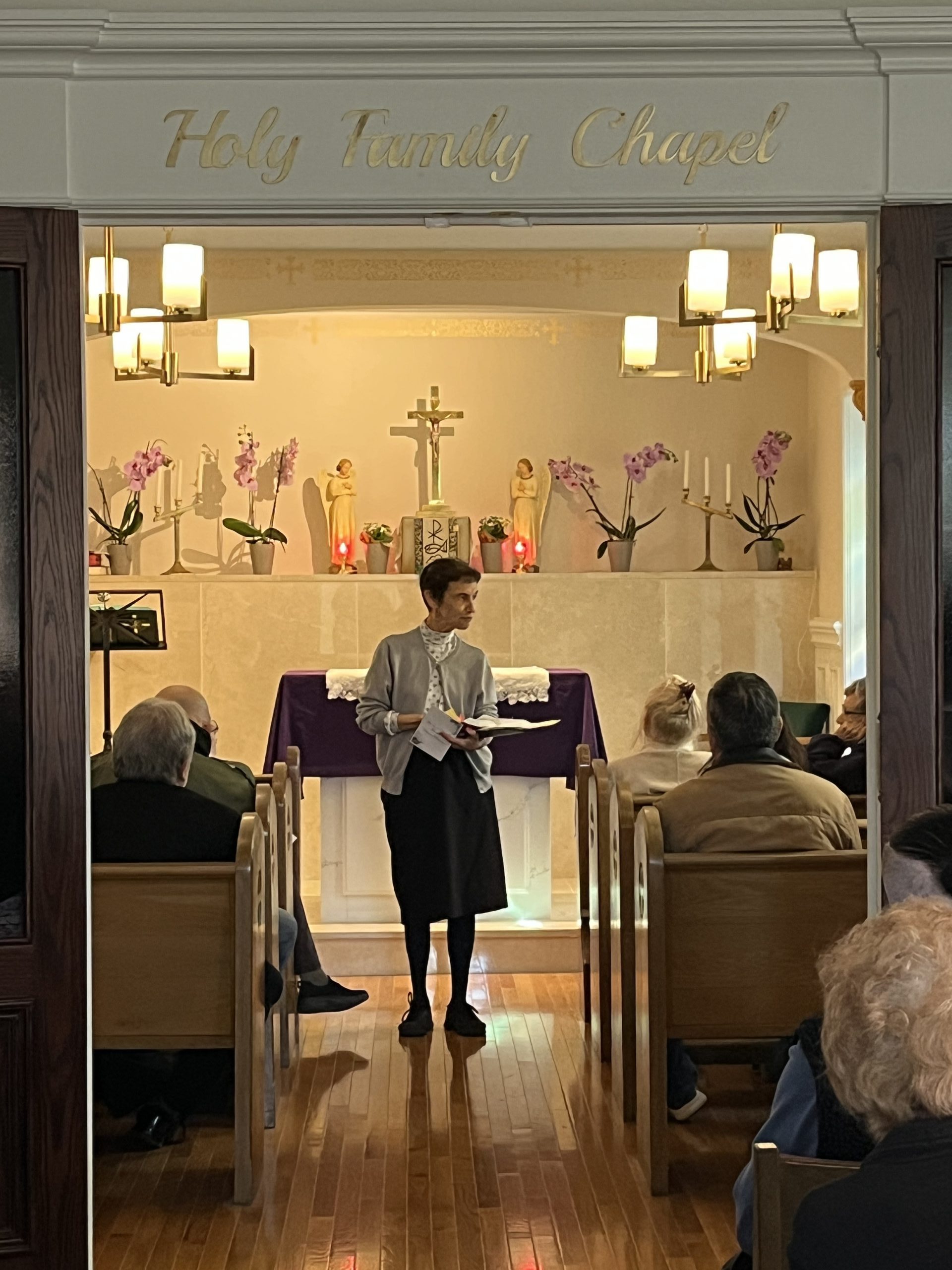
Franciscan Sister Linda Sariego shares her Advent reflection on the “foolishness of hope” with retreat participants. (Photo: Jay Sorgi)
She advanced the concept of God’s “foolish” love for us into the teaching that God’s only Son died for us on the cross to give us hope, fulfilling what Abraham was willing to do with his own son for God — but did not.
“Why are we hopeful?” she asked. “Jesus. Why are we foolish? Jesus.”
The foundation of the Church and the lives of many saints also reflect God’s immeasurable love for people, and Sister Linda cited the inspiration for the Sisters of St. Francis of Philadelphia, of which she is a member.
“St. Francis of Assisi was considered crazy, a fool for hope. Francis had to be a total fool for focusing on Jesus,” she said about the saint who created the first depiction of the birth of Jesus in a manger in Greccio, Italy in 1223.
“Franciscans are Christmas people: St. Francis of Assisi, Greccio and the first manger.”
The theme of foolishness and hope is fully rooted in a God we can hope in, Sister Linda believes, because it’s a God that is so in love with us on such an immense level that it becomes folly.
“The more we try to understand God, we can only understand God in our terms, so our terms are limited,” she said.
“We talk about somebody being a fool. ‘Look at this guy. He’s a fool. That girl, she’s a fool. Look what they’re doing.’ But also, lovers are fools. Babies are fools because they have no sense of limits. And so in terms of our relationship with God, God has no sense of limits with us. He’s the one that keeps lavishing.”
Father Farrell also sees the need for people to slow down and receive that lavishing gift of God, and to take time before Christmas to ponder God’s grace in this Advent time of waiting.
“It’s OK to do things and be busy,” he said, “but you need some downtime for prayer and meditation and, frankly, just rest.”
PREVIOUS: Sister-to-Sister Retreat Aims to Renew African Catholic Women
NEXT: Advent ‘Novena for the 83%’ Aims to Invite Catholics Back
Share this story