

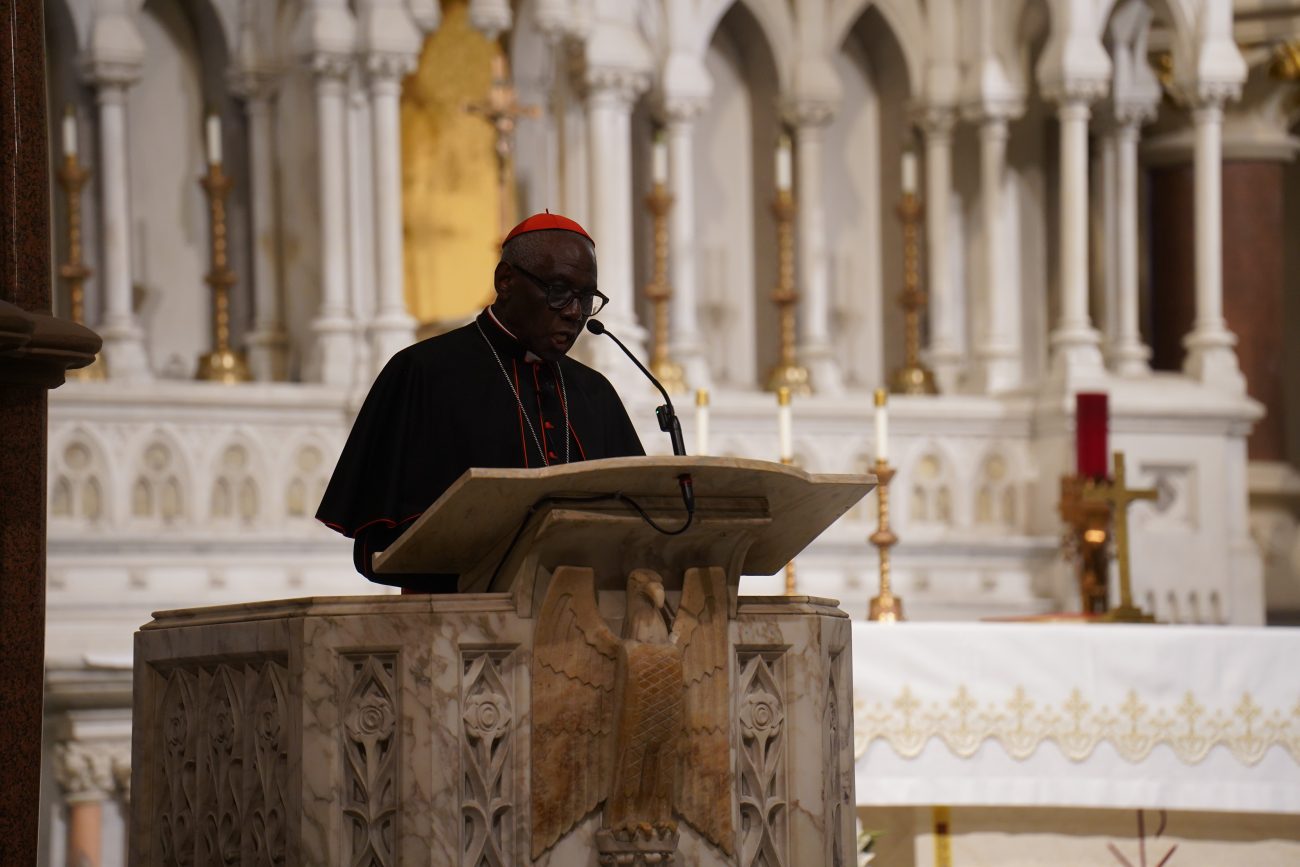
More than 300 students, families, religious, clergy, and parishioners filled St. Agatha-St. James Church in Philadelphia’s University City section Nov. 21 as Cardinal Robert Sarah delivered an address on the meaning and renewal of sacred music in the Church.
The event, which was the cardinal’s first stop in his visit to the United States, was jointly sponsored by the Collegium Institute, the Penn and Drexel Newman Centers, and the Catholic Sacred Music Project.
Cardinal Sarah, the prefect emeritus of the Holy See’s Dicastery for Divine Worship and the Discipline of the Sacraments, drew his talk from his newly released book “The Song of the Lamb: Sacred Music and the Heavenly Liturgy.”
His remarks blended theological reflection, personal anecdotes from his childhood in Guinea, West Africa, and a strong appeal to recover a sense of the sacred in liturgical worship.
From the outset, Cardinal Sarah emphasized what he called the Church’s “crisis of liturgy,” rooted in decades of what he termed confusion about the nature and purpose of worship since the Second Vatican Council.
The liturgy, he said, must be understood as “an action of Christ” that “surpasses all others” in its power to sanctify.
“The liturgy is not ‘what we do,’” he said, “but rather what Our Lord Jesus Christ does for us and in us.”
He warned against treating the liturgy as “a plaything” or a tool for ideology, noting that both traditional forms and reformed rites must be approached with reverence, fidelity, and humility.
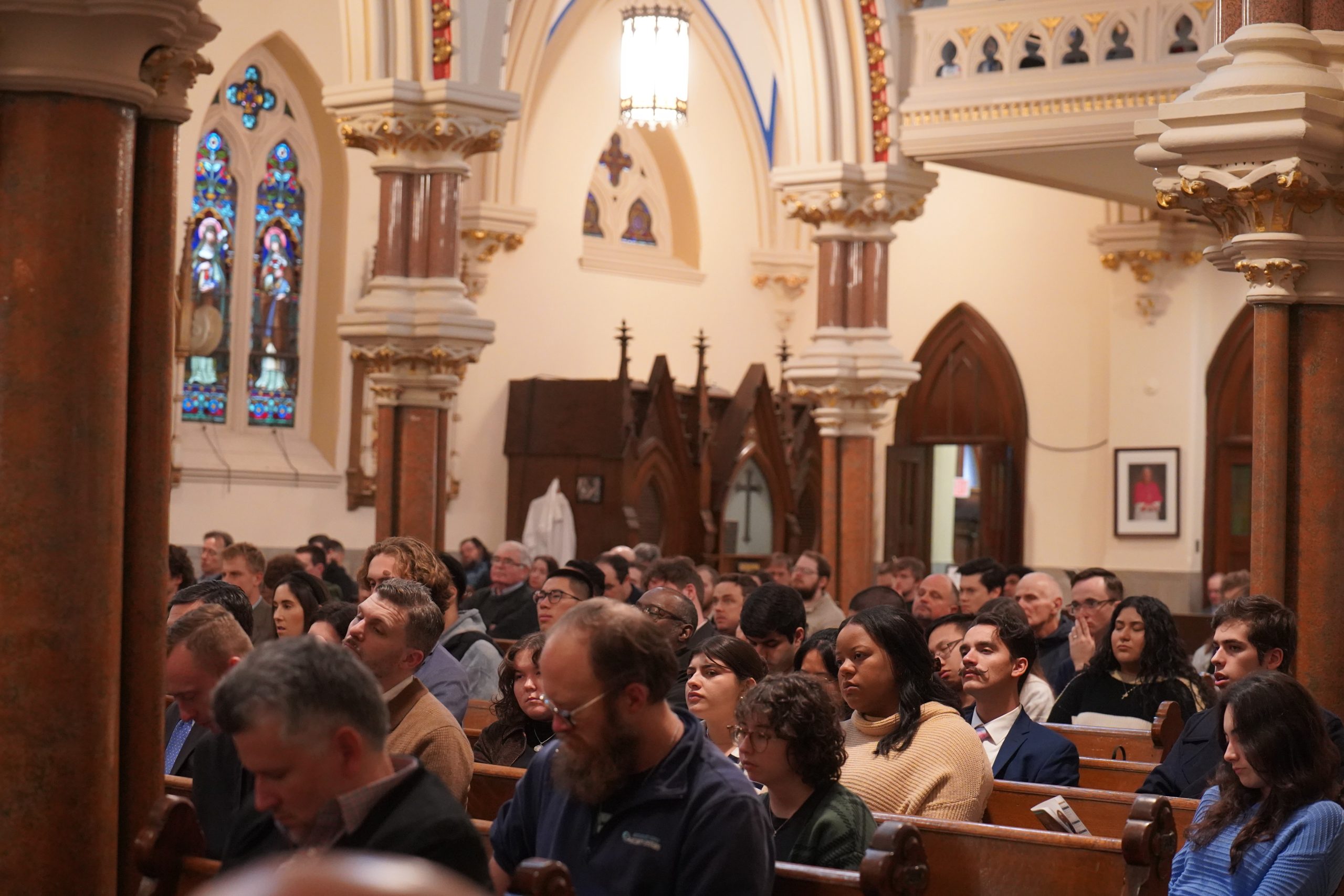
More than 300 students, families, clergy, and parishioners packed St. Agatha–St. James Church Nov. 21 in Philadelphia’s University City to hear Cardinal Robert Sarah open his U.S. visit with a talk on the renewal of sacred music. (Photo by Lindsey Najera and Daniela Medina, University of Pennsylvania)
This theme profoundly impacted many in attendance. Nicolas Cloutier, a second-year student at the University of Pennsylvania, said the talk reminded him “that the liturgy should move us more than we should move it.”
Cardinal Sarah devoted much of his address to distinguishing sacred music from other musical forms. Some music, he said, is intrinsically suited for worship; other genres, however beloved, are not.
Quoting Pope Benedict XVI in his apostolic exhortation “Sacramentum Caritatis,” the cardinal said that in the liturgy “we cannot say that one song is as good as another.”
Sacred music, he explained, has an “objective rootedness” in the Church’s liturgical tradition and orients the faithful toward the praise of God.
“If the music we sing conforms to God and his Church, we can truly call it sacred,” he said.
He recalled the missionaries who brought Gregorian chant to his home village in Guinea. Though culturally foreign in language and in sound, the chants “immersed us in the Catholic tradition,” he said, shaping the people’s prayer and identity.
Cardinal Sarah reaffirmed the Church’s encouragement of the use of Latin in the Roman rite, calling it “the language of unification of the Church,” though not denying the legitimate place of vernacular languages.
This point resonated strongly with attendees. Timothy Caí, a senior at the University of Rochester who flew 1.5 hours to attend the event, described the talk as “a great need for returning back to music that is considered sacred and separating out from music that’s not made for worship.”
He added that Cardinal Sarah’s discussion of Latin as a “universal language of unity” encouraged him to appreciate its role in the Church’s liturgical life.
For Faith Keen, a fourth-year medical student at Drexel University, the address offered clarity about worship as an act of offering.
“Sacred music is the unifying language of our liturgy,” she said, “where we unite ourselves as a body of Christ, and sacred music is the essential vehicle which we are able to do that.”
Other attendees spoke about how the Cardinal’s remarks would shape their spiritual lives going forward.
Ally Andrews, the president of Drexel Newman Center, said she felt “more of a desire for sacred music” and how it could be “useful in prayer as a vehicle to help ascend my intellect and will towards God.”
Michael Lagrutta, a Drexel psychology student, said he was struck by the reminder that “the liturgy isn’t about what we do but what God and Jesus does for us.”
Stokely Palmer, a third-year Drexel engineering student, highlighted one of Cardinal Sarah’s most repeated points.
“We do not create the liturgy … but the liturgy is Christ’s,” Palmer said, underscoring the need to “maintain what has been passed down to us.”
Daniel Cheely, executive director of the Collegium Institute and a key figure in organizing Cardinal Sarah’s visit to Philadelphia, said the event’s significance goes beyond the Catholic community.
He hoped that “students here and other members of the university at large would see that this Catholic prelate from the Global South, who is really a keen intellectual, has something to offer. And not just for those of us who are Catholics, but for the broader university community.”
Cheely also commented on the role of beauty and music in the liturgy, saying people should “more greatly value the role of liturgical music in drawing us out of ourselves into something greater.”
As controversy over liturgical practice continues to affect the Church, Cardinal Sarah urged patience, humility, and fidelity, especially as the faithful await guidance from Pope Leo XIV.
“We must pray for the Pope,” the cardinal said, “and if we fight, we offend God.”
In his final remarks, Cardinal Sarah encouraged all present to seek holiness through the liturgy and “to live the will of God … to be sons and daughters of God.”
PREVIOUS: Pope Leo XIV Calls American Youths to Relationship With Christ
NEXT: St. Bernadette Turkey Trot Raises $20K for School Upgrades
Share this story