

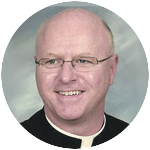
Msgr. Joseph Prior
(See the readings for the Fourth Sunday in Ordinary Time)
The Gospel reading for this Sunday’s liturgy comes from the Gospel According to Matthew. It is the opening passage of the Sermon on the Mount. The “sermon,” as it is called, lasts for multiple chapters. In this section of the Gospel, Matthew recalls some of Jesus’ teachings on how to live and act as His disciples. The evangelist highlights Jesus’ role as the new Moses, giving us the new law of the covenant.
Notice how Matthew tells us that Jesus after seeing the crowd “went up the mountain.” Now this certainly could be so that people could see and hear him, yet there seems to be something more significant. Just as Moses went up on the mountain to receive the law from God, Jesus is on this mountain giving the new law.
This image will get more explicit in the passages that follow. Jesus is revealing to us the Father’s plan for the way we should act and interact with one another.
The first part of the “Sermon on the Mount” contains what will later be called the “Beatitudes.” The first beatitude holds primary place because of its fundamental nature; the others are built on it. One might even say that the entire sermon has this as its foundation. “Blessed are the poor in spirit, for theirs is the kingdom of heaven.”
What does it mean to be “poor in spirit?” Here Jesus is not speaking of poverty in a material sense. He is speaking about being humble. The English word “humble” is rooted in the Latin word for “earth” or “ground;” hence “lowly.” One might think back to the creation stories in Genesis, when man was created from the earth. Or the verse after the expulsion from the Garden, which can also be used on Ash Wednesday when ashes are distributed: “For you are dust, and to dust you shall return” (Genesis 3:19).
Humility is rooted in our awareness of God’s greatness and our lowliness. This does not mean we look badly or look down upon ourselves for we are created good, male and female, in His “image and likeness” (Genesis 1:26). It does mean we look up from our lowly position and recognize God’s greatness, His love and His mercy.
In a different type of writing in the Scriptures called the wisdom literature (for example, Proverbs, Wisdom of Solomon, and Sirach) we might call this awareness “fear of the Lord,” which is “the beginning of wisdom” (Proverbs 9:10) and a “fountain of life” (Proverbs 14:27). Humility or poverty of spirit recognizes our place within the “big picture.”
Poverty of spirit gives us focus and understanding. It helps us to live with an awareness of God’s ever present and perfect love. He is “one God and Father of all, who is over all and through all and in all” (Ephesians 4:6). Or as St. Paul said to the Athenians at the Areopagus: “In him we live and move and have our being” (Acts 17:28).
The first reading from the prophet Zephaniah speaks of humility in terms of observing the law of the Lord. In this sense the law is seen as God’s plan for humanity. Following the law is seen as humble, for the humble person recognizes God’s ways are a sure path to justice. His ways are above the ways of men and a reliable path. Zephaniah speaks of a “remnant.” These are the people who remain faithful. They are “humble and lowly” and will find shelter in the Lord.
St. Paul, in the passage from First Corinthians which serves as our second reading, asks the Corinthians to consider themselves in the grand plan of God. He chooses “the foolish of the world to shame the wise.” Paul reminds the Corinthians that “not many of you were wise by human standards, not many were powerful, not many were of noble birth.”
Status in the world’s eyes is not something that defines us. Status is passing. It can also inhibit us if it instills pride. Rather, the one who is humble is one who is defined by God. Our greatness comes through Him who loved us into being and saves us by His Son. So, Paul says, “Whoever boasts, should boast in the Lord.”
Humility is a bedrock on which to build a Christian life as it is the foundation of Christ’s law of love. It is a virtue that underlies all we think and do. There’s a humorous story about Pope St. John XXIII that may help us on the path of humility.
Each night after a long day of service to the Church, it is said that Pope John would make these words his prayer: “It’s your Church Lord, I’m going to bed.”
“Blessed are the poor in spirit, for theirs is the kingdom of heaven.”
***
Msgr. Joseph Prior is pastor of Our Lady of Grace Parish in Penndel and a former professor of Sacred Scripture and rector of St. Charles Borromeo Seminary. Read more reflections by Msgr. Prior here.
Share this story