

College has been called “the best four years of your life.” There is some truth to this statement particularly because attending college provides a time of enhanced community, a time to live, study, and work among friends.
This is especially true for young Catholics at secular colleges, where frequent events at the Catholic Newman Center draw people into the beauty of a vibrant community of faith.
After college, however, graduates often have difficulty finding a similar faith-based community.
At the University of Pennsylvania and Drexel University in Philadelphia and other colleges around the country, Newman Centers are working to provide seniors with a Catholic community once they leave higher education through the ESTEEM (Engaging Students to Enliven the Ecclesial Mission) program.
Now in its seventh year at the Penn-Drexel Newman Center, the program pairs college seniors with a mentor who has already graduated and is in a similar field of study.
Through events such as meetings with their mentor, monthly speaker sessions and retreats, ESTEEM lays the groundwork for seniors to have the tools and confidence to find or create a Catholic community upon leaving college.
Patrick Travers, the director of Penn-Drexel Newman Center, says he “stumbled” upon the ESTEEM program. It was the answer to a problem that he found on the university campuses.

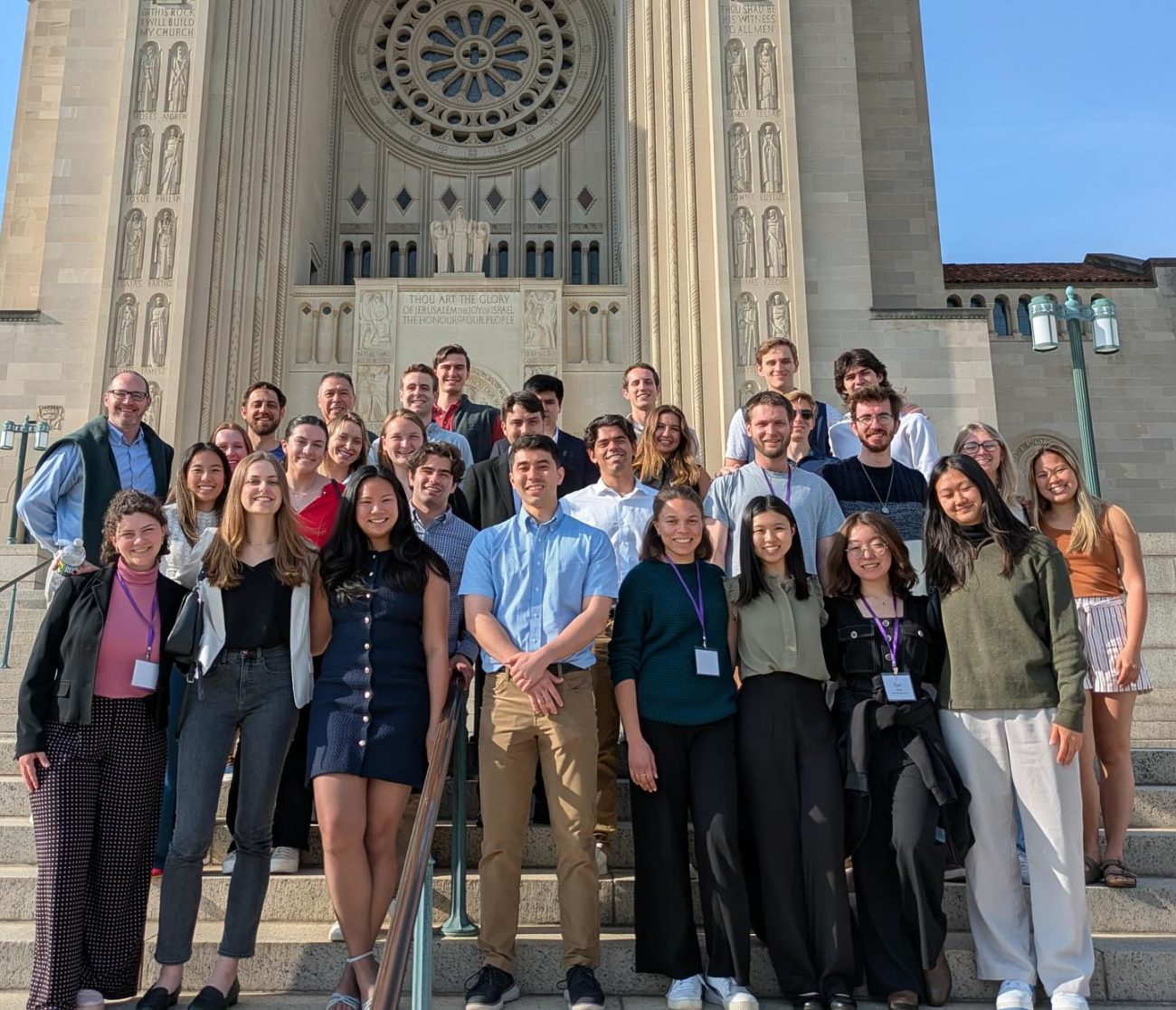
Kerry A. Robinson (center), president and CEO of Catholic Charities USA, speaks with a student from the Penn-Drexel Newman Center during the ESTEEM Capstone Conference in Washington, D.C., in April 2025. (Photo: Penn-Drexel Newman Center)
Students were developing an enthusiasm for their Catholic faith during their four years on campus, but then struggled to find a flourishing community of young adults, as at the Newman center, upon graduation.
Added to this strain was their transition to the workforce without the Newman Center’s strong support network.
Travers recognized that the success of the Newman Center also depends on its ability to prepare students for the next stage. ESTEEM, therefore, helps connect seniors with vibrant faith communities where their future jobs will be located.
The program at the Penn-Drexel Newman Center aims to continue growing the network of young adult communities so that they can provide opportunities for graduates to plug into communities where young adults are living their faith in a fruitful way, prior to graduation.
By keeping a pulse of where the Church is flourishing, normally around parish life, the Penn-Drexel Newman Center is able to smooth the transition for graduates.
“We have young alumni that are getting involved in some places, and we are able to point to these places and people and just connect people that are graduating with some of our young alumni that are really living their faith in a really vibrant way post-college,” Travers explained.
The fruits of this program are not easy to track, but the success of the communities that these graduates are forming and joining is a sign of the ESTEEM’s importance.
“We hear really great things about how (ESTEEM alumni) are either involved in or leading young adult communities, particularly here in the Archdiocese,” Travers said. “We really see that.”
Lexi McCullough, who graduated with an accounting degree from Penn, spoke highly of her experiences with the program and how it helped her as she made the transition to the working world.
“I learned so much from my mentor, despite the background differences, and we were able to have a lot of conversations about how she was able to be herself and be a practicing Catholic in the workforce,” McCullough said.
Attending a secular school can make it harder for students to meet others living out their faith, which is one of the reasons that Newman Centers were founded and are such a hub on college campuses for young adult Catholic life.
ESTEEM then takes this one step further by showing how that faith can be lived out in community among a largely secular work force.
“Hearing (the monthly speakers’) stories of how they were able to share Christ’s light in their workplace was really powerful and something I hadn’t been exposed to,” McCullough said.
Travers encourages all Newman Centers to join the ESTEEM program.
“I couldn’t be more of an advocate for other schools to try it out,” he said. “It literally has almost no cost involved. There’s a $250 membership fee and you just implement it however you see fit. It is super easy to implement.”
Broader adoption of ESTEEM promises to continue the resurgence of young adults in the Church as they live out Christ-like lives for their peers to witness.
For more information on the national ESTEEM program, visit https://esteemlead.org/.
Share this story