

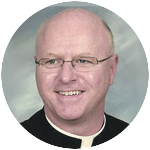
Msgr. Joseph Prior
(See the readings for the Fifth Sunday of Lent)
The grief was overwhelming. Where light had once been bright there was only darkness. The questions swirled in her mind like a tornado. She felt alone in her sorrow. “No one could possibly understand my loss, no one knew him or loved him the way I did,” she may have thought.
Thoughts and feelings like these are not uncommon when we face the loss of a loved one. Perhaps Martha and Mary were experiencing the same as their brother died. The grief was strong. Mary, who once knelt at the feet of Jesus listening to his every word, will not come out to greet Jesus as he approaches. Was she angry at him? Not a few people get angry at God at the loss of a loved one.
Martha, when she meets Jesus, expresses her confusion and pain when she says: “Lord, if you had been here, my brother would not have died. But even now I know that whatever you ask of God, God will give you.” Jesus’ answer is an invitation to faith, a faith that will see her through grief and sorrow to light and life.
St. John the Evangelist recalls several of the great “signs” of Jesus in the Gospel. The signs Jesus performs are an invitation to faith, to believe in Him and receive the love and life He is offering. The signs, one of which we encountered last week with the healing of the man born blind, now move into an even more amazing and wonderful sign – the raising of Lazarus.
The sign reminds us of the conflict between the ways of the world and those of God. The realm of the world is captured by different themes that run throughout the fourth Gospel. The themes present the contrast in terms of above/below and darkness/light. In last week’s Gospel we recall the latter: blindness is replaced by sight; doubt by faith; darkness by light.
This week we revisit that image; the greatest force in the realm of the world is death, the ultimate “darkness.”
Details in the account point to the profundity of this sign and the power of Jesus’ faith, calling for belief in all situations of life, even and perhaps most urgently, the tragic and trying.
First, Jesus is friends with Lazarus and his sisters – pointing to His friendship with all humanity (“I do not call you servants anymore, instead, I call you friends for I have revealed to you everything I have learned from my father.”). Second, Jesus knows Lazarus is sick and will die and He waits. He waits trusting in the Father for He knows this has to happen so that His glory will be revealed and people may believe in Him.
Third, Lazarus has been dead for three days, bound head to toe in the burial cloths. He is bound but will be set free at the word of Jesus. Fourth, the dialogue with Martha, which lies at the center of the encounter, brings it all together with Jesus’ words: “I am the resurrection and the life … do you believe this?”
The paschal mystery we are preparing to celebrate at Easter is a participation, through faith and the sacraments, in Jesus’ passion, death and resurrection. We are united with Him through baptism into His death and are promised a like share in His resurrection.
God’s plan for human salvation was slowly revealed ever since man was created and then turned away from God. The prophet Ezekiel, speaking for the Lord, looks forward to salvation as he says: “O my people, I will open your graves and have you rise from them … I will put my spirit in you that you may live.”
Dante in his “Divine Comedy” beautifully recalls the power of Christ’s death which breaks the power of death. In Canto IV of Inferno, the pilgrim Dante is led by Virgil, his guide through the underworld. They converse:
“Tell me, my Master, tell me, thou my Lord,”
Began I, with desire of being certain
Of that Faith which o’ercometh every error,
“Came any one by his own merit hence,
Or by another’s, who was blessed thereafter?”
And he, who understood my covert speech,
Replied: “I was a novice in this state,
When I saw hither come a Mighty One,
With sign of victory incoronate.
Hence he drew forth the shade of the First Parent,
And that of his son Abel, and of Noah,
Of Moses the lawgiver, and the obedient
Abraham, patriarch, and David, king,
Israel with his father and his children,
And Rachel, for whose sake he did so much,
And others many, and he made them blessed;
And thou must know, that earlier than these
Never were any human spirits saved.”
An ancient homily for Holy Saturday presents the freedom from death won by Jesus in these words:
“Something strange is happening – there is a great silence on earth today, a great silence and stillness. The whole earth keeps silence because the King is asleep. The earth trembled and is still because God has fallen asleep in the flesh and he has raised up all who have slept ever since the world began. God has died in the flesh and Hell trembles with fear. He has gone to search for our first parent, as for a lost sheep. Greatly desiring to visit those who live in darkness and in the shadow of death, he has gone to free from sorrow the captives Adam and Eve, He who is both God and the Son of Eve.
“The Lord approached them bearing the Cross, the weapon that had won him the victory. At the sight of him Adam, the first man he had created, struck his breast in terror and cried out to everyone, ‘My Lord be with you all.’ Christ answered him: ‘And with your spirit.’ He took him by the hand and raised him up, saying: ‘Awake, O sleeper, and rise from the dead, and Christ will give you light.’”
The second reading for this Sunday’s liturgy, from St. Paul’s Letter to the Romans, reminds us that we too have a share in Christ’s victory over death by the Spirit dwelling within us. It is through baptism that the Spirit comes to dwell in us: “… if Christ is in you, although the body is dead because of sin, the spirit is alive because of righteousness. If the Spirit of the one who raised Jesus from the dead dwells in you, the one who raised Christ from the dead will give life to your mortal bodies also, through his Spirit dwelling in you.”
Jesus breaks the power of death. The raising of Lazarus is a sign to us of Jesus’ desire that we be released from the bonds of death and set free; of His power over death; of His own death; and His victory over death.
It is that victory he shares with us in love. It is that victory that robs death of its power: “Where, O death, is your victory? Where, O death, is your sting?” (I Corinthians 15:55) It is that victory which leads us from the darkness of death, sorrow and grief to the bright light of life, love, joy and hope. And so, He who is “the resurrection and the life” calls us to faith.
***
Msgr. Joseph Prior is pastor of Our Lady of Grace Parish in Penndel and a former professor of Sacred Scripture and rector of St. Charles Borromeo Seminary. Read more reflections by Msgr. Prior here.
Share this story