

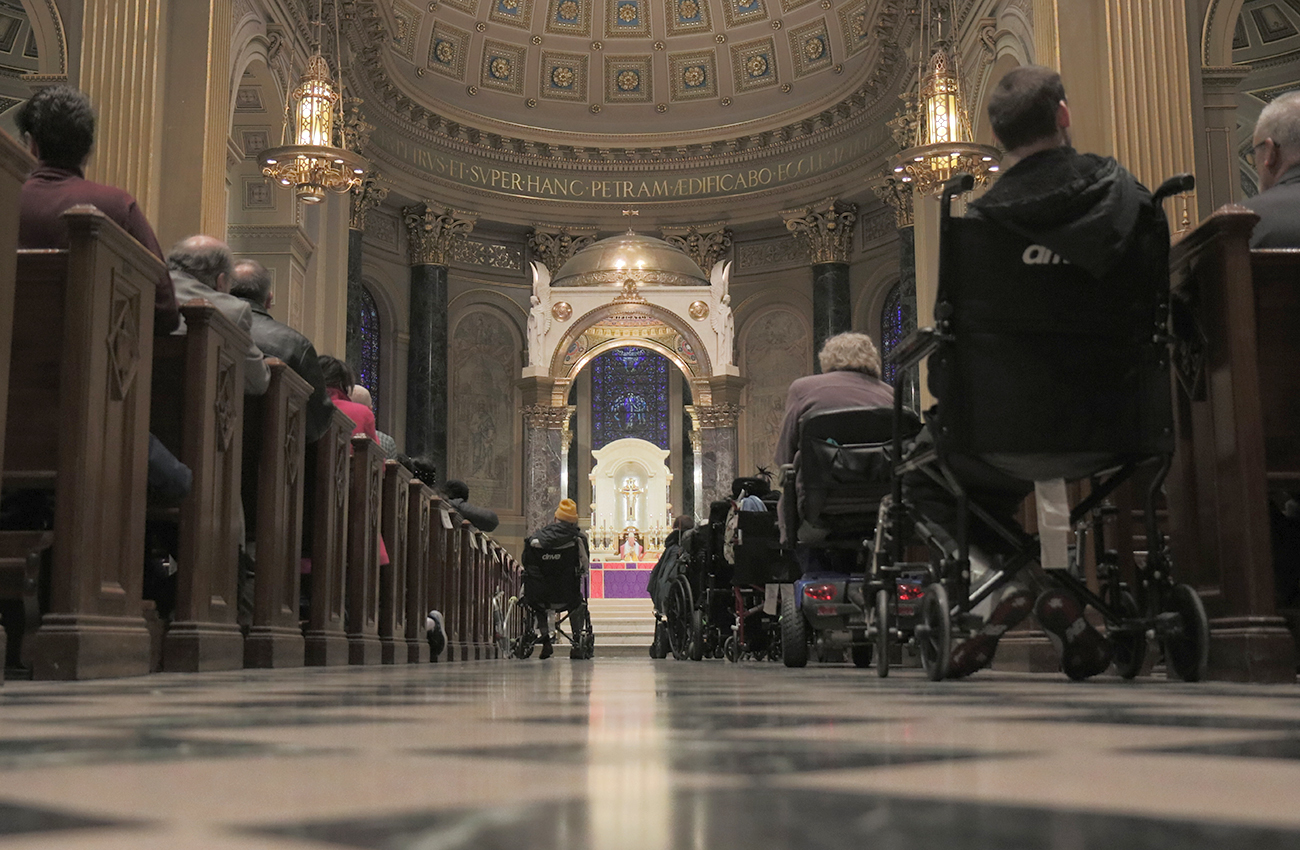
Individuals with disabilities and mental health battles say they often feel unseen.
The Catholic Church of Philadelphia has created a way for them to be better seen and included in sacramental experiences within the parish and in everyday life, and to inspire empathy in all the faithful.
The archdiocesan Office for Persons with Disabilities and the Deaf Apostolate, along with the National Catholic Partnership on Disability, are hosting “Building Belonging for All: Foundations for Inclusive Communities,” a series of free disability and mental health training opportunities throughout March.
“A little over a year ago at this point, the Catholic Church of Philadelphia was entered into a mentorship program related to disabilities,” said Natalie Morales, the director of the Office for Persons with Disabilities and the Deaf Apostolate.
“We’ve actually been working with the Diocese of Phoenix in increasing our disability ministry and things that we can do here just to help spread the word more, and even have people recognize that this is a thing that we can plan for.”
She says that churches and people in ministry should expand the definition of disability to better meet people’s practical and spiritual needs.
“We have people often think about individuals that are using mobility aids or wheelchairs when they think of a disability. But in reality, there’s so many other people that are already sitting in our pews that have various other disabilities, but a lot of times they’re invisible disabilities,” Morales said.
“Someone was recently diagnosed with an autoimmune disease, for example, and (we’re) thinking about how we support those individuals. Maybe it’s someone who suddenly had an illness happen and now they’re no longer able to come to church, so (we’re) thinking about individuals who are now homebound and what we can do to ensure that they’re still included in our faith communities.”
She adds that sacramental ministers also must learn how to serve individuals with autism or learning disabilities, particularly so they have access to sacraments.
“You cannot deny someone to receive the sacraments just because they have a disability. I’ve had conversations with individuals (reporting that) people during Mass have asked them to leave, and even clergy that have asked them to step out,” Morales said.
“It might be something so simple as there may be a child that has autism or some other sensory related disorder. Maybe they’re making noises in church (as) their way of prayer. They might be just so excited to be there (and) when the priest holds up the host, that children would start to make noise, and the parent who knows that child says, ‘This is my child engaging with the Eucharist right now. They’re talking to Jesus in that moment.’”
Morales adds that many Philadelphia-area parishes like St. John Chrysostom in Wallingford have found success with both practical initiatives and a commitment to extending welcome to those on the margins.
“They do a really great job at assessing the needs of their community, talking to the people and then providing that,” Morales said.
“At every Mass, if you speak to them ahead of time, they will provide whatever it is that you need. They have interpreters for some Masses. If you need sensory toys for children, they have that available. If you need large print missals, that’s an option. Anyone can go and know that they’ll be accepted and have a place of belonging there.”
She adds that some parishes offer sensory-friendly Masses in which music and light may be softened to assist people with particular needs. But she believes parishes can open more doors.
“Why can’t someone with a disability be on parish council?” she suggests. “I’ve seen individuals with Down syndrome serving as altar servers and actually training other altar servers as well.”
Morales sees the Church working to accompany Catholics who have struggles with mental health, particularly older individuals.
Mental health challenges tend to spike “around the teen years, and then it kind of levels off, but then it spikes again in the elderly years, around the 60s, 70s,” she said.
Parish communities should examine how they serve spouses and families of elderly loved ones with such challenges by having conversations around the issue now, “because we can literally save lives by just talking about it,” Morales said.
She encourages anyone with a desire to live their faith through outreach to persons with disabilities by participating in any one of the four sessions, two in English, two in Spanish.
She urges all Catholics to “get comfortable with being uncomfortable” in learning how to support the needs of others.
“I think we often forget that whether a person has a disability or not, they have something to offer us as well. As baptized Catholics, they’re also called to evangelize,” Morales said.
***
Sessions for “Building Belonging for All: Foundations for Inclusive Communities” will be offered in English at SS. Simon and Jude Parish’s Meehan Center in West Chester.
On Wednesday, March 18 mental health topics will include:
* Accompaniment
* Stigma
* Trauma-informed care
* Suicide prevention
On Thursday, March 19 general topics will include:
* Universal design
* Removing barriers to participation
* Adaptive catechesis
* Fostering belonging
Sessions in Spanish will be offered at St. Ambrose Parish in North Philadelphia.
On Sunday, March 14 general topics will include:
* Universal design
* Removing barriers to participation
* Adaptive catechesis
* Fostering belonging
On Sunday, March 21 mental health topics will include:
* Accompaniment
* Stigma
* Trauma-informed care
* Suicide prevention
See more information on the sessions in English and in Spanish. Follow these links to register in English or in Spanish.


Share this story