

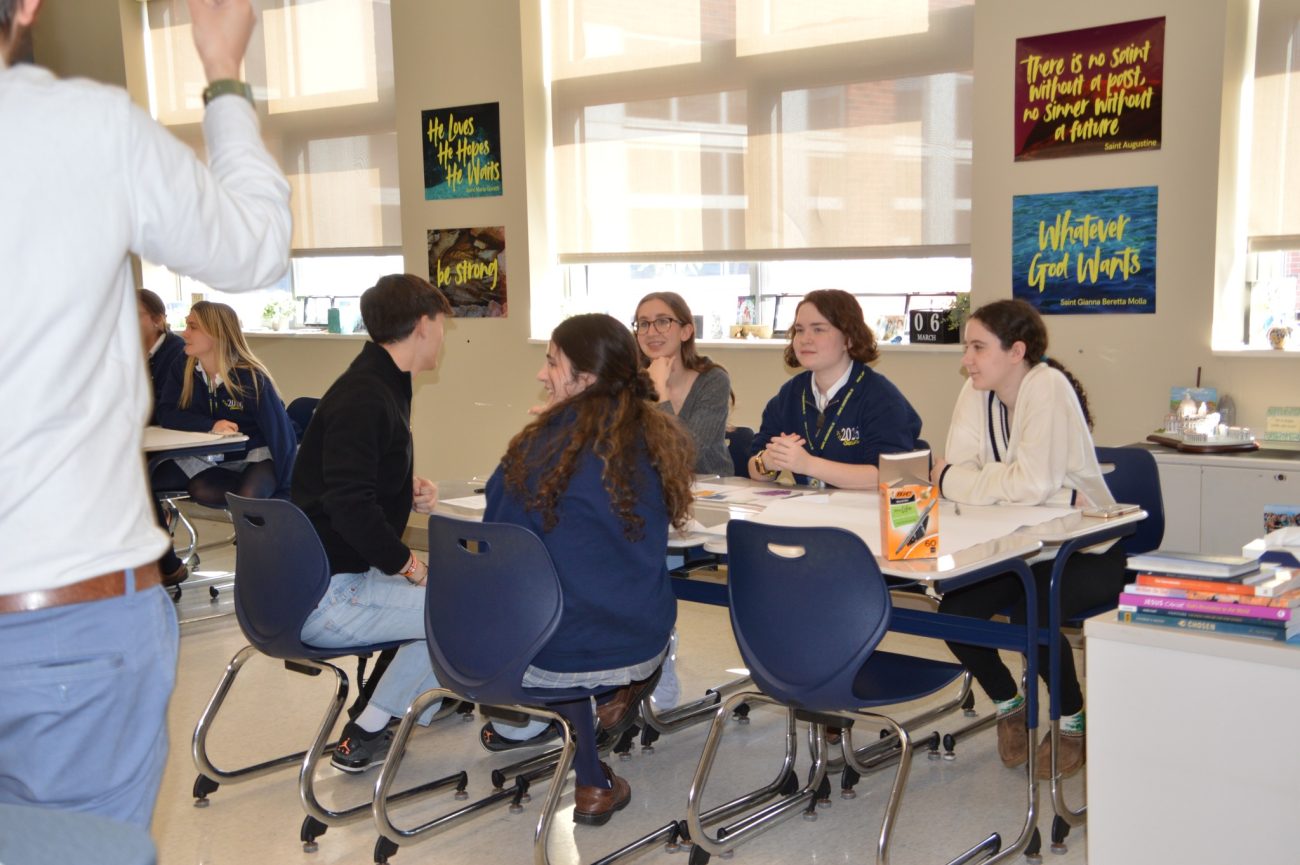
A Catholic high school in Royersford and its Jewish counterpart in Bryn Mawr have forged an educational and faith partnership that has opened students’ eyes and hearts to one another, a relationship that has lasted for as long as many of their students have been alive.
Pope John Paul II High School and Jack M. Barrack Hebrew Academy have linked their students into understanding through Friends in Faith for 16 years, and dozens of students did exactly that March 9 at PJP.
“They love the program. It has been very eye-opening for both sides, both schools, and something that they truly get a lot out of after each program that we have them attend,” said PJP Director of School Ministry Kevin Kozeniewski.
“Since 2010, more than 1,500 students from the junior and senior classes of Barrack Academy and Pope John Paul II High School have participated in this program,” said Marcia Bronstein, the regional director of the American Jewish Committee’s Philadelphia and Southern New Jersey Regional Office. “That’s an incredible testament to this program.”
She said Friends in Faith came about in 2010 as a partnership between the American Jewish Committee and the Archdiocese of Philadelphia, with the programs eventually linking to the Institute for Jewish-Catholic Relations of St. Joseph’s University.
The groups of high school upperclassmen and women get together once in the fall and once in the spring, rotating between PJP, Barrack Hebrew Academy and St. Joseph’s University.
“When they come together, they’re teaching each other. They’re teaching each other their traditions and their customs, and they’re opening it up for dialogue, what it means to them,” Bronstein said.
“There’s always two things that happen. Students go and they’re slightly nervous, slightly anxious. (They ask) ‘What are we doing? Who am I going to talk to? Who are these other students?’” Kozeniewski said.
“When we leave (they say), ‘Can we go visit them again? Can they come visit us?’ They see the similarities in being a high school student at a faith-based school, what that looks like and how their lives are actually very similar in that aspect.”
These kids might not have faith in common when they first meet, but connections happen between students who might want to talk about the Eagles or the latest Taylor Swift album.
Indeed, Monday’s encounter in Royersford began with quick conversations about each other’s faith lives but also included things that they have in common like favorite foods.
“We do icebreakers that get them out of the mindset of, ‘Oh, I’m in school. I have to be here. This is part of what I have to do,’” Kozeniewski said. “Instead, it’s fun. ‘This is a human being that I’m talking to.’ That relationship starts to build.”
Those icebreakers led to deeper discussion, respectful debate, and eventually mutual understanding of the shared foundations of each other’s faith traditions, teaching them in ways that helped students empathize with their counterparts’ perspective.
“Today was a fun day,” said PJP student Teagan Delaney, proving Kozeniewski correct. “We got to learn about each other’s faiths, and got to learn about how Passover and Lent are kind of related to each other.”
“Both Jews and Catholics can both learn beside each other and share the same ideas while respecting each other’s differences,” Barrack Hebrew Academy student Daniel Somerman added. “What was great about the program today was the debate aspect, where we get to hear both arguments from both sides, but also practice how to debate from the other perspective.”
Both Bronstein and Kozeniewski see this relationship as a growing branch stemming from Nostra Aetate, a 60-year-old document of the Second Vatican Council put into effect by Pope Paul VI that expanded interfaith dialogue between Catholics and people of non-Christian faiths.
“AJC has a special relationship with the Vatican because of Nostra Aetate. It changed everything,” Bronstein said. “Our rabbi from our national office met with St. Joe’s and started to create the Institute for Jewish-Catholic Relations.”
“The central theme of Nostra Aetate is that the Church doesn’t reject anything that’s true and holy in other religions. I think that Friends in Faith lives that central theme of Nostra Aetate,” Kozeniewski said.
“It allows us to live out the teachings of it. It allows us to really listen to one another. It allows us to meet each other where we are and to find that common good in each other, that human dignity, that ‘Imago Dei’ of who we are.”
That recognition of human dignity, made in God’s image, continues to grow as Friends in Faith grows and the fruitful relationship between PJP and Barrack Hebrew Academy evolves.
“Every time we bring them together, something special happens,” said Bronstein. “They’re listening to each other in a way that is very special.”
PREVIOUS: Deacons Hear One of Their Own Speak of Serving Those With Mental Illness
NEXT: Catholic Teacher Seeks Life-Saving Gift of Living Kidney Donor
Share this story