

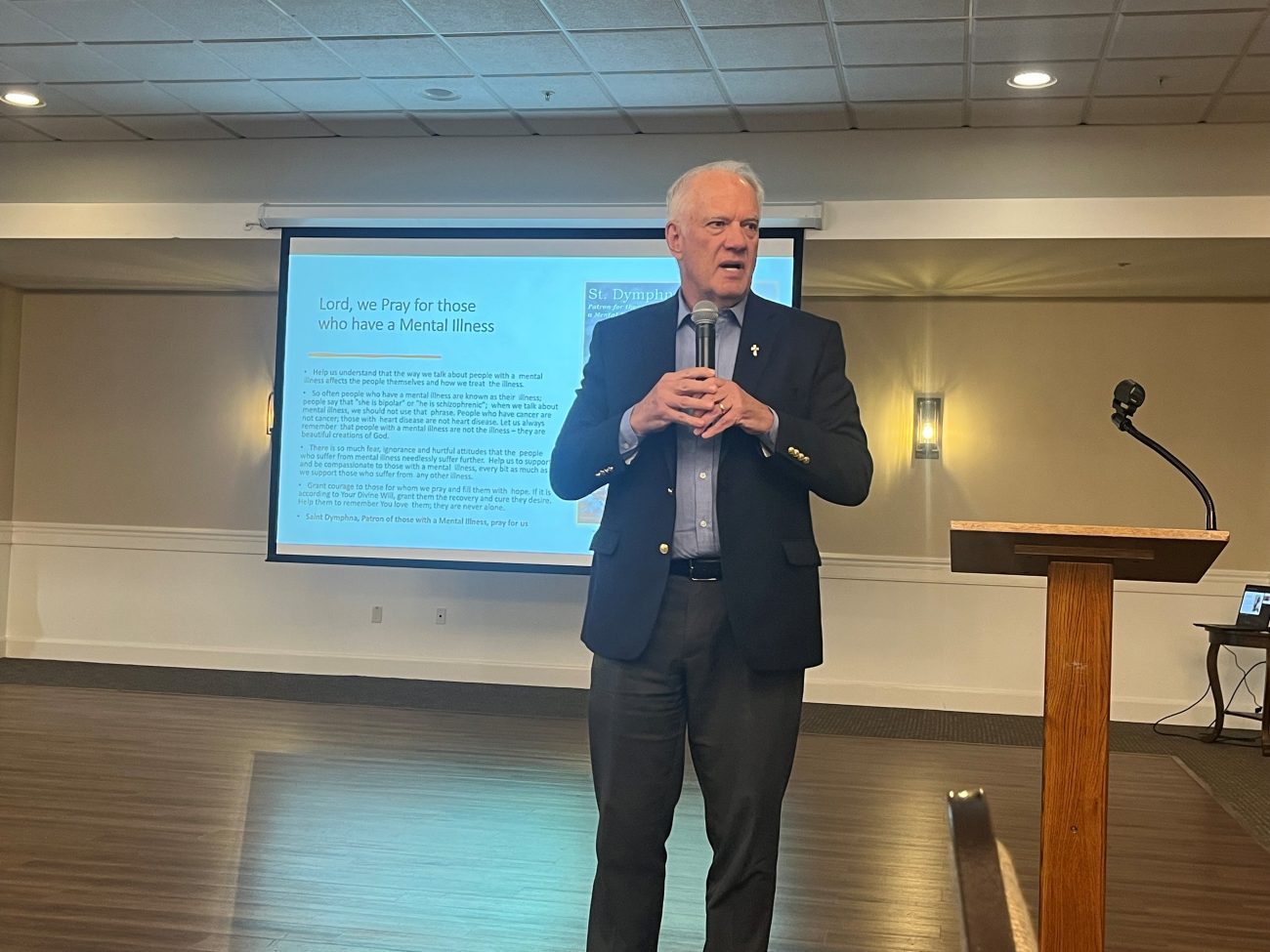
Deacon Ed Shoener battles depression, and has faced one of the worst tragedies a parent can endure when his daughter lost her battle with mental illness.
As president of the International Association of Catholic Mental Health Ministers he is devoting much of his life to helping the Catholic Church extend Christ’s ministry of healing for those who endure struggles with mental health.
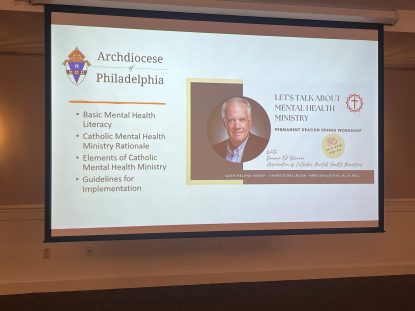
He engaged dozens of archdiocesan permanent deacons March 21 during the Office for Permanent Deacons’ Spring Workshop at St. Helena Church in Blue Bell to help them minister more effectively to parishioners dealing with mental-health issues.
“It’s not a ministry where you need to be a therapist or a counselor or a psychologist,” Deacon Shoener said.
He noted two qualities of a good mental health minister: “One, a deep love of Jesus Christ; and two, a desire to help those who are facing mental health challenges,” he said. “If you’ve got those two things, you can be a mental health minister.”
(Photo by Jay Sorgi)
Deacon Shoener, a former resident of Philadelphia’s Roxborough section, serves at St. Peter’s Cathedral in the Diocese of Scranton. He and his wife lost their daughter Katie, who faced bipolar disorder, to suicide in 2016.
In his presentation he not only presented ministry tools to help accompany individuals in mental health struggles, but also to open doors for people to talk about their own mental health.
“Not everybody is aware of some of the mental health issues that are challenging the clergy itself, challenging families, challenging parishioners,” said Deacon Gregory Maskarinec from Mother of Divine Providence Parish in King of Prussia. “When you talk about suicide, death of children, whatever it might be, not everybody is comfortable talking about it. Not all of us know where to go.
“This workshop really helps us to feel more comfortable talking to people about it, so that the more we’re informed, the better we can talk to parishioners.”
Deacon Shoener made that point and showed vulnerability by sharing his own battles with depression, which he says can affect a person’s relationship with God as well as someone’s thoughts and emotions.”
“I can tell you from living with depression, there are times when I think God doesn’t love me. I think my wife doesn’t love me. ‘Why am I a deacon? I shouldn’t be a deacon. It’s a waste of my time. I shouldn’t be doing this,’” he said.
“I know that’s not true, but that’s what these illnesses do.”
He also shared that at least 20 percent of the U.S. population struggles with a diagnosed mental illness.
“Think about that when you’re preaching and you’re standing up there in front of your people on a Sunday morning. Twenty percent of the people you’re talking to have some level of mental illness or mental health challenge,” Deacon Shoener said.
“It’s not some little, tiny percentage. It’s a good chunk of the people that we minister to. It’s a very common type of illness, just like physical illnesses are very common.”
He addressed how Pope Francis sought help for anxiety during his ministry in Buenos Aires, Argentina before his election as pope.
“He actually went to see a psychiatrist (who) gave him a number of techniques and methods to manage his anxiety,” Deacon Shoener said. “Even when he became pope, he talked about how he continued throughout his life to use those methods. Even the pope dealt with this, and even the pope got therapy and counseling.”
Deacon Shoener also addressed how Catholic teaching about suicide has changed in recent decades to better respond to the realities of mental health.
“Suicide is contrary to the love of the living God. Everybody knows that. Even people who have died by suicide know that,” he said.
The Catechism of the Catholic Church teaches that “grave psychological disturbances, anguish, hardship, (and) suffering can diminish the responsibility or culpability of the person who dies by suicide,” the deacon said, “and the Church recognizes that. The popes have recognized that.”
He strongly encouraged his fellow deacons who struggle with mental health to consider opening up to parishioners about what they endure, as a way of opening the door to others sharing their own mental health journey.
“I’m comfortable, as comfortable as you can be, talking about something like this with you. You all know the gift of listening, fully listening, so you can listen and try to understand,” Deacon Shoener said.
“By sharing your story, people might get something out of your story, but they also will know you’re someone that they can talk to about this.”
***
The following resources can help you or someone you know find healing with regard to mental health:
* Call 988 for access to the national Suicide and Crisis Lifeline and related crisis resources;
* Visit the Archdiocese of Philadelphia’s page, Be Encouraged: Catholic Support for Mental Health;
* Find a local mental health professional through the archdiocesan Mental Health Referral Network.
Share this story