

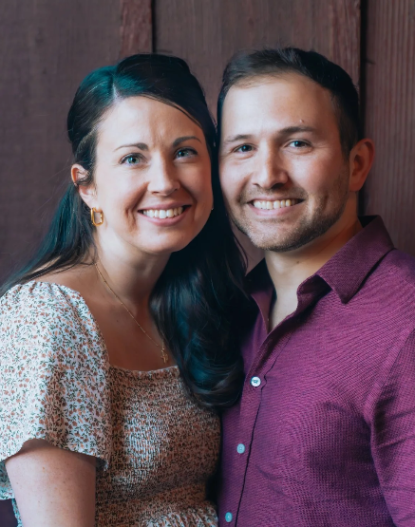
Joey Pontarelli, founder of the Catholic ministry Restored, is pictured with his wife. Pontarelli, who speaks openly about the impact of his parents’ divorce on his own life, now leads retreats aimed at helping young adults heal emotional wounds and build healthy, faith‑filled relationships.
Trauma from our past, particularly damage caused by dysfunctional relationships in our families, often becomes an obstacle that prevents us from effectively living the vocation God gives us.
An organization called Restored is hosting a weekend for young adults at Malvern Retreat House that aims to offer faithful young Catholics an avenue into the unhealed parts of their lives, and speed them toward healing and wholeness.
“We’re a ministry that helps young adults who come from broken families, whether their parents are divorced, separated, or things at home are just really dysfunctional, to heal those wounds so that they don’t end up repeating their parents’ story and instead can build strong, healthy relationships,” said Restored author, speaker and podcast host Joey Pontarelli about the retreat.
It will be held Friday, May 1 at 4:30 p.m. through Sunday, May 3 at 11 a.m., with Mass and confession opportunities provided. People can register for the retreat here.
Restored’s leaders empathize with the challenges stemming from broken families. Pontarelli said that research from 15 different countries shows that people are two to three times more likely to experience divorce in their own marriage if their parents divorced.
The U.S. Census shows that more than 1 million American children – including Pontarelli – endure their parents’ divorce each year.
“When I was about 11 years old, my parents separated and later got divorced, and it brought a ton of pain and problems into my life,” Pontarelli said. “Emotional problems, bad habits, a lot of struggles in relationships. Over the years, especially in high school, college, looking for help and healing with this particular struggle and wound, I came up empty.
“There was nothing specific and practical for a young person like me, a young Catholic, when it came to navigating the challenges I faced in my broken family and finding real practical healing, so after some success in the business world, I felt like God was calling me to build Restored.”
Pontarelli’s colleague, Operations Manager and Executive Assistant Jordana Myers, concurred.
“My parents divorced in my senior year of college, and things were dysfunctional before that as well,” she said. “Instead of just talking about what healing is like, talking about what are my wounds, this was kind of the next step for me to actually take action steps towards building a better life.”
The problems stemming from family trauma span across the lives of tens of millions of young people, and their brokenness makes it much harder to, as Pontarelli said, “pick yourself up by the bootstraps and just move on in life.”
“Often you can’t see it from the outside, but they might be struggling with really bad habits, compulsions, addictions in order to cope with their pain. They might be dealing with really intense emotional problems like anxiety, depression, loneliness, and they might be really struggling in their relationships, whether it’s falling into really toxic romantic relationships or even if they attempt marriage, ending up repeating the same pattern that they saw in their parents’ marriage in their own,” he said.
“We so often see that the young people who come from these families just end up repeating that cycle themselves and putting their kids through the very same pain that they went through as children. The question is, how do we prevent that?”
Pontarelli said the retreat focuses on young adults, which he said becomes the brain’s best opportunity for healing and growth.
“It’s when your brain’s the most plastic and you can change behaviors and habits,” he said. “You’re not too set in your ways and it’s the first time that you’re on your own.”
Pontarelli said he wants retreatants to carry three takeaways from their 43 hours in a prayerful and compassionate setting on retreat.
“One, we want to give them really concrete ways to heal and not just manage their wounds. Two, we want to give them tactics to navigate their emotions, to break bad habits and to truly feel peace, because so often they don’t,” he said.
“Finally, we want to give them a really concrete plan to beat their fear of marriage, which is very visceral.”
The retreat will show in a faith-filled way how each person’s body and brain react to trauma, dive into reflective mental and emotional exercises built by psychologists, and enter into a priest-created study on forgiveness.
Retreat leaders say they don’t have qualifications for therapy and addiction treatment, but their retreat can open up the discussion to help people facing addictions walk a path of healing.
The retreat will present Catholic themes on love and marriage with experts showcasing “what makes a really healthy and beautiful marriage,” Pontarelli said.
“We’ll dive into pulling on the Church’s wisdom in different areas on repairing your relationship with God, because we believe that He is the divine physician.
“All these human tactics I think are good,” Pontarelli said. “I think God gave a lot of them to us. But ultimately He’s going to be the one to heal us.”
PREVIOUS: Malvern Retreat House to Honor Local Catholics Who Embody the Faith
NEXT: St. Joseph’s Prep Receives $74M Gift, Largest Known for U.S. Catholic High School
Share this story