

Pope Leo XIV, a Villanova University alumnus, offered a challenge to the Catholic Church on the 10th anniversary of the encyclical of Pope Francis entitled “Laudato Si’,” which calls the Church to greater, more active care for God’s creation in a time of what the late Holy Father described as an environmental crisis.
EcoPhilly Co-Founder and Board Chair Nicholas Collura cited Pope Leo’s challenge to the approximately 120 people who attended “From Hope to Action,” the annual conference for the Philadelphia-based organization hosted May 9 by Villanova University.
“God will ask us if we have cultivated and cared for the world that He created, for the benefit of all and for future generations, and if we have taken care of our brothers and sisters,” Collura said, quoting the Holy Father.
“What will be our answer?”
The attendees came from across the Archdiocese of Philadelphia, but also from Harrisburg and even Chicago. They took part in a series of talks, panel discussions, and question-and-answer sessions while encountering fellow faith-centered ecological organizations with whom they could partner and take action.
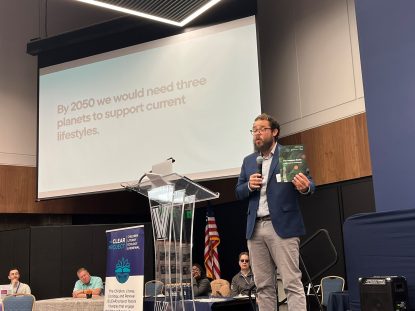
Joshua van Cleef, director of the Office of Peace and Justice for the Catholic Diocese of Lexington, Kentucky, speaks during EcoPhilly’s annual “From Hope to Action” conference May 9 at Villanova University. (Photo by Jay Sorgi)
Joshua van Cleef, the director of the Office of Peace and Justice for the Catholic Diocese of Lexington, Kentucky, spoke to the ecological urgency of our times.
He cited a study co-created by the Vatican and the Stockholm Environmental Institute in 2023 called “Our Common Home,” which revealed the future effect of the ecological damage being caused at this time.
“By 2050, we will need three planets to support us if we don’t make a drastic shift in what we consume and what we throw away,” van Cleef said.
“We don’t have three planets. The environmental crisis is measurable. It’s urgent.”
Leaders who spoke at the conference said taking immediate action to care for the world God gave us can originate from the personal, the parish and even diocesan level.
Van Cleef showed that an entire diocese can successfully commit to greater ecological stewardship simply by taking steps that can not only help steward the environment, but also create financial savings to reallocate for other ministries.
He said the Lexington Diocese had two goals, the first of which the diocese already accomplished in creating and implementing Laudato Si’ action plans for environmental stewardship. The effort involved dedicated parish teams creating ecology ministries.
Van Cleef added that the second goal of Lexington Bishop John Stowe is in process: the diocese reaching net zero effect on climate pollution by 2030.
“We saw people join into this work that had never been active in the Church,” van Cleef said. “We had scientists, we had solar folks; people just started jumping up. It wasn’t the usual people on parish councils. And the pastors said, ‘We can do this.’”
Numerous Philadelphia-area parishes are already taking such steps at the local level, including Our Mother of Good Counsel in Bryn Mawr where numerous parishioners along with Augustinian Father Joseph Mostardi leading action steps from composting to greater use of LED lights and exploring the possible installation of solar panels.
Sometimes those steps happen from grass-roots efforts like those championed by parishioners like Christina Puntel of St. Vincent de Paul Parish in Philadelphia’s Germantown section. She organized children to bring banana peels to Mass.
“I had a bucket of compost, and I said this is what’s going to happen to these banana peels in six months,” she said. “That compost will be able to grow more plants. So this is the cycle of life, decay, and rebirth.”
Personal change, leaders said, can come from actions as small as aligning our purchasing power. EcoPhilly Project Manager and Education Committee Chair Aaron Lemma said Catholics need to focus their buying decisions on things that aren’t wasteful.
One example is to reconsider purchasing and using a nonbiodegradable substance like polystyrene foam. Its negative impact on human health, he suggested, doesn’t honor God.
“How do we just make those small changes to do more for the environment, for each other?” Lemma asked.
Catholic ecology advocates held sessions with students about ways they can be individually engaged in day-to-day practices that create less negative impact on what Pope Francis described as “a fragile world.”
Another panel discussion engaged attendees on the effects of artificial intelligence (AI), its dangers as communicated by Pope Leo XIV, and ways to control that technology.
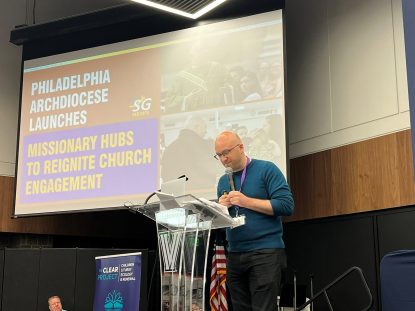
Nicholas Collura, co-founder and board chair of EcoPhilly, addresses attendees during the “From Hope to Action” conference May 9 at Villanova University. (Photo by Jay Sorgi)
Collura added that EcoPhilly is taking active steps within the missionary hubs that are part of the current Trust and Hope initiative of the Archdiocese of Philadelphia, showcasing that grassroots commitment is growing locally.
He summed up the message of the day, linking the conference’s title “From Hope to Action” to the challenge issued by Pope Leo and Pope Francis.
Collura said the day called for spiritual conversion in which people move from gathering data and information about our environment to taking actions in care for God’s creation.
“How can we connect the cry of the earth and the cry of the poor,” he said, “not through discourse, but by our lived presence in action as converted people?”
Van Cleef added the words of Pope Francis in “Laudato Si’,” summarizing why he believes the Church must adopt stronger stewardship of the environment. He paraphrased Psalm 24, which references how all of creation belongs to God, the true owner of the earth.
“What’s our task?” van Cleef said. “We’re not owners. Our job is to till and keep what belongs to God.”
PREVIOUS: Volunteers Sought for National Eucharistic Pilgrimage Procession in July
NEXT: Archbishop Pérez Announces New Clergy Assignments Starting July 1
Share this story