

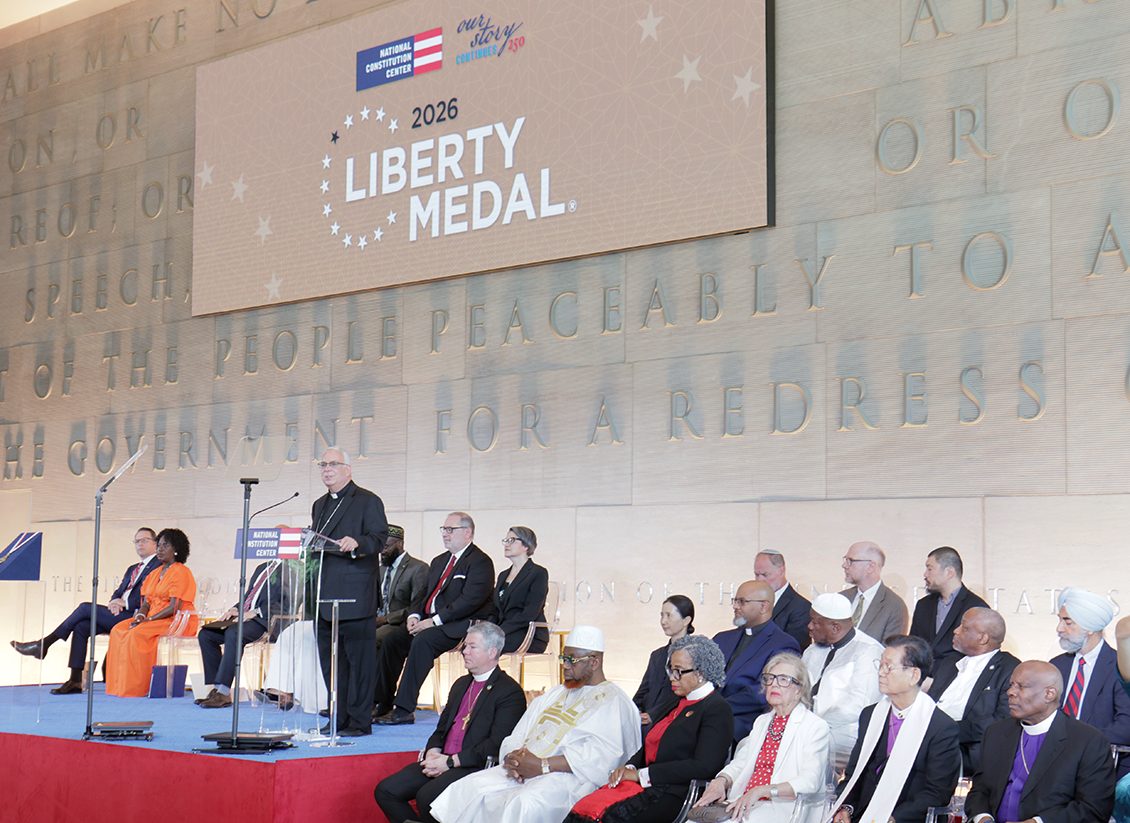
Pope Leo XIV wore the Liberty Medal and its red, white and blue ribbon proudly beside his pectoral cross on his white papal garments on Friday, July 3. Although in Rome, he addressed an interfaith audience inside the National Constitution Center in Philadelphia through a live broadcast.
From his residence, the American pontiff witnessed the standing ovation of the audience on the day before the 250th anniversary of the founding of the United States of America only two blocks from the Constitution Center inside Old City’s Independence Hall, where the Declaration of Independence was signed in 1776.
Pope Leo spoke of being “a son of this great country” as he invoked “God’s blessings upon America’s future, that the lofty ideals enshrined at the beginning of the Declaration of Independence may continue to guide the flourishing of the nation in unity, justice, and peace.”
Representatives of the National Constitution Center had already traveled to the Vatican to confer the medal upon Pope Leo on April 30.
Friday morning’s crowd gathered as part of the celebration of America’s 250th birthday inside the Constitution Center. The event was initially planned to be held outside at neighboring Independence Mall, but was moved indoors due to temperatures that eventually reached 102 degrees.
A long list of dignitaries joined the festivities Friday, including Pennsylvania Gov. Josh Shapiro, Philadelphia Mayor Cherelle Parker, and faith leaders from all three Abrahamic religions including Philadelphia Archbishop Nelson J. Pérez who called Friday a day of “great joy.”
“This honor is a fitting recognition of the Holy Father’s long-standing dedication to advancing liberty for all people throughout the world, particularly the gift of religious freedom,” the Archbishop said.
“His work as a priest, a bishop, a cardinal, and now shepherd of the universal Church has always focused on uplifting the inherent dignity of all people and building pathways to peace.”
He noted the Holy Father’s years of study at Villanova University and his time spent living and working in the Philadelphia region before entering priestly ministry in the Augustinian order.
In the little more than one year since his election as pope, his pontificate has been “marked by a desire for genuine encounter with all people and filled with the compassionate love of Jesus Christ,” the Archbishop said.
“That love unconditionally embraces the stranger, the immigrant, the poor, the sick, the unhoused, those struggling with addiction, and all those in need. It does so without discrimination.”
He reminded the audience that such an embrace was more than an ideal, but a mission to which everyone is called. “When we fulfill it,” he said, “we lift barriers preventing our brothers and sisters from experiencing the fruits of freedom and liberty.”
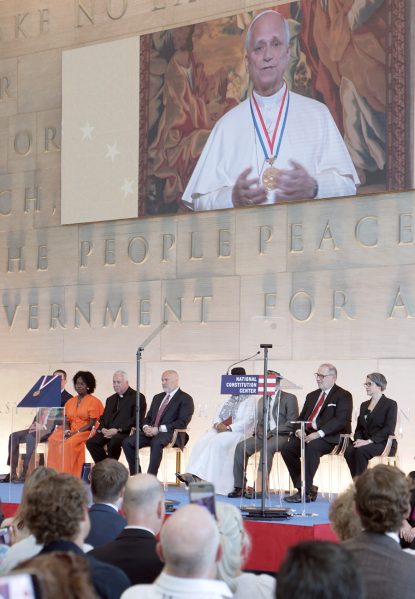
Pope Leo XIV speaks July 3 from Rome to an audience via live broadcast at the National Constitution Center in Philadelphia, from whom he received the 2026 Liberty Medal. (Photo by Sarah Webb)
Pope Leo said during his talk that the Declaration of Independence’s assertion that, as he said, “all men and women are created equal and endowed by their Creator with certain inalienable rights,” stems from the language of the Enlightenment of the 18th century, but is more deeply rooted in the understanding of the human person as created in the divine image of God.
“It is indeed here that we discover the basis of human dignity, dignity which precedes the establishment of any state and whose custody constitutes its very purpose.”
The Holy Father said that a nation’s vitality is deeply connected to the value it gives to every human life, that a person’s very God-given existence endows dignity upon every person, and that such inherent worth of every person has led generations to praise the works of God and offer reverence for that gift of human life.
“It’s precisely this reverence that we must continue to cultivate, one that sways the hearts of individuals and inspires laws that recognize and safeguard the gift from the moment of conception to natural death,” he said.
“In this regard, the moral greatness of a nation is manifested above all in its capacity to support, protect, and cherish the lives of all, especially the most vulnerable and those whose worth is questioned.”
Pope Leo reflected the words of St. John Paul II in explaining how even though many people view freedom as being able to do what one desires, authentic freedom means doing what one ought to do for another person. Each person possesses the capacity to commit to the truth and sacrifice for the greater good, the pope said.
He added that such principles rooted in the truth of the dignity of the human person inspired the founding of the United States and led Americans to build a nation of laws founded upon a common dream based on that truth.
“Unity lent strength to that dream, giving rise under God to the United States of America,” Pope Leo said. “Out of many, one. In order for a nation to flourish, it must be truly united not by goals bound to momentary endeavors, but by ideals that do not fade with the passing of time.
“I therefore pray that this, the 250th anniversary of the founding of this great nation, may be the occasion of a solemn recommitment to these ideals that have made America a country that values peace and prosperity, a country characterized by generosity and nobility of heart.”
Pope Leo concluded his talk by commending everyone “as well as the future of the nation,” to God who is “the source of true freedom and lasting peace, the One whose very name is peace.”
He ended with the invocation, “May God bless America.”
***
Read Pope Leo XIV’s full address to the National Constitution Center here.
PREVIOUS: Newest Archdiocesan Shrine for Adoration Opens in Havertown
NEXT: Thousands Mark Climax of National Eucharistic Pilgrimage in Solemn Mass, Procession in Philadelphia
Share this story