

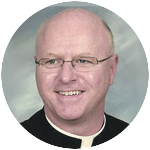
Msgr. Joseph Prior
(See the readings for the 29th Sunday in Ordinary Time)
God is not defined nor limited by the actions of man. He is God not man (except in Jesus who is God made man). Yet we human beings sometimes want to be God. We want to make the decisions, direct our destiny, be in charge or control, be independent. Sometimes we may even want to control God himself.
Perhaps this kind of thinking has something to do with the question put to Jesus in this Sunday’s Gospel passage: “Is it lawful to pay the census tax to Caesar or not?”
The Pharisees and the Herodians are trying to trap Jesus. Their insincerity and their attempt to manipulate are seen as they introduce their question: “Teacher, we know that you are a truthful man and that you teach the way of God in accordance with the truth. And you are not concerned with anyone’s opinion for your do not regard a person’s status.”
This of course is true, yet they do not believe it for if they did, they would not be trying to trap Him. Jesus sees through this and says: “Why are you testing me, you hypocrites?”
He then asks for a coin. Because they are living under Roman rule it has the emperor’s image on it. He asks whose image it is and they reply “Caesar’s.” Then Jesus says: “Then repay to Caesar what belongs to Caesar and to God what belongs to God.”
The Pharisees and Herodians have refused to believe in Jesus – the man of truth, who teaches the way of God in truth, who is not swayed by human opinion. They are not giving to God what belongs to God. They are clinging to their own power and influence, failing to see who it is with whom they speak. Perhaps they are so convinced of their own opinions, notions or righteousness that they are, in effect, blinded to see God’s saving activity unfolding before them.
God’s saving actions are not limited by human beings. Somehow God works, even through the foibles of human behavior, to direct His saving will. Great nations and empires with all their power, wealth and might are subject to Him. The first reading brings this out as the prophet mentions Cyrus as the Lord’s anointed.
In order to understand the passage, we might want to consider the book of Isaiah for a moment. Most scholars today see the book we have now as a collection of three writings, written at different times. The first and largest section is associated directly with the prophet Isaiah who lived in the eighth century BC.
The passage for Sunday’s reading comes from what is referred to as Second Isaiah. The historical setting is sometime after the rise of Persia and their defeat of the Babylonian Empire. It was this empire that destroyed Jerusalem and the Temple in 587 BC leading the people to Babylon in exile. The “Cyrus” mentioned in this passage is the King of Persia who conquered the Babylonians and allowed, perhaps even directed, the conquered people to return to the Promised Land, to Judah.
Second Isaiah reflecting on this sees the invisible hand of God directing the salvation of Judah through Cyrus. So the prophet writes, speaking in the name of the Lord, “For the sake of Jacob,” which is another name for the people of Judah, “my servant, of Israel, my chosen one, I have called you by your name, giving you a title, though you knew me not.”
The Lord continues: “I am the Lord and there is no other, there is no other God besides me. It is I who arm you, though you know me not, so that toward the rising of the sun and the setting of the sun people may know that there is none other besides me. I am the Lord, there is no other.”
The point is that no one is greater than God. Human beings, no matter how gifted or talented, no matter how knowledgeable or powerful, no matter how rich or influential, are not greater than God. And He can even work through them to bring about His saving will. Perhaps this is one of the things Jesus is getting at when he says: “Give to Caesar what is Caesar’s and to God what is God’s.”
What then is God’s? Basically everything. Everything in the universe is a product of His will. He made all things so in that sense all belong to Him. Human beings, however, He also made free so we could love. Loving God entails placing our faith in Him, our hope in Him, our trust in Him, our confidence in Him.
This does not mean we just sit back and go for a ride, so to speak, through life. Rather it underlies who we are and gives direction to what we think and how we act. It is putting God first in our lives. This may entail a change in how we approach things.
There is a famous anecdote about Abraham Lincoln. Some versions of the story have it taking place at the first Congressional Prayer Breakfast. It was during the Civil War. The country was divided, many of our young were being killed and there was no end in sight. One of the pastors asked the president: “Shall we pray that God is on our side?” Lincoln paused for a moment staring at the man then said, “Reverend, perhaps we should pray that we are on His side.”
How about in the more immediate situations in life? Consider these prayers: “Dear God, if you do this or that, I’ll do this;” “Please Lord, if it be your will, let this or that happen;” “Lord, in your beneficent wisdom, show me the way forward or how to deal with this situation;” and simply, “Lord, have mercy and help me.” The first prayer puts ourselves in the center; the last three, God.
Jesus’ interaction with the Pharisees and Herodians reminds us to keep God at the center of our lives. While we live in this world, we live with political realities. From the smallest borough to the great nations, we are subject to governments. This is not a bad thing for we need to have stability so we can live in harmony and care for one another and steward the resources given us.
Fortunately for us, we live in a democracy which gives us responsibility for that governance. At the same time, no human system of governance is perfect. At times injustice occurs, at times oppression, at times aggression. At times difference of opinion, policy and outlook lead to division and animosity.
While we would not be in the right to ignore or dismiss these situations, it is good to remember who is ultimately the ruler of the world and to renew our faith in Him who can steer the ship even when we can’t see the course ourselves.
***
Msgr. Joseph Prior is pastor of St. Dorothy Parish in Drexel Hill and a former professor of Sacred Scripture and rector of St. Charles Borromeo Seminary. Read more reflections by Msgr. Prior here.
Share this story