

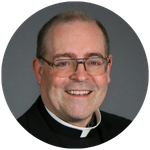
Father Patrick J. Brady
As a credentialed amateur “greetologist” — a field I invented roughly 15 minutes ago in preparation for writing this article — I can confirm that humanity has developed approximately 4 billion ways to acknowledge another person’s existence. My family, through sheer determination and a complete absence of self-awareness, has attempted every last one of them.
The worst offender is my cousin Fiona from Jersey. And I mean the original Jersey (equally as unique) — the little island in the English Channel she moved to from Donegal because she “adores France.”
Fiona grew up in County Donegal, geographically located in Ireland and spiritually located about 9,000 miles from anything resembling the French Riviera. Nevertheless, sometime in her early 20s, she spent what I believe was a long weekend in Provence and has never emotionally returned.
She came back speaking with her hands. She came back pronouncing “croissant” with muscles the human face was never designed to use. Most ominously, she came back kissing people on both cheeks.
Every Easter, every Christmas, every wedding, funeral, or vaguely mandatory family event, the same scene unfolds. Fiona spots me from across the room. Her eyes light up. Her arms spread wide. She approaches in the swooping confidence of someone who has seen this done in films.
I panic. Left cheek first? Right? Does it reverse in the Southern Hemisphere? Is there a leap-year exception? I commit. We both go left. The resulting forehead-to-forehead collision registers somewhere between two commuter trains and an earthquake.
When I regain consciousness, I’m usually on the floor while Fiona, in a faint French accent that definitely didn’t exist in Donegal, asks whether I am all right. By my count, this greeting has produced 47 concussions.
And yet I keep showing up.
Because the way we greet one another reveals what we believe about one another. Some are attempts at affection. Some are attempts at culture. And some, like the greeting we hear throughout the Mass, are doing something far more profound. Because the most important greeting you will ever hear is not trying to avoid a collision. It is preparing you for an encounter.
“The Lord be with you” is ancient, deeply biblical, and saturated with theological meaning.
One of the earliest and most striking examples appears in the Book of Ruth. Famine drives Naomi’s family into exile, her husband dies, her sons die, and she returns to Bethlehem in grief so deep she tells people, “Do not call me Naomi; call me Mara (bitterness).”
In the next chapter, Boaz enters the scene and greets his reapers: “The Lord be with you.” They reply, “The Lord bless you.” Boaz is not merely saying, “Morning, lads.” He invokes the covenantal nearness of God over his workers. He is speaking the language of accompaniment into a barley field. Ordinary speech had become theological speech. Everyday greetings had become miniature creeds in Israel’s life.
This phrase echoes through salvation history at the most decisive moments. God tells a terrified Moses, “I will be with you.” An angel finds Gideon hiding in a winepress (not exactly the traditional habitat of mighty warriors) and declares, “The Lord is with you, mighty warrior.” God has always had a knack for seeing potential where we see only panic.
The greeting signals covenant presence: the God who walks with His people, fights for them, and dwells among them.
This promise becomes flesh in the Gospel of Luke. The angel Gabriel greets Mary: “Hail, full of grace, the Lord is with you.” In her, the ancient words turn literal. Emmanuel, God with us, is conceived.
The Church carries this same richness into every Mass. “The Lord be with you” appears at key threshold moments in the liturgy:
- At the beginning of Mass, we are gathered from ordinary life into sacred worship.
- Before the Gospel, Christ is about to speak to His people.
- Before the Eucharistic Prayer, we approach the mystery of Calvary made present on the altar.
- And before the dismissal, we are sent back into the world as witnesses, back out into traffic, grocery lists, and Monday morning.
At each key moment, the Church invokes the same ancient greeting because every one of those moments requires the real and active presence of the Lord.
When the priest greets us, he is not merely making an announcement. He is praying.
The priest stands before the people and invokes over them the only thing that can truly sustain them: the presence of God.
“The Lord be with you” doesn’t feel warm the way “Good morning!” feels warm. But that’s because it’s doing something far greater. It’s not describing the room or acknowledging the crowd. It’s making a claim about reality — that the God who walked with Moses, who called Gideon out of hiding, who took flesh in Mary’s womb, is truly present here, now, among these people in this place.
We are stepping into a conversation as old as Israel, as deep as the covenant, and as astonishing as the Incarnation. The Church repeats this greeting because Christians never gather alone. Every Mass begins, unfolds, and ends with the promise that God remains with His people.
Though, admittedly, with significantly fewer concussions than Easter at my cousin Fiona’s house. Which, now that I think about it, may itself be evidence of divine mercy.
***
Father Patrick J. Brady is vice-rector of St. Charles Borromeo Seminary and parochial administrator of St. Stanislaus Parish in Lansdale.
Share this story