

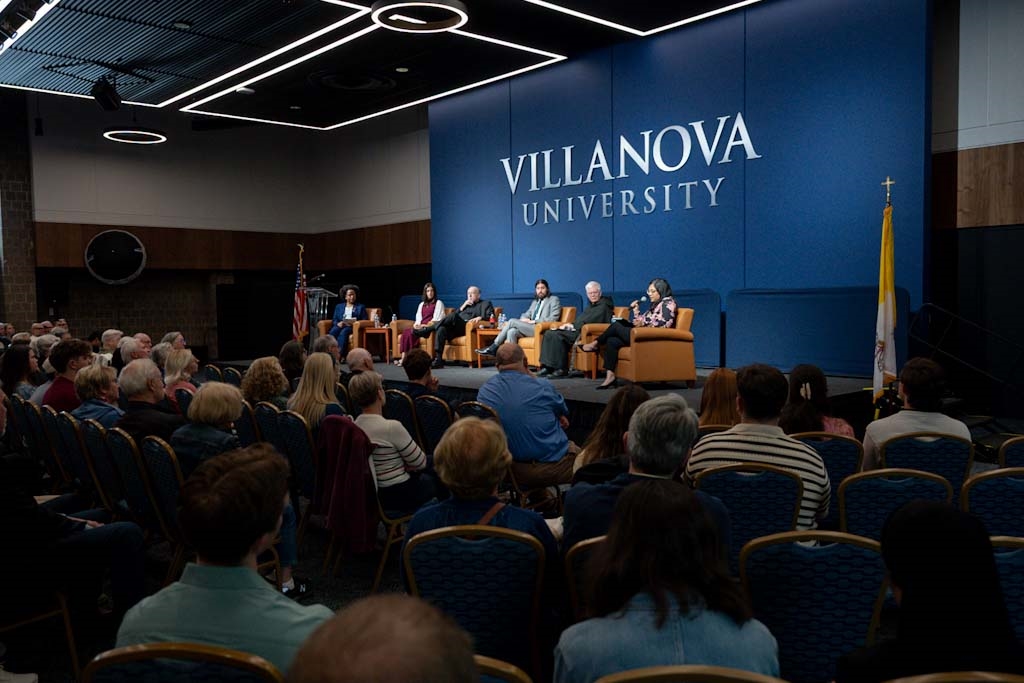
The luster hasn’t left the halls, walkways, and chapels of Villanova University since the moment one of their own graduates became Pope Leo XIV on May 8, 2025, and an American cardinal came to mark that moment this week.
Perhaps no other place in the United States east of his hometown of Chicago was more appropriate to host a panel discussion on how God is using the Holy Father and the charism of the Augustinian order to grace the world as Villanova did on April 28 with “Pope Leo @ One: Augustinian, Pastoral, Prophetic,” at the university’s Connelly Center.
“He has been a true Augustinian in terms of unity, and a true pastor in terms of synodality and prophecy in terms of his role in the world,” said Cardinal Robert McElroy of Washington, D.C.
He revealed the debate within last year’s conclave that pondered how to move forward from the groundbreaking pontificate of Pope Francis, the first Jesuit and first pontiff from the Western hemisphere and the global South.
“There were different assessments of what should happen in the life of the Church. Some felt the trajectory of Pope Francis should be propelled, others felt there should be retrenchment, and there was some division over this,” said Cardinal McElroy.
The College of Cardinals soon settled upon the election of the American Augustinian Cardinal Robert Prevost on the fourth ballot, who chose the name Leo XIV.
“As he has grappled with this question of forward progress or retrenchment,” Cardinal McElroy said, “he has done it in an Augustinian way, one in heart and soul and harmony together, by seeking to integrate the different elements within the life of the Church and the leadership of the Church.”
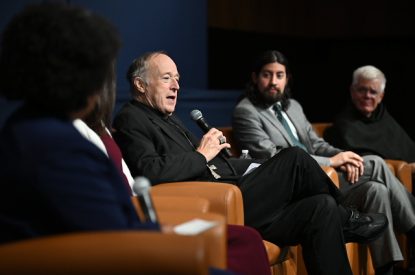
Cardinal Robert McElroy of Washington, D.C., speaks during a Villanova University panel reflecting on the first year of Pope Leo XIV’s pontificate and the Augustinian values shaping his pastoral and prophetic leadership. (John Shetron/Villanova University)
The panel at Villanova cited many examples of such collaborative work by the 1977 university graduate, including his guidance of American bishops as they tackle various issues in U.S. politics.
Pope Leo’s leadership, according to panelists, stems from the Augustinian values of unity–being of one mind and heart in God–regarding issues of immigration or war in the Middle East.
“There has been polarization within the bishops on certain issues of public policy, and the pope has guided us in a certain way toward an integration that had resulted last November at the conference meeting,” the Cardinal said.
He was referring to the Special Pastoral Message by the United States Conference of Catholic Bishops last November concerning the impact of federal policies on immigrants.
“There was a greater commitment, both of unity and substance, and unity in terms of education, energy, and commitment, on any issue that I’ve ever seen in my 15 years of being a bishop.”
Panelists during the 75-minute talk said the same Augustinian value of “unitas,” unity and community which Pope Leo XIV developed during about 20 years of ministry in Peru, also has touched the pastoral and prophetic aspects of the Holy Father’s first year.
“Look at his missionary background in Peru. You see just how attuned he was to the needs of the community that he served in very rural, very poor Peruvian communities afflicted by an era of terrorism going on at the time, (and with) conflict (and) migration,” said National Catholic Reporter journalist Justin McClellan, who covered the pope’s recent apostolic visit to Africa.
“Take this charism of unity that is instilled by his Augustinian nature, and then you have that attuned to the pastoral challenges that are afflicting the global South, and I think that that is what informs his prophetic character.”
Villanova Assistant Professor of Theology and Religious Studies Dr. Jaisy A. Joseph added that the Augustinian value of truth, in communion with that of unity, imparts prophetic words such as in documents like the pope’s “Dilexi Te” on care for the poor, and how he has pointedly called out those who “wage war.”
“He embodied the very essence of caritas showing that the pursuit of truth is empty if it does not begin with a heart that beats in solidarity with those who suffer,” Joseph said.
“(Pope) Leo has challenged the global community to choose a different path, one where our relationships are shaped by the heart rather than a negotiation of power.”
The panelists noted that Pope Leo’s quiet, thoughtful nature reflects his interior life, which perhaps contrasts the power of his continuing statements on God-given human rights and dignity.
“The moral compass is clear,” said Augustinian Father John J. Lydon, the director of Villanova’s Mother Cabrini Institute on Immigration.
“To be prophetic means you’re speaking what God wants us to hear and not what governments necessarily want to hear, so I think he’s prophetic constantly, and I think that’s what popes are supposed to do.”
Much of the conversation also focused on the impact that Pope Leo’s pontificate has had on the university whose classrooms he once occupied, whose dorms he lived in, and whose Augustinian roots and mission became the foundation of his ministry as priest, bishop, and eventually pope.
“It really allowed our faith and the Vatican to come to the doorstep of Villanova, and (allowed) us to see this thing that sometimes feels very far away. That initial proximity is really beautiful,” said Villanova student Hannah Kalamarides, who participated in the Jubilee Year of the Synod at the Vatican last October.
“We have this responsibility of (being) sent out into the world, and what are we going to do with it? How are we going to take how Villanova formed us those Augustinian values and live it out in our day-to-day life?”
PREVIOUS: Bishop Chylinski Addresses Mental Health Awareness in New Video
NEXT: Couples Celebrate Sacrament of Marriage Through Good Times and Bad
Share this story