

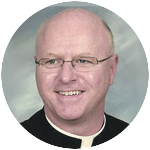
Msgr. Joseph Prior
(See the readings for the 22nd Sunday in Ordinary Time)
St. Thomas More in Robert Bolt’s play and film “A Man for All Seasons” has a famous interchange with another historical character, Richard Rich. The scene is during More’s trial for treason, in which Rich gives false testimony against More. More notices the chain of office around Rich’s neck and asks if he might see the seal.
It is the office of the attorney general for Wales, and after looking at it More turns to Rich and partly quotes a line from this Sunday’s Gospel that says, “‘What profit would there be for one to gain the whole world and forfeit his life?’ but for Wales?”
In real life More is unjustly convicted, executed and eventually canonized. Rich goes on to hold a number of offices, grows rich off confiscated Church property, serves as Chancellor of England and dies a natural death. According to Wikipedia, “Since the mid-16th century Rich has had a reputation for immorality, financial dishonesty, double-dealing, perjury and treachery rarely matched in English history. The historian Hugh Trevor-Roper called Rich a man “of whom nobody has ever spoken a good word.”
In a sense the two men characterize the paths of which Jesus speaks in the Gospel. The one is the path of life and the other of death. The paradox is that the path of life involves death, death to self. The paths, if we may use that image, reflect the contrast in the fourth Gospel between the heavenly realm and the worldly realm. Central to the path of life is following He who is “the way, the truth and the life,” the one who willingly lays down His life to take it up again in the resurrection.
The centrality of the cross in Jesus’ mission is highlighted by his continuing dialogue with Simon Peter. The earlier part of this conversation was the Gospel passage for last Sunday. Peter acknowledges Jesus as “the Christ, the Son of the living God.” Jesus sees the Father at work in Simon’s confession and declares him “Peter,” the rock on whom He will build the Church. He then gives him the “keys to the kingdom.”
The tone changes dramatically as Jesus speaks to Peter and the other disciples about His passion, death and ultimate resurrection. When Peter objects Jesus quickly and quite forcefully replies: “Get behind me Satan! You are an obstacle to me. You are thinking not as God does, but as human beings do.”
Perhaps we sometimes sympathize with Peter in this scene. At this point in the ministry, the cross and passion were so foreign to him (and the other disciples) that he obviously did not know what he was saying. It is somewhat similar to his reaction at the transfiguration when he suggests building three tents, which requires the Father to speak: “This is my beloved Son, with whom I am well pleased; listen to him” (cf. Mt 17:1-8). Peter will slowly come to understand the necessity of the cross, the power of divine love and the cost of discipleship.
The emphasis on the cross does not stop here. As we continue hearing from the Gospel of Matthew, Jesus will explicitly predict His passion three times with numerous allusions to it as Calvary approaches. Here Jesus associates it with discipleship. The cross is the ultimate sacrifice of love where, using Jesus’ words in the fourth Gospel, Jesus embraces the greatest love – laying down one’s life for one’s friends. He teaches us: “Whoever wishes to come after me must deny himself, take up his cross, and follow me.”
The hallmark of a Christian life is the profession of faith in Christ Jesus who died for us and rose from the dead. The profession is both in word and deed. The martyrs of the faith in every century give vivid witness to this profession. Circumstances in the “world” in which they lived led to their persecution and death.
At the same time, we see brilliant witnesses of laying down one’s life, the sacrifice of self, in the more regular circumstances of life throughout these same centuries. For most of us the opportunities present themselves every day for every encounter with another human being affords us the chance to put another person’s needs before our own.
Every celebration of the Eucharist challenges us to take up the mantle of discipleship, while also giving us the grace to do so. The words of consecration remind us of the sacrifice, and the celebration indeed makes it present: “Take this all of you and eat of it. This is my body which will be given up for you … Take this all of you and drink of it. This is the chalice of my blood, the blood of the new and eternal covenant, which will be poured out for you and for many for the forgiveness of sin.” Then the words of exhortation, “Do this in memory of me.”
The words have a double meaning. On the one hand they refer to the eucharistic celebration. On the other is the call to imitate what we celebrate at Mass – Jesus’ laying down His life for His friends, the call to sacrifice. In the Fourth Eucharistic Prayer, shortly after the consecration, the prayer offered reminds us of this call, and our petition for divine assistance in living it out: “Look, O Lord, upon the sacrifice which you yourself have provided for your Church, and grant in your loving kindness to all who partake of this one Bread and one Chalice that, gathered into one body by the Holy Spirit, they may truly become a living sacrifice in Christ to the praise of your glory.”
The interchange between Thomas More and Richard Rich gives subtle but poignant witness to the paths of life and death of which Jesus speaks in the Gospel. The path of life is found in and through Jesus. His call to discipleship is the call to divine life. His call to discipleship is a call to love. His call to discipleship is the call to sacrifice, a living sacrifice of praise.
***
Msgr. Joseph Prior is pastor of St. Dorothy Parish in Drexel Hill and a former professor of Sacred Scripture and rector of St. Charles Borromeo Seminary. Read more reflections by Msgr. Prior here.
PREVIOUS: Who Is Jesus? Our Answer Leads Us to Serve Everyone in His Name
NEXT: Work of Healing Relationships Done With Love, in Model of Jesus’ Passion
Share this story