

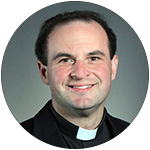
Father Eric J. Banecker
Poor Peter. Only moments after making the Church’s first great profession of faith— “You are the Christ, the Son of the living God”—he finds himself rebuked by the very Lord who had just entrusted him with the keys of the kingdom.
In Matthew’s Gospel, the contrast is striking. Peter has recognized Jesus as the Messiah, the Anointed One of Israel; yet when Jesus begins to reveal that the Messiah must suffer, be killed, and rise on the third day, Peter recoils.
That reaction reveals a deeper tension. The Old Testament speaks in more than one key about God’s promised deliverance. There is the hope of the Messiah: the chosen and anointed one, the Son of David, who would restore Israel and bring God’s people back from exile. But there is also the mysterious figure described especially in Isaiah: the suffering servant, the one who bears affliction in an atoning way on behalf of the people.
What Jesus reveals—first in his preaching and finally in his Passion—is that these two figures are not separate. There is not a glorious Messiah on one side and a suffering servant on the other. In Christ, they are one and the same. The true newness of the Gospel is that God saves not by avoiding suffering, but by entering into it and transforming it from within.
Peter is the first to confess Jesus as the Christ, the Son of the living God. He is also the first to recoil when Christ explains what that confession entails. Jesus tells the disciples that he must go to Jerusalem and suffer greatly.
Peter responds by rebuking him. The man newly entrusted with authority in the kingdom immediately offers the Lord advice which is, from a merely human point of view, understandable—but from the perspective of God’s saving plan, profoundly mistaken.
And so this makes Peter, the great apostle, also the great obstacle. And all of us, at any point in our lives, who would have a Messiah that doesn’t suffer—any of us at any point in our lives that would want Jesus to be our Savior without the cross—we too are those who must get behind because we have misunderstood. We have taken human ways of thinking and applied them to the ways of God, which are ultimately always more mysterious and always more beautiful.
Maybe the real problem is not that Jesus himself would suffer, though that obviously filled Peter and certainly the others with cause for fear and sadness. Maybe the real problem is the next thing that Jesus says and the implications of his own suffering: “Whoever wishes to come after me must deny himself, take up his cross and follow me.”
The great Christian paradox: whoever wishes to save his life will lose it. Many people including many of the great saints in the course of history—think about St. Augustine, whose feast we just celebrated the other day, or St. Ignatius of Loyola—recognized that whatever earthly pursuits they were spending their whole lives trying to accomplish, in the end, didn’t get them anywhere.
In the end, those pursuits left them miserable and lonely. Only Christ, the Christ who suffers for us, gave their lives true purpose and meaning. Indeed, that is the only real profit that is worth anything in our lives.
But how do we participate in the mystery of the suffering servant? Not every person suffers in the same way. Some endure terrible physical pain, grief, abuse, neglect, or hardship. Others may look at their lives and wonder whether they have suffered much at all. Some even feel a kind of survivor’s guilt, like soldiers who return from war while their comrades do not.
The Christian answer is not to compare sufferings, nor to romanticize them, but to unite whatever we bear—great or small—to the cross of Christ.
Before we can take up our crosses in our moral choices, our relationships, and our communities, we must first allow Christ to take us up into the mystery of his own death and resurrection. This is why our participation in the Paschal Mystery is not merely a private act of endurance. It is first a gift received. Christ gathers us into himself, and only then can we offer ourselves in union with him.
St. Paul gives this truth its liturgical and moral expression when he writes to the Romans: “I urge you, brothers and sisters, by the mercies of God, to offer your bodies as a living sacrifice, holy and pleasing to God, your spiritual worship.”
He then adds, “Do not conform yourselves to this age, but be transformed by the renewal of your mind.” That is precisely what has not yet taken place in Peter: “You are thinking not as God does, but as human beings do.”
The Christian life cannot be shaped by the logic of the age. We must be transformed by the renewal of our minds. The only true logic is the logic of the Logos, the Word made flesh.
This is what Paul calls our “spiritual worship,” our reasonable worship (logikoi latria): worship conformed to Christ, who has reconciled the world to the Father through his death and resurrection and who now intercedes for us at the Father’s right hand.
This worship reaches its summit in the Eucharist. In every Mass, we are drawn into a cosmic and mystical event that embraces all of time and all of human history, until God is “all in all.” Here Christ takes us into his own life. Here he draws us into his death and resurrection. Here we learn the true logic of God.
In Christ’s perfect self-offering to the Father, we see how God thinks. We learn how we ourselves must think. And as St. Augustine taught, we are called to become what we receive. The Eucharist does not leave us spectators before the sacrifice of Christ; it makes us participants in it, so that we may deny ourselves, take up our cross, and follow him.
Christ has come to do for us what we cannot do for ourselves in order that we, united to him, might become sharers in his divine nature and act as Christ himself in the world.
In the Eucharist, he unites us to himself. Then he sends us forth to sanctify the world: through our sufferings and pains, through works of mercy, through patience with the faults of others, and through the daily offering of our lives in union with his sacrifice.
***
Father Eric J. Banecker is Vicar General and Moderator of the Curia for the Archdiocese of Philadelphia.
PREVIOUS: Work of Healing Relationships Done With Love, in Model of Jesus’ Passion
NEXT: Mercy, the Medicine of Life, Is God’s Gift to Us
Share this story