

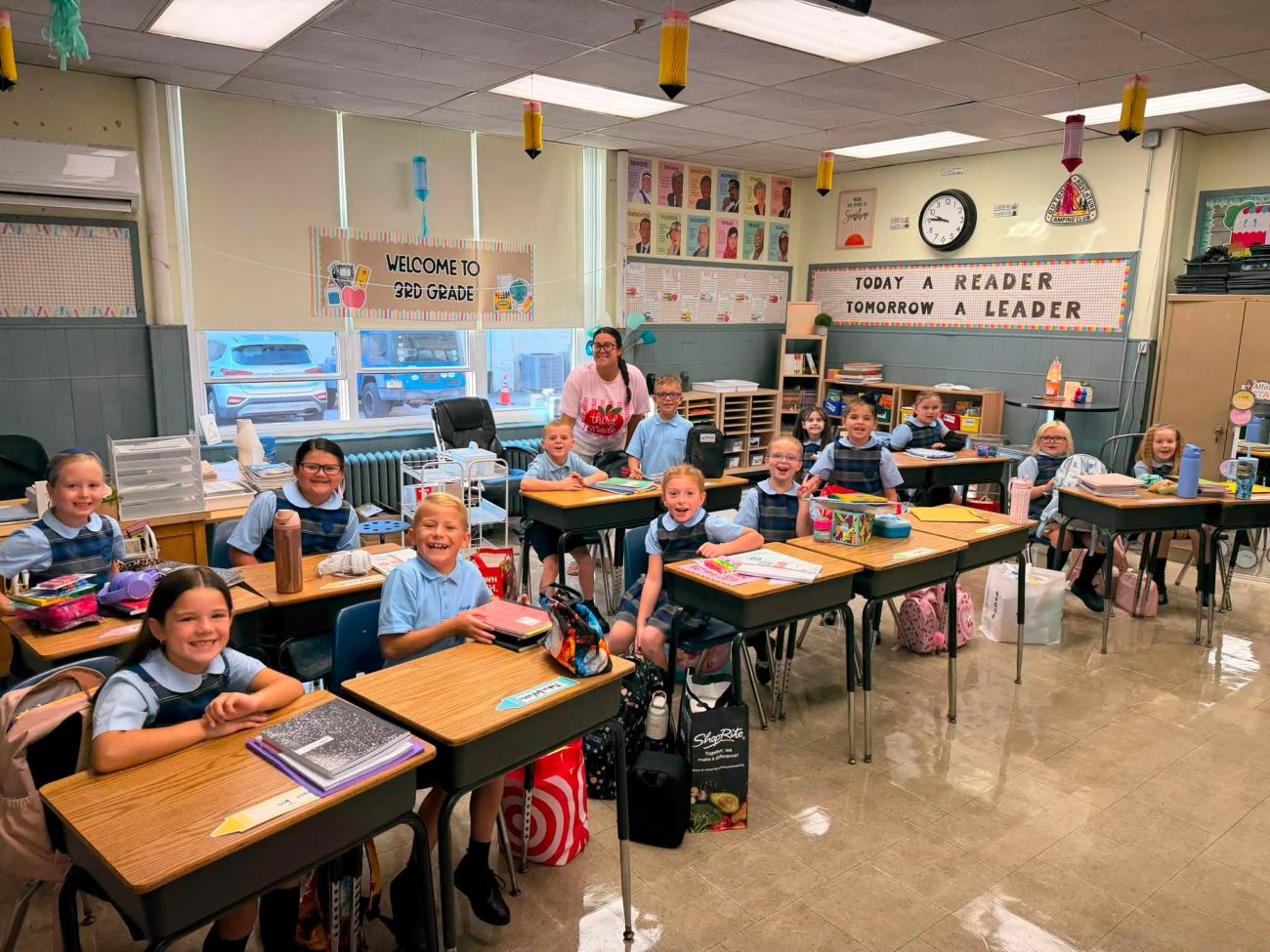
Teachers in Philadelphia-area Catholic schools will come equipped throughout the new school year with greater data-driven ability to respond immediately to students’ academic challenges and foster success.
But academic achievement is only one part of the mission. As archdiocesan schools prepare to serve a student population that may approach 44,000 this year, their leaders emphasize that faith formation remains at the heart of Catholic education.
The ultimate aim for Catholic schools is to accompany each young person on their walk with the Lord through the Catholic faith, according to archdiocesan Secretary of Elementary Education Dr. Andrew McLaughlin and his counterpart William Brannick, the Secretary of Secondary Schools and Schools of Special Education.
“If we can get them closer to God and believe in God, [that] is my ultimate goal,” McLaughlin said. “If they’re really, really connected, then [it’s] strengthening that and reinforcing that, and if they’re not, then bringing them a step closer.”
This year, students are taking that particular step through the Sacred Heart of Jesus, to which the United States was consecrated in June.
Brannick said that each archdiocesan secondary school will participate in a project where students will create their own artistic rendition of the Sacred Heart of Jesus, which Auxiliary Bishop Keith Chylinski will enthrone for prominent display within each school.
Brannick said this project stems from the vision of Bishop Chylinski, who oversees the administration of Catholic education in the archdiocese, as well as Brendan Towell, Director of Spirituality and Mission for Secondary Schools and Schools of Special Education.
“It’s taking the engagement of the bishops this spring to consecrate the United States to our secondary schools and having students directly engaged in this aspect of our Catholic schools,” said Brannick.
He and McLaughlin both said elementary schools will also participate in particular programs and activities that encourage students’ devotion to the Sacred Heart.
In January of next year schools will begin the 175th anniversary of the founding of the first system of Catholic schools in the United States by Philadelphia’s own Bishop, St. John Neumann.
“We have set our first week as Founders Week within all of our secondary schools and schools of special education, highlighted by St. John Neumann’s feast day on January 5,” Brannick said, adding that schools will hold a Mass that week to celebrate the anniversary.
McLaughlin said his 2,500 elementary school teachers may eventually serve about 33,500 students this academic year, though they won’t officially know until final count totals are established. The student population at that level would be an increase of about 500 from 2025-26.
Brannick said the 15 archdiocesan high schools are looking at opening at or above 10,400 students this year.
“Four consecutive years of growth in (secondary) enrollment. That has not happened since the early 1960s, which tells us a few things,” Brannick said.
“Our parents are highly interested in having a faith-filled Catholic education. Our teachers and administrators are doing a tremendous job in educating the heart, mind, and souls of the students that are coming to them on a daily basis.”
This year teachers will be more able to respond quickly with learning solutions when students struggle in particular subjects.
“For years, decades, we used this standardized system for testing our students called Terra Nova. They would be compared to a national standard and we’d measure growth, but we’d only get the information in May,” McLaughlin explained.
“Overall, it would tell us how schools are doing and students, but we weren’t getting enough information. It was hard for teachers to get to it really then look at (results).”
He said schools are now moving to a platform called i-Ready, which will provide three shorter tests throughout the year in three subject areas. Teachers can receive results within a day or so, according to McLaughlin, and compare them to national standards. Based on those results, teachers may accelerate a student’s grade level, he added.
Each of these new developments enable Brannick and McLaughlin to continue following and expanding the educational legacy of St. John Neumann. that has become ingrained into the Philadelphia region’s history and culture, rooted in the Catholic faith.
“In some ways, it adds a little more pressure to the schools, because there’s these expectations of what took place in the past, and there’s expectations that it should continue to be that way,” said McLaughlin. “That impacts everything we do, that sense of history.”
“We are quite literally walking in the footsteps of a saint,” said Brannick. “There are not many schools or school systems throughout the country that have had the opportunity to be around for 175 years. We are truly carrying forward the vision of St. John Neumann.”
PREVIOUS: Catholic Charities Backpack Drive Provides School Supplies, Food To Hundreds of Philadelphia Students
NEXT: Joey Crawford, NBA Ref and Philly-area Parishioner, Inducted into Hall of Fame
Share this story