

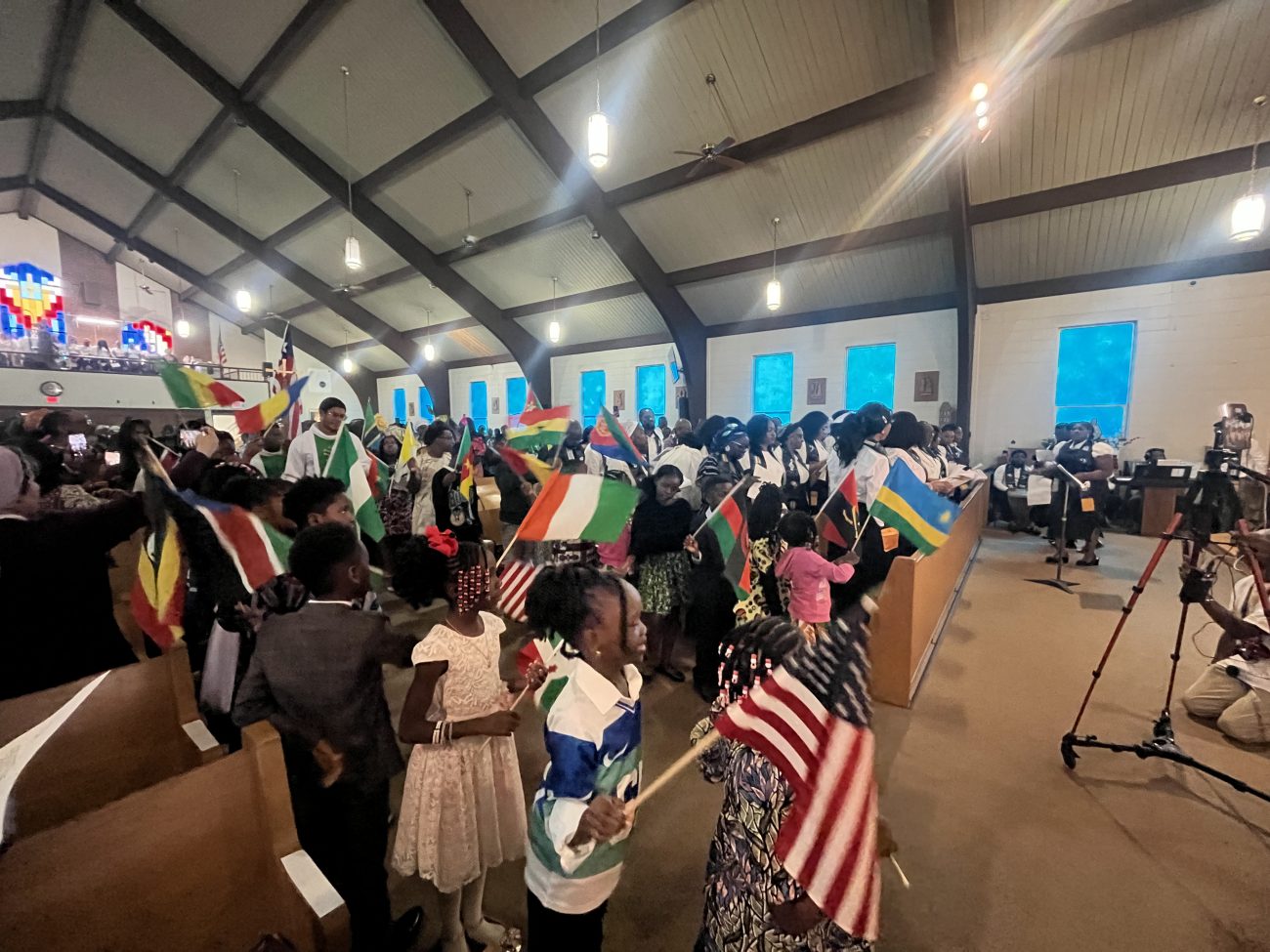
They spoke and sang in 13 languages. The choirs came from six nationalities. Their children carried 19 national flags. They all joined together in celebrating their common Catholic faith and their ancestral homelands in Africa.
A nearly full congregation filled St. Irenaeus Church, part of Divine Mercy Parish in Southwest Philadelphia’s Eastwick neighborhood, with joy, color, and love of God during the two-hour African Family Heritage Mass on Sunday, Oct. 11.
It was organized by the archdiocesan Office for the African Catholic Apostolate and celebrated by Bishop Jerome Feudjio of the Diocese of St. Thomas in the U.S. Virgin Islands, the first African-born bishop in America.
“I’ve been a missionary in that part of the world for 37 years. It is good, but it is a very, very heavy responsibility because I have to represent you well,” the Cameroon-born bishop told the congregation, many of whom are also immigrants to the United States or children of those who came to America.
Sister Florence Enechukwu, MSHR, who leads the African Catholic Apostolate, listed numerous new African nations that joined their community of Catholics in Philadelphia, including Cameroon and the Democratic Republic of the Congo.
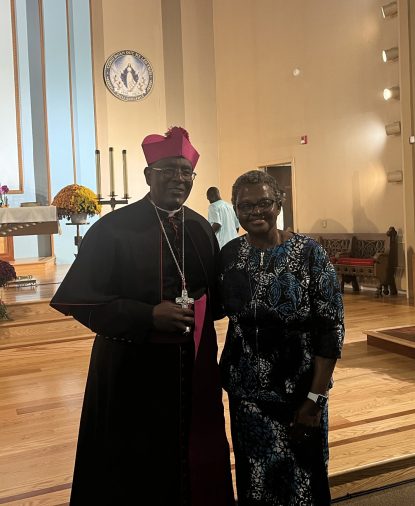
Bishop Jerome Feudjio of the Diocese of St. Thomas in the U.S. Virgin Islands and Sister Florence Enechukwu, MSHR, director of the Archdiocese of Philadelphia’s Office for the African Catholic Apostolate, are pictured during the African Family Heritage Mass at St. Irenaeus Church in Philadelphia Oct. 11. (Photo: Jay Sorgi)
The African Catholic Community of St. Barnabas Parish in the nearby Elmwood section of the city, a combined community of different nationalities, also joined the list of African Catholic groups.
The international joint choirs covered much of the front of the church as well as the entire choir loft. They filled the day with joyfully exclaimed songs of praise for God, along with the Scripture readings for the Mass.
Those readings spanned from Isaiah’s declaration of a God-given feast for all people with rich food and choice wines to the parable Jesus spoke about in St. Matthew’s Gospel, which likened the kingdom of heaven to a wedding feast.
Bishop Feudjio’s homily spoke deeply to the congregation’s shared experience and that of each person who came, saying that no nation is forgotten and no faithful heart is ever excluded.
“It is the promise of communion, humanity reconciled with God and gathered as one family around His table,” he said. “That promise speaks tenderly to people who know exile, people who know struggle, people who are longing.”
The bishop spoke of how the African diaspora bears unavoidable wounds from slavery, filled with “displacement, injustice, harshness and tears.” Yet he spoke of how God still fills people with endurance and hope, providing ample reason for prayer and praise.
“Through generations, brothers and sisters, our people have trusted that God remains near,” he said. “Faith taught us to sing before dawn and to hope when the road was long. Today, we remember with gratitude the Lord has carried us, the Lord is carrying us, and the Lord will not abandon us.”
He explained how in the banquet described in the Gospel, the king invites whomever he wishes to the feast. The bishop called this invitation the good news entrusted to the Church because God reaches out and moves beyond crossroads.
“We are testimonies of God,” Bishop Feudjio said. “Look at you. We are in the Church listening to God’s Word. We have received the deposit of the faith and we have believed. Here we are,” he said, looking out at people dressed in countless expressions of diverse national heritage yet unified by experience and faith.
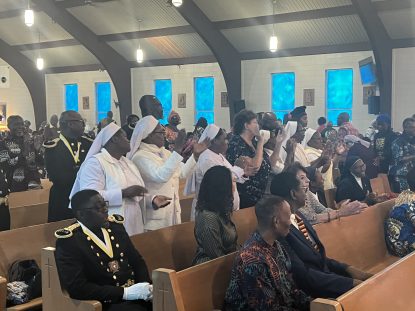
Faithful participate in the African Family Heritage Mass at St. Irenaeus Church in Philadelphia Oct. 11. (Photo: Jay Sorgi)
“God’s invitation crosses oceans, borders, languages, and generations. The Gospel took root in Africa and was received, lived, and handed on by communities whose witness enriches the universal Church.”
Such witness that comes from the Holy Spirit, who transforms people with open hearts, calls for us to respond, the bishop said, adding that the wedding garment to which the Gospel passage referred is the life of Christ in baptism, renewed by grace, made manifest in action.
He described the cost of discipleship in terms of courage, repentance, forgiveness and humility, and the fruit of one’s faithful actions.
“It is faith bearing fruit in holiness. It is faith bearing fruit in justice, in mercy and love,” he said.
“We cannot ask God for mercy while refusing mercy to one another. We cannot rejoice in our heritage while neglecting the young, abandoning the elderly or permitting division to the good among us. The Holy Spirit does not accept that.”
Bishop Feudjio said that those assembled must turn their African heritage into a mission. The faith of their ancestors, the prayers taught by parents, the wisdom given by elders, the sacrifices of community builders who had little, and the hope of those who traveled long distances must become alive again in them.
“An African proverb reminds us, brothers and sisters, that fine words do not cultivate the field,” he said. “The Gospel must enter our choices. The Gospel must transform us.”
Following the Mass, the families and individuals joined in a feast in which each African community present shared their cuisine.
Share this story