

In 2002, a Catholic school parent sent a letter addressed to Donna Fanelli at Catholic Charities of Philadelphia’s Nutritional Development Services, thanking her for feeding his daughter through a school lunch program.
For nearly 25 years, Fanelli has kept that typed note, dated Oct. 28, 2002, tucked away in a desk drawer. “I go back to it from time to time, and it just reminds me of all the good that we do.”
Fanelli has spent the last 30 years of her 40-year archdiocesan career with Catholic Charities, where she currently serves as an operations manager. Early on, she determined family eligibility for free or reduced lunches for a federal income-based nutrition program.
“I would send the letters telling them what their status was,” Fanelli recalled. “Augustinus wrote directly to me . . . thanking me for providing meals for their child.”
As new immigrants, the family found the school lunch program a huge help, Augustinus noted in the letter, adding that he was so happy to be able to provide a Catholic education for his daughter. She was an eighth-grade student at Thomas Aquinas School in South Philadelphia.
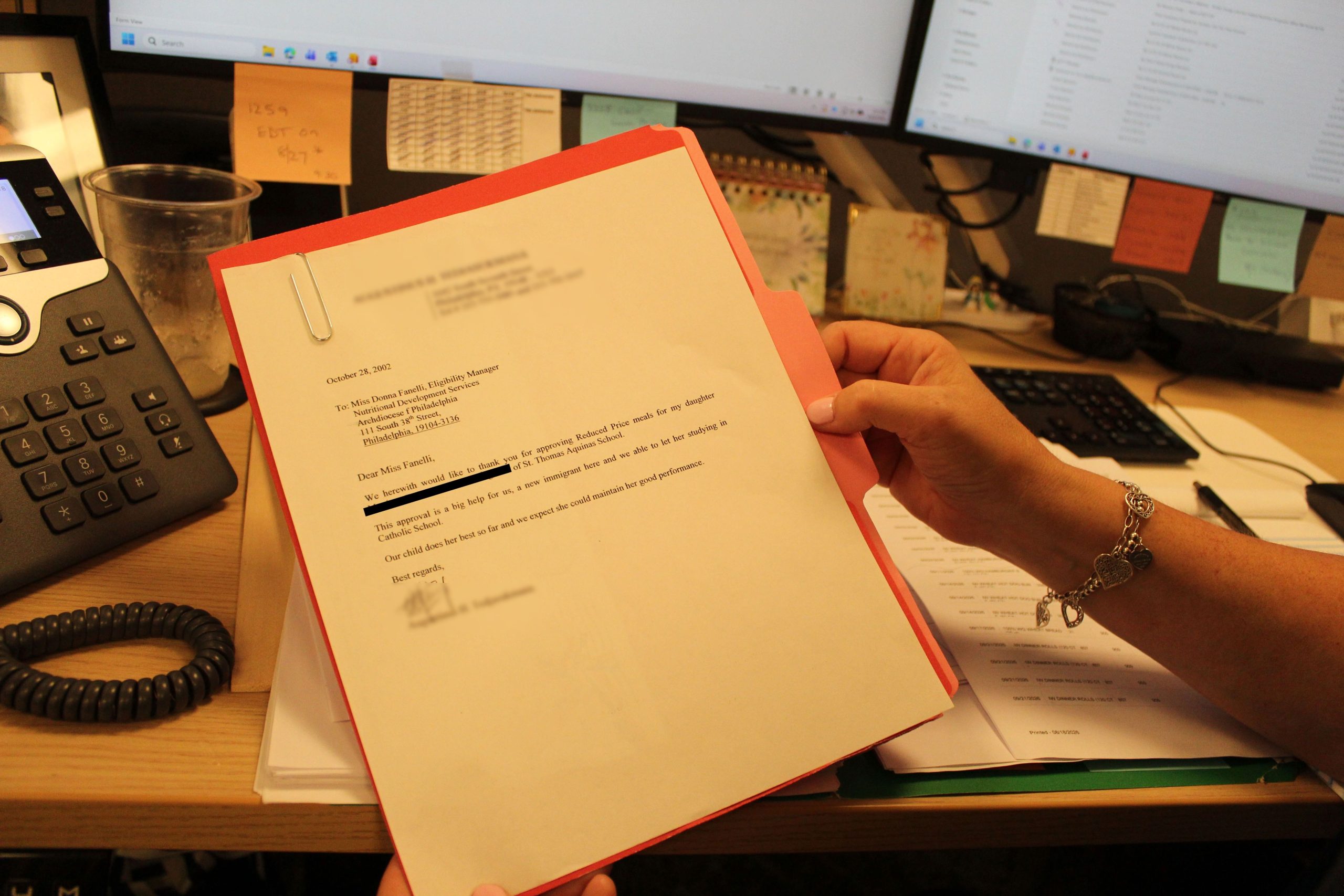
A thank-you letter received in 2002 remains a cherished reminder of Catholic Charities’ mission for Donna Fanelli.
Stories like this are at the heart of why Catholic Charities exists.
Fanelli’s belief—no one should have to struggle with hunger—aligns perfectly with the Gospel call to feed the hungry and Catholic Charities’ mission to ensure those facing food insecurity have access to nutritious food and vital resources.
Healthy food is essential to a child’s ability to learn, grow, and develop. “The meals the children are eating, these one or two meals in school, may be the only meals they’re having all day long,” she said. “To be able to provide that service is an incredible feeling.”
Today, Catholic Charities continues to administer the federal nutrition program, among several ways it fulfills one of its four pillars of service: to nourish the hungry. Each school day, their program distributes an average of 7,600 breakfasts and 17,000 lunches to children throughout southeastern Pennsylvania.
More than 100 parochial, private, and charter schools participate. “It doesn’t matter what faith or denomination you are. We are here to help everyone,” Fanelli said.
Free meals are available in schools in low-income areas enrolled in the federal Community Eligibility Program (CEP), created in 2010 to provide mealtime equity. Students can receive breakfast and lunch at no cost, regardless of family income.
Far more than school lunches
Through its ministry to nourish the hungry, Catholic Charities focuses on two main areas —the federally funded Children’s Nutrition programs and the Community Food Program. Since the school year ended, it provided 366,000 meals to 256 summer programs and continued to feed 2,700 children in 65 daycare centers. Nearly 2,600 suppers are served per day. During the new academic year, Catholic Charities expects to work with 110 after-school programs and provide breakfast and lunch at 100+ schools.
Between 2024-2025, 166,000 people received 8.1 million meals.
“We make it look seamless, but there’s so much that goes into it,” Fanelli said. As operations manager, she’s behind the scenes, coordinating with warehouse staff on routing, logistics, and solving problems related to equipment breakdowns, inventory shifts, and delivery delays.
“No matter what happens, we always make sure we get the meals to the sites for the kids each day,” she said.
Catholic Charities’ impact extends beyond children to the community at large. The Community Food Program distributes fresh, frozen, and non-perishable food to 50 pantries through federal funds, private donations, and food drives. Last year, schools and parishes collected 700,000 pounds for distribution to pantries and food cupboards throughout the five counties served by the Archdiocese of Philadelphia.
SNAP changes and increased demand
Catholic Charities’ commitment to alleviating hunger is more critical than ever due to cuts and changes to the federal Supplemental Nutrition Assistance Program (SNAP), which reduced or eliminated food aid for millions throughout the country. For example, some refugees and asylum seekers, despite legally living in the U.S., are no longer eligible for SNAP (widely referred to as food stamps).

Donna Fanelli at her desk early in her career with Catholic Charities. (Courtesy Photo)
As inflation and world events drive up the costs of food and other necessities, federal SNAP cuts exacerbate the ongoing affordability crisis. In this environment, families are often forced to realign their spending habits; some household funds that used to pay for rent, utilities, or gasoline go to groceries instead.
Fanelli has noticed a definite increase in demand for food. “People don’t have enough money to buy what they need to feed their families,” she said.
Thanks to Catholic Charities, many at-risk children are fed in the summer months and before, during, and after school. “We’re not only helping the students, but we’re also helping the parents. Meals their children eat in school—that’s money the parent is saving and can use toward other things,” she said.
“If Catholic Charities was no longer providing these meals, there would be a lot of children who would go hungry,” Fanelli said.
***
This piece was previously published in Catholic Charities of Philadelphia’s 2026 Summer Magazine. View the full magazine here.
Share this story