

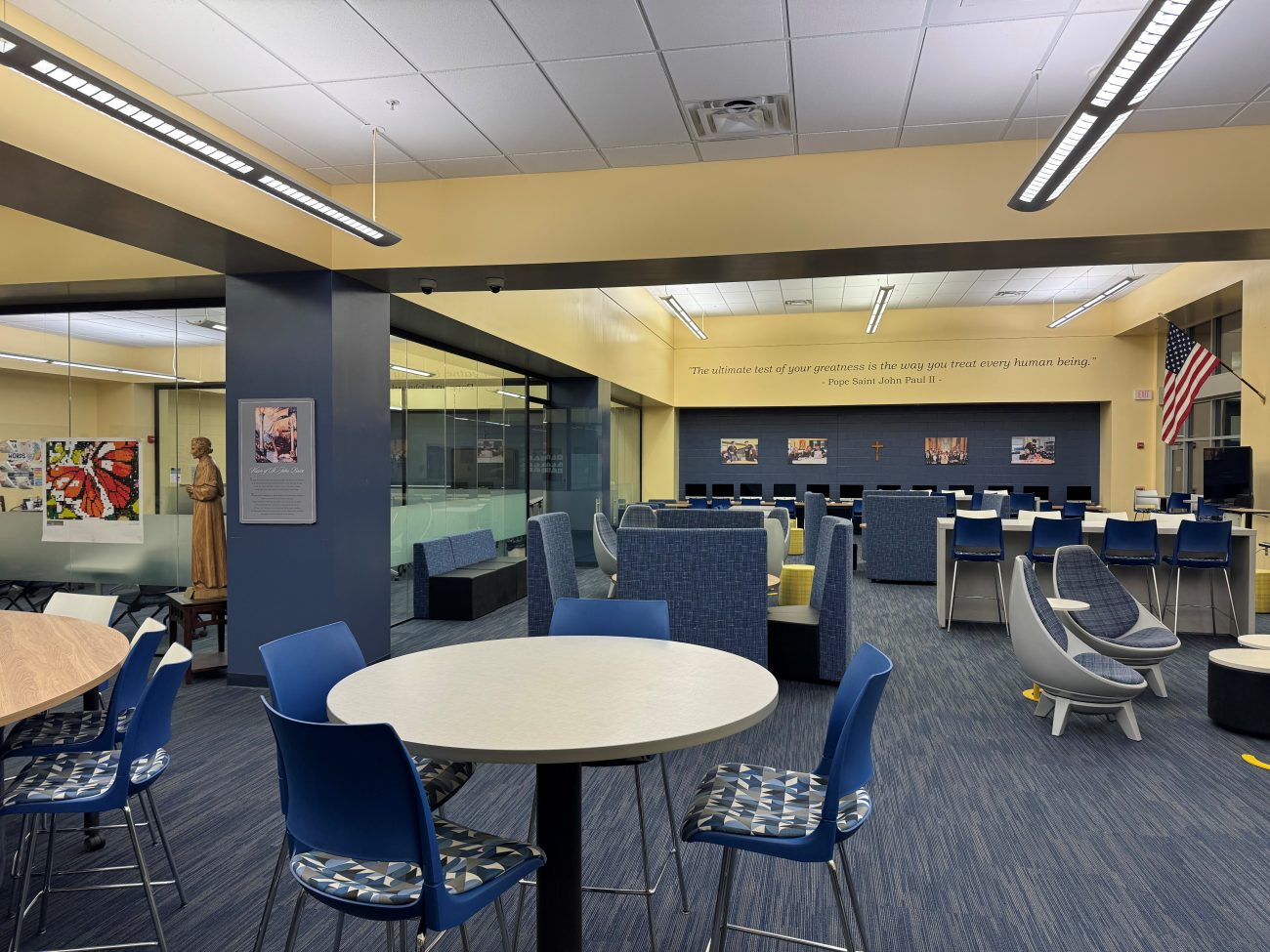
The CLAWS to PAWS program refers not only to students of St. Teresa of Calcutta School in Limerick, whose mascot is a tiger, continuing their education at nearby Pope John Paul II High School in Royersford, whose mascot is a panther.
It also describes a partnership between the two schools to provide consistent academic support for students with learning differences throughout their 13-year educational journey, from kindergarten through high school.
The programs build on one another: Pope John Paul II’s PAWS (Panthers Achieving Worthwhile Success) and St. Teresa’s CLAWS (Children Learning to Achieve Worthwhile Success) provide coordinated academic support for students at both schools.
“For the first time we really have a continuum of learning support, starting in the early primary years all the way through high school,” said Joseph Rogers, director of academic support at Pope John Paul II.
He and Jaclyn Rocks, the principal at St. Teresa of Calcutta, are applying the concept of universal design for learning, which aims to break down educational barriers for students with learning differences and other needs.
The educators are also sharing their approach with local Catholic schools and nationally at various conferences.
“We have an annual summer learning series at PJP and we invite elementary school teachers across the archdiocese to learn more about universal design for learning, and different strategies to engage diverse learners,” Rogers said.
Rocks said she attended that meeting with her 24-year background teaching many students with learning differences or with struggles organizing their time, or other challenges along their academic journey.
But the issue also has personal meaning for her, as she has a child with executive functioning and attention issues, and a nephew who needs special education. Executive functioning describes the cognitive skills that allow for greater focus and multi-tasking.
“Mr. Rogers was talking in the meeting. I stopped in the middle of the meeting and at the training, I texted my husband and I said, ‘This is where your daughter needs to go to high school,’” Rocks said. “Long story short, Joe and I started talking.”
They then developed their academic support collaboration through the generosity of many donors including the Ambassador’s Fund for Catholic Education and the Connolly Foundation, along with BLOCS.
Rocks’ daughter now attends PJP, simply because she believes the PAWS program matches her daughter’s needs.
Offered to students with a diagnosed learning difference supported by an individualized educational program (IEP), PAWS includes everything from quiet study spaces before and after school to National Honor Society tutoring, instruction on organizational and study skills, and accessible technology.
PAWS has grown over the last five years, serving 76 PJP students this year who come from both Catholic and public schools, with families giving positive feedback that they finally could receive necessary academic support for their kids through Catholic schools.
Rocks said that seeing PAWS led her to see how to implement a similar program at the elementary school level.
“Joe is the first person I met that has a similar belief in this learning program, and actually had it off the ground over at PJP,” Rocks said.
“I wanted to do it at the grade school level so that kids (and) parents that chose Catholic education would be able to have those supports consistently, (from) kindergarten through 12th grade.”
She said that St. Teresa of Calcutta’s CLAWS program offers a learning support program more focused on executive functioning. It’s designed to build skills that seamlessly connect into PAWS at PJP so the students’ success can continue.
Their program currently serves 20 students, with a waiting list already underway.
“We are ecstatic that we have a partner to create this true continuum. We would do this with any school,” Rogers said.
They explained how their programs not only carve out learning support classes throughout the day, but offer separate classes for executive functioning and other real-world skills, all within intentionally bright, open spaces within each school that are proven to help students with these needs.
“There’s many layers to this program,” Rocks said. “We’re able to actually provide classroom time, not only for executive functioning, but at an early age of social emotional learning.”
Both Rocks and Rogers believe in sharing this concept of continual academic support, and are focusing on speaking at conferences locally and nationally to help Catholic schools across America build similar platforms to help students.
They will be presenting at a future National Catholic Educational Association conference, and a Christian Brothers Conference for schools connected to that religious order that has a long relationship with Philadelphia’s West Catholic Preparatory High School.
“We are now able to build this partnership and hopefully create a model for many grade schools and high schools across many archdioceses in the United States,” Rocks said.
“This is an obligation for us to welcome students who desire a Catholic education, but might need additional academic support. It’s part of our mission and who we are,” Rogers added.
That mission deeply includes reaching young people whose challenges with education often lead them to struggle to believe in school, something Rocks sees in her own home.
“Because of Joe, my daughter shows up every day at Pope John Paul. She doesn’t like school, she never liked school, but because of the PAWS program, she wants to go to school every day,” Rocks said.
“That, for me, is worth more than the honors or the accolades, that she has somebody that she feels understands her. That’s what these programs, at the end of the day, are doing.”
Share this story