

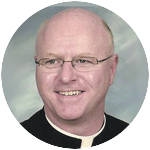
Msgr. Joseph Prior
(See the readings for the Thirty-third Sunday in Ordinary Time)
“Well done my good and faithful servant. Since you were faithful in small matters, I will give you great responsibilities. Come, share your master’s joy.”
We hear these words twice in Jesus’ Parable of the Talents. We can imagine the great joy those two servants experience in hearing those words. They have engaged their responsibilities wholeheartedly and now share the reward of their stewardship.
The parable is the Gospel reading for this Sunday’s liturgy. This time of the year, as we head toward the Solemnity of Christ the King (which is the last Sunday of the liturgical year) a general theme in the Mass readings is one of vigilance as we await the Lord’s return.
Hearing Jesus’ parable in this context, we might see Him as the man who lends out his “talents” to us, His servants, as we await His return.
Nowadays most people hear this parable and immediately think that “talents” means certain abilities, aptitudes or gifts that one possesses. For example, the ability to do a certain sport, or play a certain instrument, or easily engage others in conversation, or be able to build something, or to show extraordinary patience, or to have a great mind. The examples could go on.
Sometimes we might use the expression “they’re a natural,” or “they have a gift.” While these could possibly be applied to the parable, the “talent” of which Jesus speaks is actually a large sum of money. In fact, a very large sum of money.
A single talent would represent 6,000 days of work for a Roman soldier – in other words the pay for approximately 20 years worth of work. In today’s standards, for an average person, that would translate to somewhere between $400,000 to $600,000 – again for a single talent. So what is the point? The point is that the talents – whether five, two or one – represent something very valuable.
Now Jesus is not teaching us to be shrewd investors of money. The “talents” symbolize something valuable. They are given to the individual who previously did not possess them. They are a gift. In this sense, we might look at what the Father has given us through Jesus.
When Jesus begins his public ministry, generally speaking the first thing He does is announce the Kingdom and then invite people to follow Him. He then forms the followers into disciples by showing them how to live, to worship, to interact with one another, to suffer, to heal, to forgive, to love, to have compassion, to care for the poor and needy, to welcome the stranger, to proclaim the Kingdom, and many other things.
Perhaps it is these “things” that represent the “talents.” All these teachings are “gifts.” Notice too that they are of such great value that we could never place a price on them; they are “priceless.”
In reading the parable it is essential to understand that the “talents,” however we identify them, have the ability to increase by the effort of the one who receives them. If we read these “talents” as the gifts of the kingdom, the teaching of Christ in word and deed, or the Gospel, then we will recognize that the gift will only increase as we incorporate that into our lives. The gifts will grow as we strive to give them flesh, so to speak, in our living.
If we do not, the gifts will just sit there stagnant, unused. It would be like the rich man who had spent a great deal of money to purchase a beautiful illuminated Book of the Gospels. He put it on a large table in the entrance hall to his mansion. One day a friend entered the house, saw the book and went over to see what it was. When he asked the rich man what it was, he replied “It’s a very valuable Book of the Gospels.” “Do you read it?,” the guest asked. “Oh no it’s too valuable, it’s just for show.”
Jesus says in the fourth Gospel, “I came that they might have life and have it more abundantly” (John 10:10). The gift of life Jesus gives us is a share in His life, divine life, the life of love. His teaching, in word and deed, help us to live this life we have been given so that we might have life in abundance.
Jesus gives us the gift of Himself in word and deed along with His body and blood so that we can have this life in abundance. The vigilance we keep is living like those first two servants in the parable: by taking the gifts, incorporating them into our lives and have them multiply and increase.
Living this vigilance, we too can hope to hear the words spoken to the first two servants: “Well done my good and faithful servant. Come, share your master’s joy.”
***
Msgr. Joseph Prior is pastor of St. Dorothy Parish in Drexel Hill and a former professor of Sacred Scripture and rector of St. Charles Borromeo Seminary. Read more reflections by Msgr. Prior here.
Share this story