

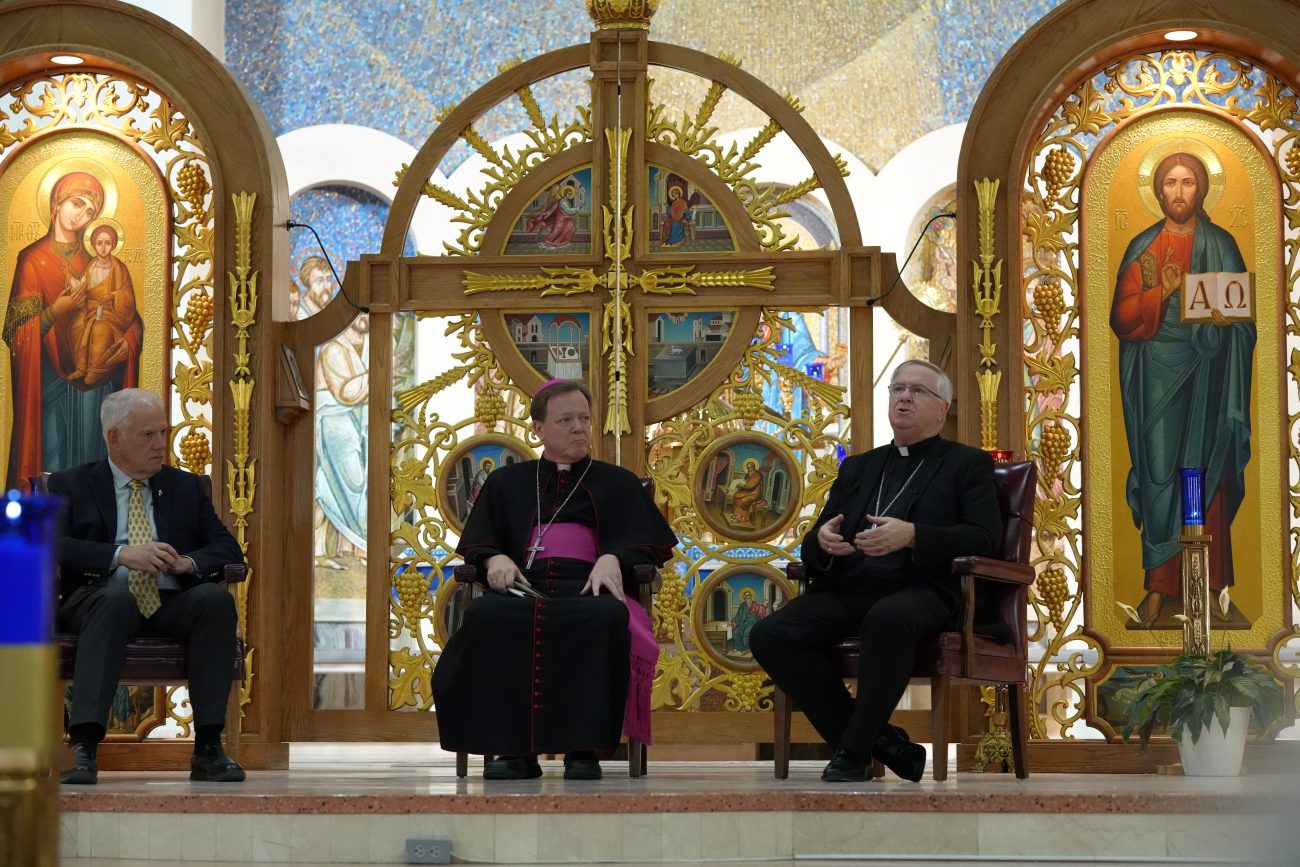
The golden-domed Ukrainian Catholic Cathedral of the Immaculate Conception became for Auxiliary Bishop Keith J. Chylinksi and more than 100 visitors “a safe space for us, allowing us a healing presence” on Thursday evening, Nov. 19.
The occasion was a roundtable conversation entitled “Placing Mental Health in the Lord’s Hands: An Evening of Prayer and Reflection on Mental Health Ministry,” hosted by Philadelphia Ukrainian Metropolitan-Archbishop Borys Gudziak.
Nearly one-quarter of Americans experience mental health distress, according to Archbishop Gudziak, who noted the Ukrainian Byzantine Catholic community is experiencing a much higher percentage due to trauma in Ukraine’s history and its current war with Russia.
“In my ministry I’ve encountered very painful and even tragic circumstances that point out that we really need to be attentive to this,” he said. “Our integral human wellness is inspired, uplifted and improved through the basic message of Jesus. God loves you.”
Joining Archbishop Gudziak and Bishop Chylinski were Bishop John P. Dolan of Phoenix, Arizona and Deacon Ed Shoener, president of the Scranton, Pa.-based International Association of Catholic Mental Health Ministers.
“We’re a unity of body and soul,” Bishop Chylinski said, “and even sometimes when there are sufferings or weaknesses within the body, the soul is operating, and spiritual insights can happen. God can transcend any kind of suffering.
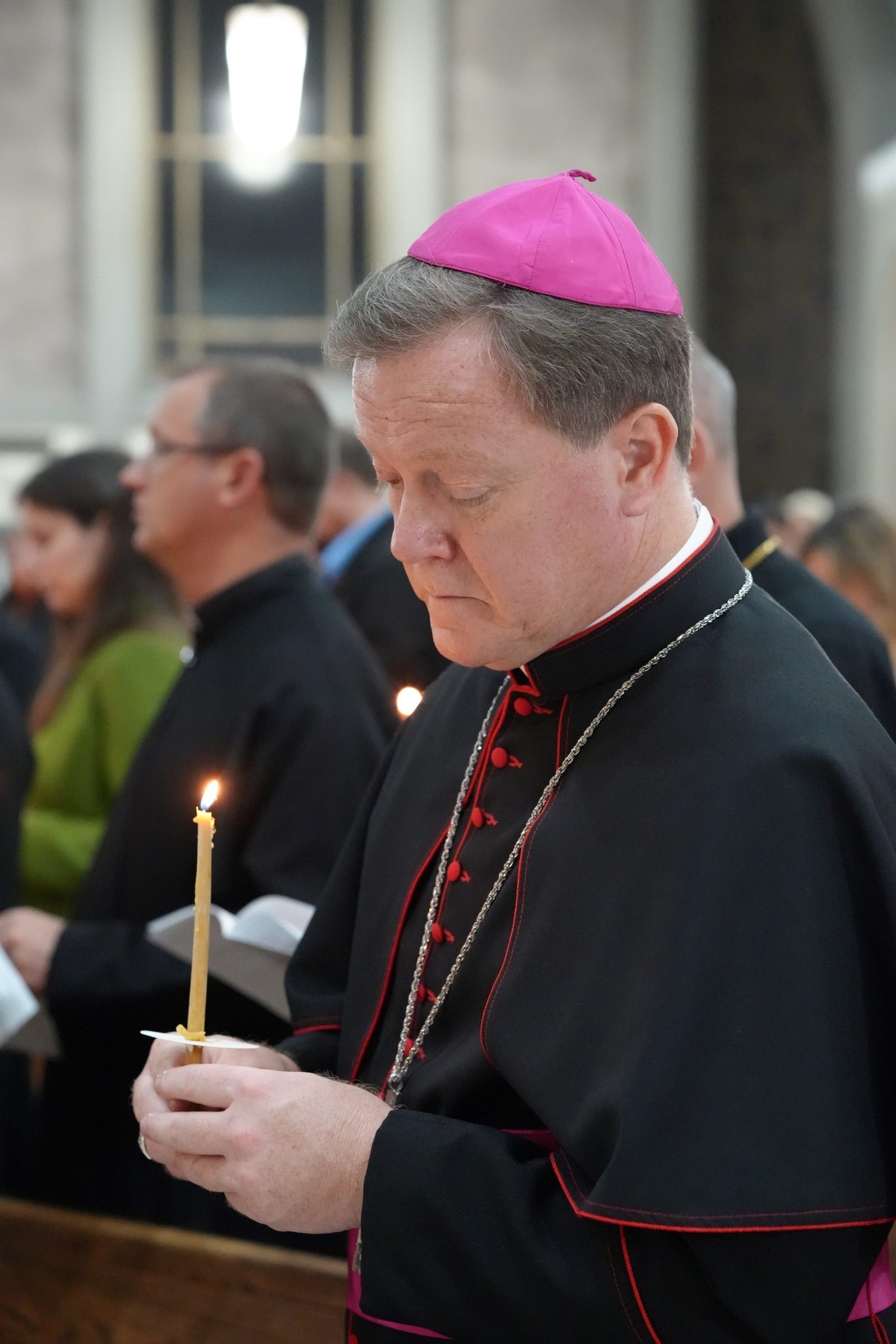
Auxiliary Bishop Keith J. Chylinski holds a lighted candle during Vespers Nov. 19 at the Ukrainian Catholic Cathedral of the Immaculate Conception in Philadelphia. (Photo: Ukrainian Catholic Archeparchy of Philadelphia/Oksana Loziak)
“People who have physical sufferings are really drawn so deeply into the mystery of the cross, and for those with faith, really into redemptive suffering. Those with mental struggles as well, and illness, can do the same.”
The three-person roundtable discussion followed a deeply moving 75-minute Vespers service that Archbishop Gudziak led with priests from other Ukrainian Catholic eparchies in the United States and other rites that are also in communion with the Holy Father.
It also followed the announcement of the launching of Ukrainian Catholic Charities USA, a new arm of compassion in the Ukrainian Catholic Church.
It will focus on issues of hunger, refugees and mental health, while continuing to partner in many other charitable projects with Catholic Charities on local and national levels.
“I am truly blessed to be here in the presence of members of the Ukrainian (Catholic) rite who experience various forms of trauma in your life. We certainly are aware, at least through the news. (although) not in the way that you are aware, of the trauma that is going on there in Ukraine,” Bishop Chylinski said.
“Ukrainian Catholic Charities, I think, is just an example of the beauty that you’re not allowing yourself to be paralyzed.”
Shoener lost his daughter Katie, who died by suicide in 2016. Since then, he has made it his mission to help the Catholic Church grow in overcoming the unnecessary stigma that exists when people show their vulnerability and the pain they endure living with mental illness.
He cited how 135 people die by suicide every day in the United States, with 1 million people taking their own life each year across the world.
“That’s not all the people struggling with mental health and mental illness. The numbers get much, much bigger there,” he said.
“The door has been cracked open a little tiny bit, and the Holy Spirit’s blowing through that opening in the door and bringing this ministry into the life of the Church.”
Bishop Dolan has lost three siblings and a brother-in-law, each of whom took their own life. He now serves as Chaplain of the International Association of Catholic Mental Health Ministers, and he established the Diocese of Phoenix’s Office of Mental Health Ministry.
He recognizes that most Catholics don’t have the professional training as a psychologist, counselor or psychiatrist, but he believes that shouldn’t stop them from being present to those who suffer through mental illness.
“We can’t solve every problem in the world. We’re not even supposed to. I’m convinced of that,” Bishop Dolan said.
“But we can be with people in our prayer, in our work with people, in our accompaniment with people. That’s where we work best. Just like Mary Magdalene and John the Beloved stood with Jesus at the cross, we don’t run away. We stand with.”
Bishop Dolan shared a way that he has been called to help someone in accompaniment for an entire decade, talking to this person 15 minutes every week without fail, the kind of presence anyone can give.
“Every time that person starts to have a little discouragement, I will say, ‘Don’t you remember when you were here? Look at that success. Look at where you were. Look at where you are.’ Those little moments of hope, those celebrations of hope, invite a person to carry on,” he said.
“It’s like that candle, the light that shines in the darkness. People can feel like they’re just immersed in the darkness. It gives us this strength.”
Bishop Chylinski, who earned a master’s degree in clinical psychology, encourages anyone enduring mental illness to help understand that God does not call people to live alone or to carry one’s personal crosses alone.
“When we offer our own sufferings and share it with another person, of course ultimately with God, when we realize that we’re not alone, it actually takes away the fear (and) the shame,” he said, and they begin to dissipate “because you realize that you’re actually part of the same human family.”
“Don’t be afraid. And if you take that courageous step to reach out, you will not regret it,” he said.
***
Resources:
Call 988 for access to the National Suicide Prevention Lifeline network and related resources for those in a mental health crisis.
Visit “Be Encouraged: Catholic Support for Mental Health,” a resource of the Archdiocese of Philadelphia.
Find a mental health professional in the Philadelphia region.
Share this story