

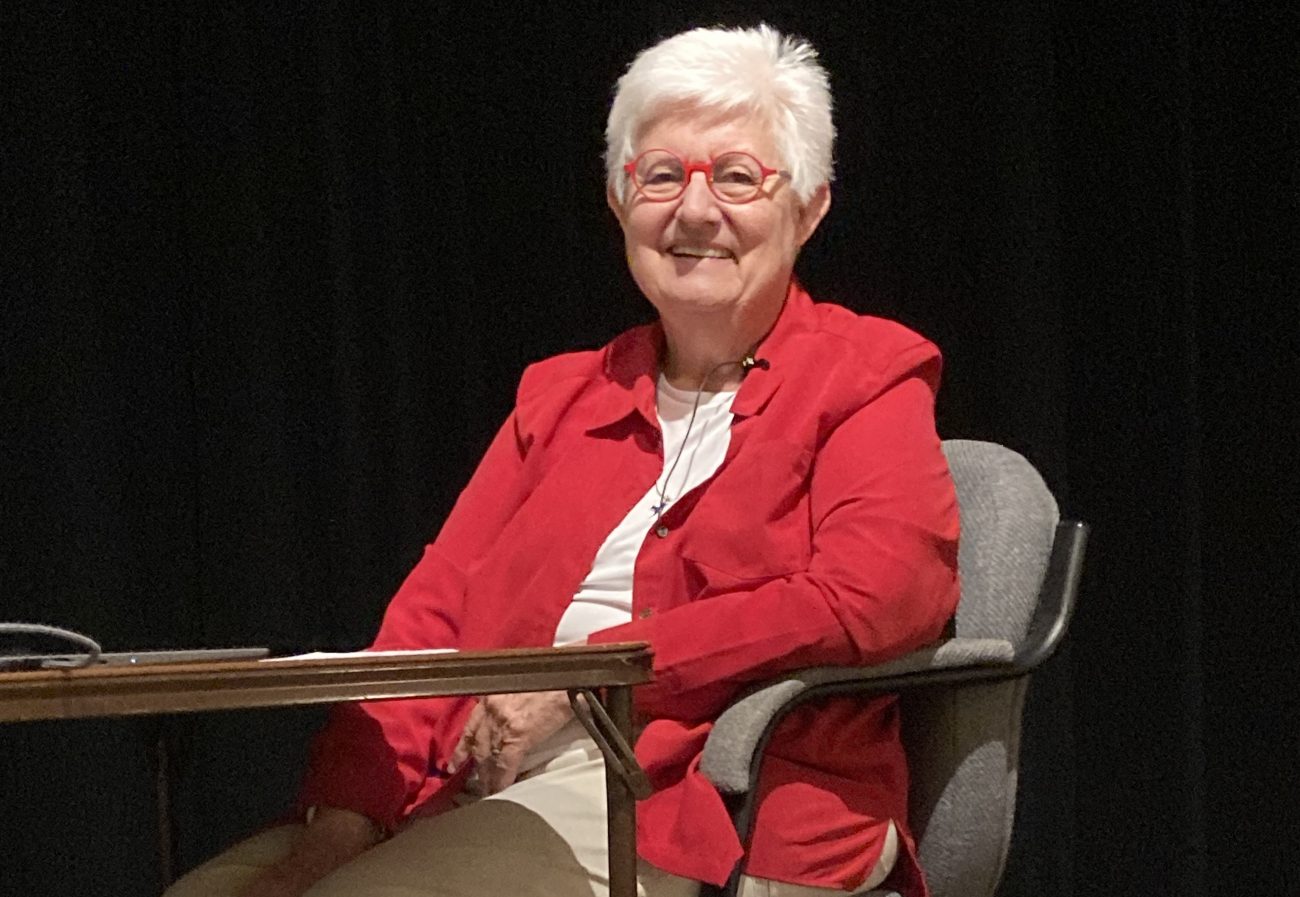
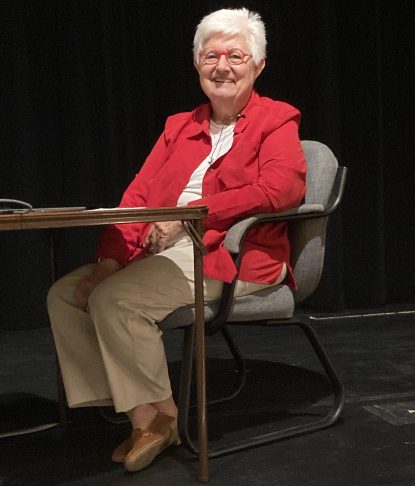
Sister Carol Rittner, 82, a Sister of Mercy and professor emerita of Holocaust and Genocide Studies at Stockton University, poses for a portrait. Rittner recently spoke at Maris Grove Retirement Community in Glen Mills, Pa., where she discussed moral responsibility and lessons from the Holocaust. (Photo by Sue Denny)
If Anne Frank had been your neighbor in Amsterdam in the 1940s, would you have helped her?
That was one of several thought-provoking questions Sister of Mercy Carol Rittner posed at a recent lecture at Maris Grove Retirement Community in Glen Mills. Sister Carol, 82, has devoted her life to studying the moral and ethical failings of the Holocaust.
Alarmed by media reports of rising antisemitism on college campuses and elsewhere, Maris Grove Catholic Council member Linda Shook invited Sister Carol to speak at the Delaware County community. The women have been family friends for 50 years.
“I want to make sure everyone is aware of the atrocities of the past,” Shook said.
Sister Carol is Professor Emerita of Holocaust and Genocide Studies at Stockton University in New Jersey, and has written more than 20 books about genocide and human evil.
After joining the Sisters of Mercy in 1962, she spent her early years as a religious sister teaching English in a Catholic high school. One of the books she taught was “Anne Frank: The Diary of a Young Girl,” still widely used to introduce students to the Holocaust.
Anne kept a written account of the years her family and four other Jews hid from the Nazis in an attic annex of an Amsterdam rowhouse.
Sister Carol recited and displayed on a screen the classic line from the teen’s July 15, 1944, diary entry: “I still believe, in spite of everything, that people are truly good at heart.”
Less than nine months later, Anne, 15, was dead. Her father, Otto Frank, was the only annex resident to survive the concentration camps.
“I wonder, had she survived, would she have written those words today?” Sister Carol asked her senior audience members, many of whom were alive during World War II.
For Sister Carol, a more formative influence was Viktor Frankl’s “Man’s Search for Meaning,” the Austrian psychiatrist’s chronicle of his experiences in four concentration camps.
“What I missed when I read the “Diary of Anne Frank,” I did not miss when I read ‘Man’s Search for Meaning,’” she said. “The book had an enormous impact on me.”
Austria had a population of 6.7 million in 1938, and the vast majority of citizens were Catholic, according to Rittner. “Why didn’t his neighbors help him when the Nazis came to destroy him and the Jews?”
In 1984, Sister Carol began working with Elie Wiesel, renowned Holocaust survivor, novelist, and human rights activist. She helped to organize an international conference to share the stories of thousands of non-Jews who risked their lives—and the lives of their loved ones—to help Jews.
Following the conference she wrote her first book, “The Courage to Care,” and produced a 30-minute documentary narrated by Wiesel with the same title. The film was nominated for an Academy Award in the documentary (short subject) category.
Exactly 40 years after its national public television premiere in May 1986, the Maris Grove auditorium was silent, the audience transfixed as they watched the film and its powerful, sometimes shocking accounts of real-life rescuers.
“I don’t know whether to cry or applaud,” Maris Grove resident Bridie Power said following the lecture.
She was 5 years old, living in County Monaghan, Ireland, when she became aware of the war after listening to adult conversations and “learning things I shouldn’t know about,” Power said. She remembers being afraid all the time of war and violence.
“I hear stories of people being so brave, and I wonder, ‘Would I have done that?’ Probably not,” she said. “There were so many cowards like me, frozen by fear.”
In early 1942, scholars say approximately 80 percent of the Jews of Europe were still alive, according to Rittner. By the middle of 1943—only 18 months later—80 percent of the Jews were dead.
Adolf Hitler and the Nazis could not have carried out their “dirty rotten killing business,” Sister Carol said, without the complicity of people who refused to act.
Six million Jews died not only because of the killers, Sister Carol said, but because of the indifference of others, many of them Christians.
Sister Carol concluded her 70-minute lecture by referencing the works of the late Yehuda Bauer, one of the world’s foremost Holocaust experts. He called for moral responsibility in preventing future atrocities and suggested adding three commandments to the Ten Commandments:
“Thou shalt not be a perpetrator; thou shalt not be a victim; and thou shalt never, but never, be a bystander.”
PREVIOUS: Stacy Gallagher Named President of Pope John Paul II High School
NEXT: Archdiocesan Pastoral Center Moving to New Offices June 8
Share this story