

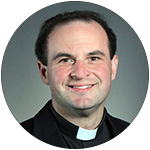
Father Eric J. Banecker
In the all-boys Catholic high school I attended, junior year was moral theology year. As I recall, freshman year was an introduction to Catholic theology, sophomore year was Scripture, senior year was Church history — but junior year was moral theology. And all of a sudden, 28 or 29 high school junior young men in a Catholic high school would turn into doctors of the law.
When we got into junior year moral theology class, we would begin to ask questions about the finest details of the commandments and the Beatitudes — effectively, though it was never said explicitly, working from the premise of “What is the absolute minimum I need to do to not get in trouble with God, or not to go to hell?”
If we’re all honest with ourselves, we can all be spiritual juniors in high school sometimes. I think we can all look at our lives as Catholic Christians and ask: What are my obligations? What am I supposed to do? What are the boxes I need to check? We can all fall into that temptation on occasion. It’s a kind of spiritual reductionism.
But Jesus’ parables in the Gospel for this Sunday give us the opportunity to look at things in an entirely new way — to discover faith in Him as a surprise and a delight. Faith in Jesus Christ transforms our lives. When we recognize the great gift we have received by entering into relationship with Him, we begin to ask not “What do I need to give in order to meet the requirements?” but “What more can I give in response to the Lord, who has given all for me?”
Jesus says this is what the kingdom of God is like: one who finds the treasure and sells everything to buy the field and one who discovers the pearl and gives away everything to obtain it. The kingdom is the reality that, once encountered and appreciated for what it is, is worth giving my life away in order to obtain it. In this way, our efforts to find the bare minimum become not just incorrect but undesirable.
Ultimately, life in the kingdom of God means living with the awareness that God has loved me completely — despite the sinfulness of humanity, the sinfulness I’ve been heir to through the fall of our first parents. Despite all that, God has loved me into existence. He has given me an eternal destiny.
In Christ Jesus our Lord, crucified and risen from the dead, we are reconciled to the Father, and through the Holy Spirit poured out upon the Church where Christ continues to be present in the sacraments, we continue to have communion with him, who leads us to the Father.
We recognize this when we think of the stories — just in the last few years — of so many people, especially young people, locally and around the world, discovering the faith and seeking to become Catholic. When you talk to them, you see that they are discovering the Catholic faith as if for the first time: not as a set of rules and obligations, but as something worth giving everything for.
Now, of course, we all struggle in different ways to live up to that. We all have our own weaknesses and failures that keep us from fully living out our place in the kingdom of God. This is why we fast and do penance, why we should make frequent use of the sacrament of Penance and Reconciliation, why we continue to read and study the truths of the faith, and especially why we pray each day to know the Lord and His will for us, begging for the grace to carry it out.
We all need all of that. I’m not saying we have to be perfect for God to love us — that is not what this is. It’s that when I truly discover what the kingdom of God is, I recognize that Jesus has called me to something much greater than I can possibly imagine.
Jesus didn’t say in the Great Commission, “Go therefore and go to Mass every week.” He didn’t even say, “Go therefore and put money in the basket every week.” (We should do both of those things, by the way!) He said, Go therefore and evangelize — make disciples, proclaim the Gospel, integrate all nations into the life of the kingdom.
This, of course, means participation in the Sunday Eucharist. Of course it means placing a few dollars in the basket, and not just a few dollars, but all of my resources: my time, my energy, my finances, everything.
This is not to be experienced as a burden, but as a joy. The man doesn’t buy the field with regret and trepidation, he rejoices, recognizing it as something worth everything. The man doesn’t only begrudgingly go and purchase the pearl of great price, he joyfully gives away everything in order to obtain it.
And so we ask the Lord for the grace to do the same: to learn joyfully and faithfully the great power of God’s love for us and, as Christ has given us the total gift of self, to imitate the parables, which teach us to respond with that same act of sacrificial love.
***
Father Eric J. Banecker is Vicar General and Moderator of the Curia for the Archdiocese of Philadelphia.
PREVIOUS: When Finding Life’s Treasures, the Wise Give Thanks to God as King
NEXT: We Hear God’s Word, and He Feeds Us With His Immense Love
Share this story