

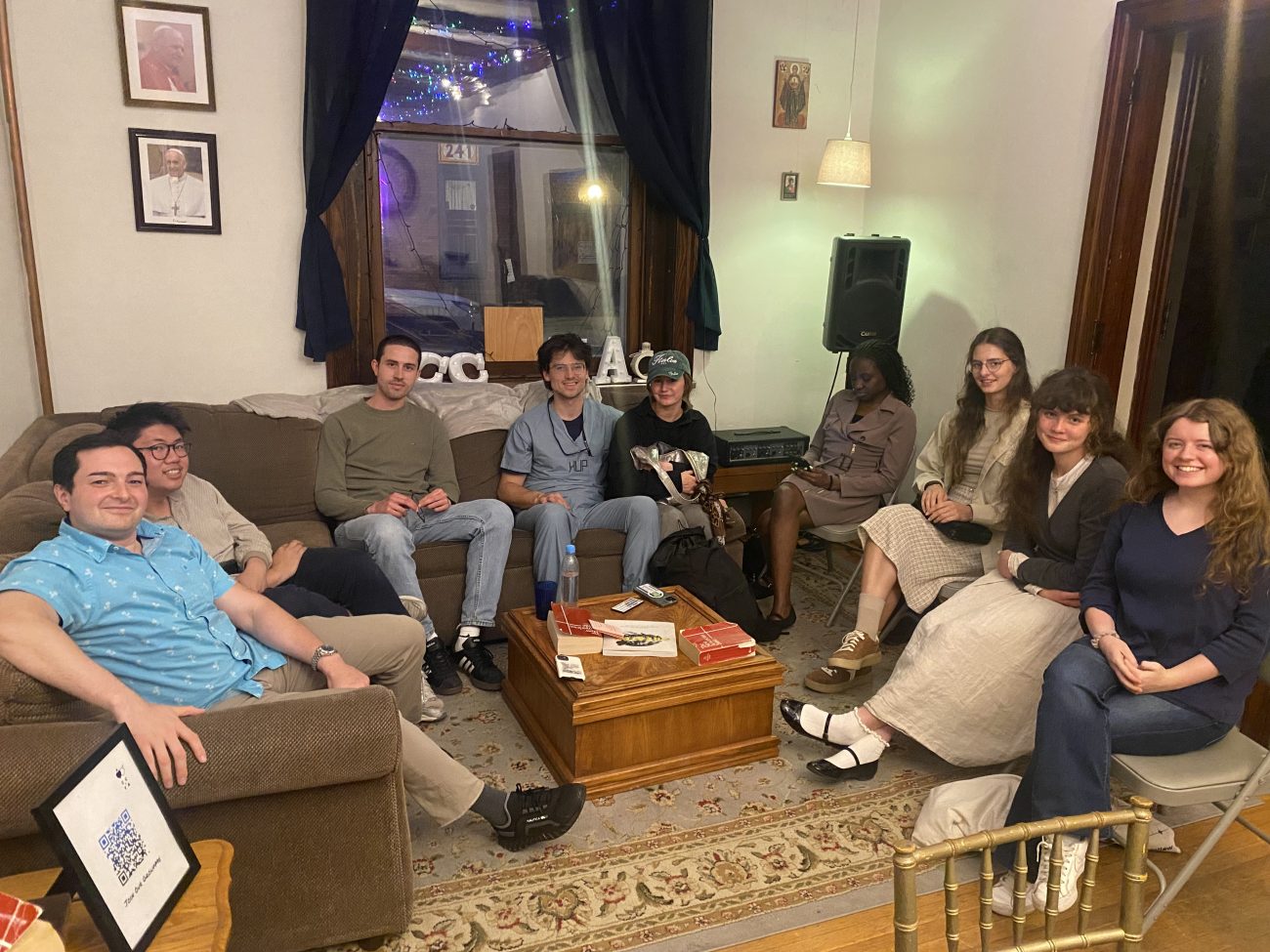
Catholic life lived out in a communal setting typically happens in religious orders, where people support each other in lives of similarly shared vows.
Some lay Catholics like Ashley Bennett and Patrick Hohenshilt are choosing to create their own self-organized household communities of faith outside an institutional setting, often as a way of further dedicating their lives to Christ and fostering shared relationships in the faith.
“Living in this community for five years has been such a blessing in so many ways,” said Bennett. She and six other Catholic women share what they call the Margaret Healy House, a converted mansion owned by the Missionary Servants of the Most Blessed Trinity near Father Judge High School and the Mother Boniface Spirituality Center in Northeast Philadelphia.
Hohenshilt is one of nine young adults living at the Catholic Center for Young Adults (CCYA) on the campus of St. Stanislaus Catholic Church in South Philadelphia. Father Shaun Mahoney, who had been involved in a young adult community himself before ordination to the priesthood in 1991, started the house in 2014.
“The purpose of the CCYA is to bring young adult Catholics closer to Jesus Christ and to (conversion), done by achieving a witness of faith-filled Catholic community where people may come to a hub of spiritual renewal,” Hohenshilt said. “The goal is to bring about a critical mass of holiness which is capable of changing the world and the diocese.”
Numerous other intentional Catholic communities exist for post-college lay people in the area, including the Sacred Heart House at Holy Cross Catholic Church for women in Springfield, Delaware County, and the Frassati House for men at Notre Dame de Lourdes in Swarthmore, Delaware County.
Bennett, who is coordinator of ministry with youth and young adults for St. Jude Parish and Shrine in Chalfont, lived in an intentional Catholic household during college at Franciscan University of Steubenville, Ohio.
She said about 50 to 60 percent of students there lived in households which offered a faith life deeply infused into the time housemates shared.
“We gathered multiple times a week for different prayer opportunities (like) praise and worship and adoration night, and had intentional time together in community and in prayer,” Bennett said. “But we also had study sessions (or) wrote our papers all together, watched a movie together, went on retreat once a semester together.”
Bennett said the ability to transfer some of that experience from household life at Franciscan University into intentional community in Philadelphia has deeply accentuated her life, all within a community that works hard to support each other in everything from the long list of household chores and upkeep to the fostering of each other’s faith lives.
“When we all come home from work every night,” she said, “we have people that we can rely on.”
Much of that reliance comes from shared moments of unity through the most important aspect of their lives, such as a priest celebrating Mass or leading eucharistic adoration for Bennett and her roommates.
They can remain inside their home for these moments because their home has a tabernacle to reserve the Blessed Sacrament.
Hohenshilt says that Christ-centeredness also creates the same common connection, meaning and opportunity to live the mission of Christ in service to each other and beyond. He said their home aims to create a sense of regularity in a distraction-filled world.
His community hosts a weekly Bible study and weekly Catholic-specific events to build a sense of rhythm and connection with their extended community.
“Faith witness is contagious, which means being intentional about the space you are cultivating and communicating to others allows for others to be in the presence of faith-filled conversations which breed Catholic joy,” Hohenshilt added.
“Faith only enriches our current adventures and vocations by filling in the cracks of our understanding with God’s divine wisdom.”
Both homes also have attracted many youth ministers, which builds opportunities to talk “shop” faithfully with fellow professionals in evangelization. They share work experiences and build off each other, spiritually, socially and in their career.
They also see their homes as training grounds that can prepare a person for vocations of community, seminary, religious life, or marriage.
Hohenshilt understands that living in such a community is often temporary, reflecting the similar nature of everyone’s time on earth, but it opens a chance for people to understand a new path for their lives.
“You experience this together, and it teaches and beckons you to place your trust in Jesus,” he said. “It teaches you honor and gratitude for those who have come before you, laying a foundation under your feet to be the very person to do the same for others.”
Bennett believes that many parishes have currently unused residential buildings that could offer more opportunities to create intentional lay communities across the region that can further support the faith lives of Catholics and foster missionary discipleship.
“Sometimes those who live in an intentional community, the reason they move in is purely financial at first,” she said.
“But then it turns into an evangelization of themselves personally, or even a new evangelization of someone born into the faith, baptized and raised in the faith but then has drifted away, and I think that’s one of the places of evangelization.”
PREVIOUS: St. Maria Goretti Parish Dreaming Big, Raising Funds for New Parish Center
NEXT: Archbishop Pérez Announces Latest Clerical Assignments
Share this story