

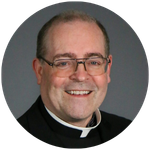
Father Patrick J. Brady
“And with your spirit” is not a phrase you hear much in modern American life. Nobody says it at Starbucks. Nobody says it while you’re waiting for an oil change. If they did, everyone in the room would probably look around for ghosts.
And yet we Catholics often say it without thinking. There is an old joke about a bishop who begins Mass, taps the microphone, and mutters, “There is something wrong with this microphone.” The congregation immediately responds, “And also with you.”
People have a real gift for answering words they’ve stopped actually hearing. We learn a response, repeat it often enough, and eventually the words bypass conscious thought altogether. Which is unfortunate, because some responses are too important to say without thinking about them.
Before there was a Starbucks on every corner, in my youth, the place to be was Farrell’s Ice Cream Shop at the Granite Run Mall. That’s where Psycho Pete, the neighborhood bully, got himself a job. Farrell’s made you wear a little paper hat and a striped apron and smile at strangers. Putting Pete behind that counter was like hiring a grizzly to run a petting zoo. Everybody knew it would end in blood. We just didn’t know whose.
Somewhere in the first couple of weeks, Pete decided that answering “you too” to everything covered his entire obligation to customer service. It was efficient. Not even rude, really. And it exhausted his vocabulary (although my memory of his loquaciousness may be colored).
Then the cake happened. A family had ordered one of those big ice cream cakes Farrell’s kept frozen hard enough to prop open a door. They jammed about 40 candles into it, lit every one, and set it on a table, a little too close to the paper streamers. The streamers caught, then the tablecloth caught, and a well-thought-of corner of the Granite Run Mall was on its way to becoming a legend.
A man in a suit came charging up to the counter, eyes wide, smoke curling up behind him like the gates of somewhere warm. “Young man, I believe the room is on fire!”
“You too,” responded Pete, as undisturbed as a hibernating bear. Between the man’s apoplexy and Pete’s total serenity, it took a few extra minutes for anybody to call the fire department. That was the end of the job and the paper hat. Pete went back to bullying full-time, which everybody agreed suited him better anyway.
The thing about “and with your spirit,” however, is that it was never intended as the liturgical equivalent of “same to you, pal.” It comes straight from St. Paul: “The Lord be with your spirit” (2 Tim. 4:22). When Paul says “spirit,” he doesn’t refer to our mood. He means the deepest part of us, the place where the Holy Spirit goes to work and where we’re joined to Christ. He isn’t wishing anybody good health or a good parking spot, or safety from fire. He’s calling down grace.
So why “your spirit” instead of plain old “you?” John Chrysostom, who was such a gifted preacher that Christians nicknamed him “Golden-Mouth” — a nickname I would very much like for myself, though my family remains stubbornly opposed — explained that the priest at the altar is not acting merely as a private individual. He is not some private fellow named Father Jason who happens to like golf.
The priest ministers through the gift he received in ordination. When the people respond, “and with your spirit,” they are recognizing the work of the Holy Spirit in the priest. You could paraphrase it, loosely, as “may the Lord keep alive the grace He gave you for this holy work.”
The translators who handed us “and also with you” back in the 1970s meant well. They wanted plain modern English. Trouble is, that’s not what the Latin said, or the Greek, or what almost anybody else on earth was saying. Walk into Mass in Italy, Poland, or Germany during those same years, and the people were all still answering with some version of “and with your spirit.”
The Church restored the older form in the 2011 Missal. The continuity of the response from Paul is a reminder that the Mass is bigger than any one of us, any one language, any one century. The priest offers the greeting. The people affirm the Spirit at work in his ministry. And together everybody remembers the Mass isn’t a show you watch. It is a living prayer in which we participate.
Every time you say “and with your spirit,” you’re repeating words Paul dictated from a prison cell. You’re responding in a way that started in the apostolic age and continues today. That is the secret of the liturgy. It is always bigger than the building you are standing in. The congregation around you is a small part of a family connected through the Spirit that stretches back through every century the Church has been alive.
So next Sunday, take the half-second. Remember, the power of those words is an invocation of the Holy Spirit’s power. And whatever you do, don’t respond like Psycho Pete.
***
Father Patrick J. Brady is pastor of St. Stanislaus Parish in Lansdale.
PREVIOUS: Jesus Teaches Lesson on Prayer: ‘Being Together’ With the Father We Love
NEXT: Our Cries of ‘Lord, Help Me!’ Are Answered by Jesus, the One Who Saves
Share this story