

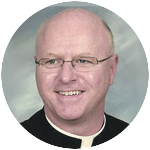
Msgr. Joseph Prior
(See the readings for the 20th Sunday in Ordinary Time)
Pope Francis was elected on March 13, 2013. Less than four months later he made his first trip outside of Rome to the island of Lampedusa in the Mediterranean Sea. The island was the destination to which migrants headed after the perilous journey across the sea from Africa. Pope Francis visited the island to remember those migrants who died on their way.
I remember a particularly striking photograph taken of the Holy Father with a crowd of migrants. The crowd was gathered around him, surely a nightmare for the Swiss Guard, but all they wanted was to be with him. There was a young girl in the crowd who gave the Holy Father a crayon-drawn picture. The scene was a boat with people on it in the sea being tossed about by the waves. A little girl in the drawing, presumably herself, had a voice bubble coming from her mouth which contained the words: “Help us! Help us! Help us!”
The image came to mind in reading the Gospel for this Sunday’s liturgy. The woman whose daughter was possessed by a demon used similar words in her encounter with Jesus saying: “Lord, help me.” The encounter is a significant one as is the miracle and the message.
The woman is a Canaanite, not a member of the Jewish people nor of the covenant. Yet she can call Jesus “Lord” and “Son of David.” Amazingly, she can see who He is while so many around her fail to see, and she is a foreigner. The disciples ask Jesus to dismiss her. Jesus seemingly agrees, noting his mission unfolds first to Israel then to the Gentiles.
She begs, “Lord, help me,” and Jesus says to her, “It is not right to take the food of children and throw it to the dogs.” She is undeterred saying: “Please, Lord, even the dogs eat the scraps that fall from the table of their masters.” Jesus, seeing the profound faith of the woman, says: “O woman, great is your faith! Let it be done as you wish.”
Within the context of the unfolding of the covenant first with Israel then to all humanity, we see a particular incident that not only foreshadows or points toward universal salvation (like the magi in the infancy account) but a moment where the salvation offered through that covenant breaks through the barriers of time and tribe.
Jesus, the one who saves, hears the plea of the Canaanite. His compassion wells up in response to her persistent faith and He heals. The woman represents the faith-filled foreigners of Isaiah’s prophecy in the first reading. These people, though not Israelites, observe the covenant of the Lord. He in return will take them to “my holy mountain and make joyful in my house of prayer; their burnt offerings and sacrifices will be acceptable on my altar, for my house shall be called a house of prayer for all peoples.”
The woman’s great faith gives us an example in prayer. She turns to the Lord for she knows that He can help her. She acknowledges Jesus for who He is, the “Son of David” and “Lord.” These are signs of her faith. She is persistent in her pleading for help. She believes Jesus will help her. All these can provide witness to us as a people of prayer.
The woman’s background as well as the interchange remind us (both at the same time) of the special role of Israel in salvation history and Jesus’ gift of Himself for all peoples and nations. Israel were the people chosen from all the peoples of the world for God to begin the work of salvation through whom He manifested Himself as the One God. The revelation reaches its climax as God becomes man in Jesus. He enters into the covenant as a Jew then opens the door for all peoples to know God’s love and mercy and to be saved through His death and resurrection.
The little girl who Pope Francis encountered at Lampedusa 13 years ago reminds us of people in need around the world. They are foreign by earthly markers. She makes the same plea that the Canaanite woman made: “Lord, help me.” The three simple words provide a great prayer for anyone and everyone in need.
***
Msgr. Joseph Prior is pastor of St. Dorothy Parish in Drexel Hill and a former professor of Sacred Scripture and rector of St. Charles Borromeo Seminary. Read more reflections by Msgr. Prior here.
PREVIOUS: ‘And With Your Spirit’ Isn’t a Shallow Throwaway Line
NEXT: Who Is Jesus? Our Answer Leads Us to Serve Everyone in His Name
Share this story