

In today’s era of artificial intelligence, Pope Leo XIV addressed the challenge of upholding the reality of God-made humanity and objective truth through his groundbreaking encyclical letter “Magnifica Humanitas: On Safeguarding the Human Person in the Time of Artificial Intelligence.”
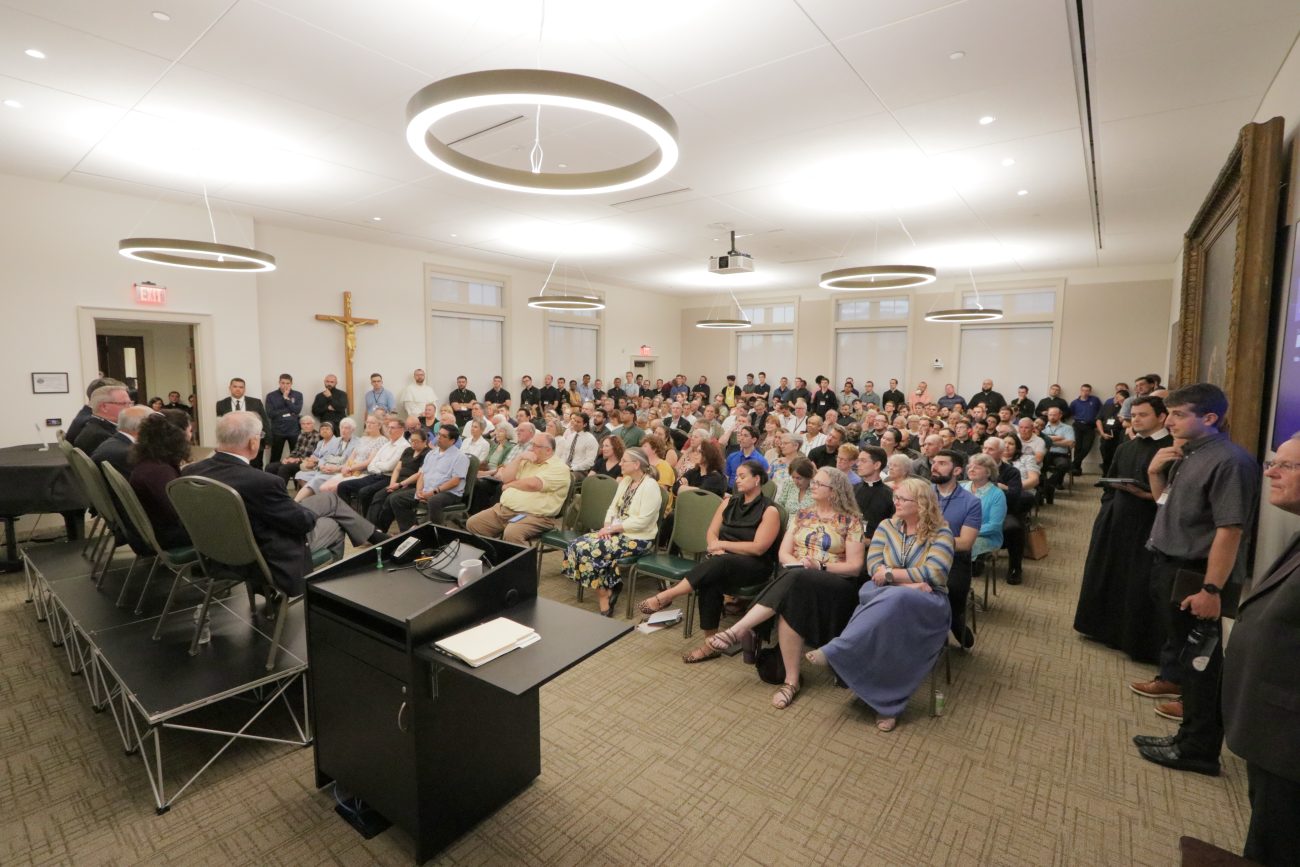
Six educators at St. Charles Borromeo Seminary presented particular aspects of that challenge Tuesday night, Aug. 25, as each examined one chapter of the encyclical and fielded questions by the capacity audience of nearly 200 people at the seminary’s annual Cardinals’ Forum.
Dr. Francesco Cesareo, a history professor at both the seminary and Villanova University, presented the relationship between the Catholic Church and its social teaching to times of the past that brought similar challenges, such as the Industrial Revolution.
“The (first) chapter directly links the legacy of Pope Leo XIII’s encyclical Rerum Novarum to the essence of this document. Just as the Industrial Revolution drastically rewarded human labor, capital, (and) societal structures, AI represents the new disruption of the 21st century,” Cesareo said.
“The Church, when faced with historical changes, exercises (the) right and duty to examine social realities, making pronouncements about them, and indicating paths for finding just solutions.”
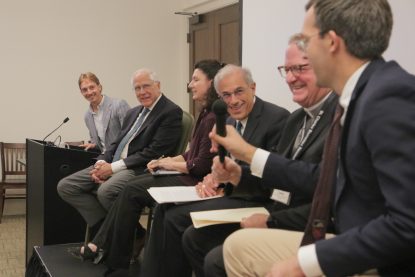
Panelists from St. Charles Borromeo Seminary speak during the annual Cardinals’ Forum on Aug. 25. (Sarah Webb)
He added that the Holy Father asks the same question that his predecessor Pope Leo XIII asked during the Industrial Revolution: “What does it mean to be human? What is the essence of humanity in the midst of the changes that we are experiencing technologically?” Cesareo said.
Deacon Charles Lewis, the director of the seminary’s School of Diaconal Formation, dove into the theological and moral foundation of the encyclical, where Pope Leo XIV reminds people to consider technology within the more important framework of the human person.
Addressing the encyclical’s second chapter, on the Church’s social doctrine, the deacon said it “includes aspects like human dignity, human rights, the common good, solidarity, subsidiarity, social justice, and integral human development.”
“The chapter says that the central question is not simply what AI can do, but what kind of human community AI helps us to build,” he said.
He highlighted Pope Leo’s emphasis of all God’s children owning the same human dignity, that human rights are owed to people due to their dignity, and that technological progress does not automatically mean human progress.
That perspective “challenges any use of AI that would deepen inequality, exclude the vulnerable, or treat some people as less worthy because of data profiles, economic status, disability, age, race, migration status, or social position,” Deacon Lewis said.
“AI should be directed toward shared human flourishing rather than private gain or efficiency as a good in itself.”
Oblate Father Thomas Dailey, the Cardinal Foley Chair of Social Communications at the seminary, described how AI creates promises about technology that can lessen the dignity and grandeur of the human race.
“AI can imitate and simulate, but it cannot educate,” he said. “To use the pope’s words, ‘When efficiency becomes the ultimate measure of value, human beings are tempted to see themselves as a project to be optimized rather than as persons called to relationship and communion.’”
He also revealed how the pope spotlights the dangers of unchecked technological power making people more isolated and potentially dominated and excluded by those in power.
But Father Dailey also shares a hopeful call from Pope Leo, “his call to disarm AI.”
“To disarm, he says, means discrediting the assumption that technical power automatically confers the right to govern,” said Father Dailey. “The pervasive technocratic paradigm amplified by the digital revolution and AI threatens to normalize an anti-human vision.”
Dr. Nicholas Ogle, a professor of moral theology at the seminary, unpacked parts of Magnifica Humanitas that showcase the ways that AI threatens the cultural, political and social life of humanity.
AI may have “effects on education, labor, financial markets, the environment, the family, and even on human freedom itself, as governments and corporations compete with one another to extract as much data as possible from an unsuspecting populace,” Dr. Ogle warned.
He said, however, that Pope Leo reveals how societies shouldn’t demonize or idolize technology, but utilize it through the lens of truth as a common good that is not subjectively owned by those in power.
“He states that truth is not a possession to be monopolized nor a territory to be defended, but rather a gift to be shared,” said Dr. Ogle.
Dr. John Haas, John Cardinal Krol professor of moral theology at the seminary, connected the issue of artificial intelligence to the just war theory. He pointed out that the encyclical described how AI can be used to help defend and protect civilians.
But he added how use of AI in warfare may lead to immoral actions simply because the technology can process faster than humans can, but do so without a moral perspective.
“There is now the danger that algorithms may replace human discernment that would indeed render the just war theory ‘out of date,’” he warned. “What we cannot allow to happen is for the moral agent to be replaced with an algorithm. We cannot allow the power to act to exceed our powers to foresee and to judge.”
Dr. Kelly Anderson, the chair and an associate professor of the seminary’s Department of Sacred Scripture, both began and capped the night’s presentations by using the Bible to show the effect that hierarchical control of technology and AI can have upon society when not used for a Godly purpose.
“We are living in a certain slavery. We are building the Tower of Babel,” Anderson said, citing one of two major Old Testament building projects cited in the encyclical, with the other being the God-led reconstruction of ancient Jerusalem.
“We have to cry out from the depths of our heart like the psalmist does, ask God to defeat the foes, and ask God to bring them down,” Anderson said.
But as she reminded the audience, “I think the answer to all this is Christ, and what does He do? He embraces the lowly. He doesn’t fight fire with fire. He fights it with love.”
PREVIOUS: Father Timothy Tarnacki Heads to Florida After Decade of Philadelphia Ministry
NEXT: Catholic Charities Backpack Drive Provides School Supplies, Food To Hundreds of Philadelphia Students
Share this story