

Fifty years ago this week, the eyes of the Catholic world turned to Philadelphia as it welcomed visitors to the 41st International Eucharistic Congress. The weeklong gathering ran August 1-8, 1976, and drew more than 150,000 people to the city, including many prominent church leaders and Catholic dignitaries.
With its focus on the Eucharist, liturgical celebrations were an integral part of the Congress. One of the high points of the event was the Congress’s closing Mass, held at JFK Stadium in South Philadelphia before an estimated crowd of 96,000. President Gerald Ford greeted the attendees and Pope Paul VI, though unable to attend in person, offered remarks by telecast.
Looking back historically, one of the other notable features of the Congress was the series of special Masses offered for more than two dozen distinct “heritage groups” to celebrate the diversity of the Catholic Church in the United States. Held at various churches and venues throughout the city, these liturgies called attention to the gifts of faith that each group contributed. Several groups also organized special concerts and festivals following the liturgies to further showcase their cultural heritage.
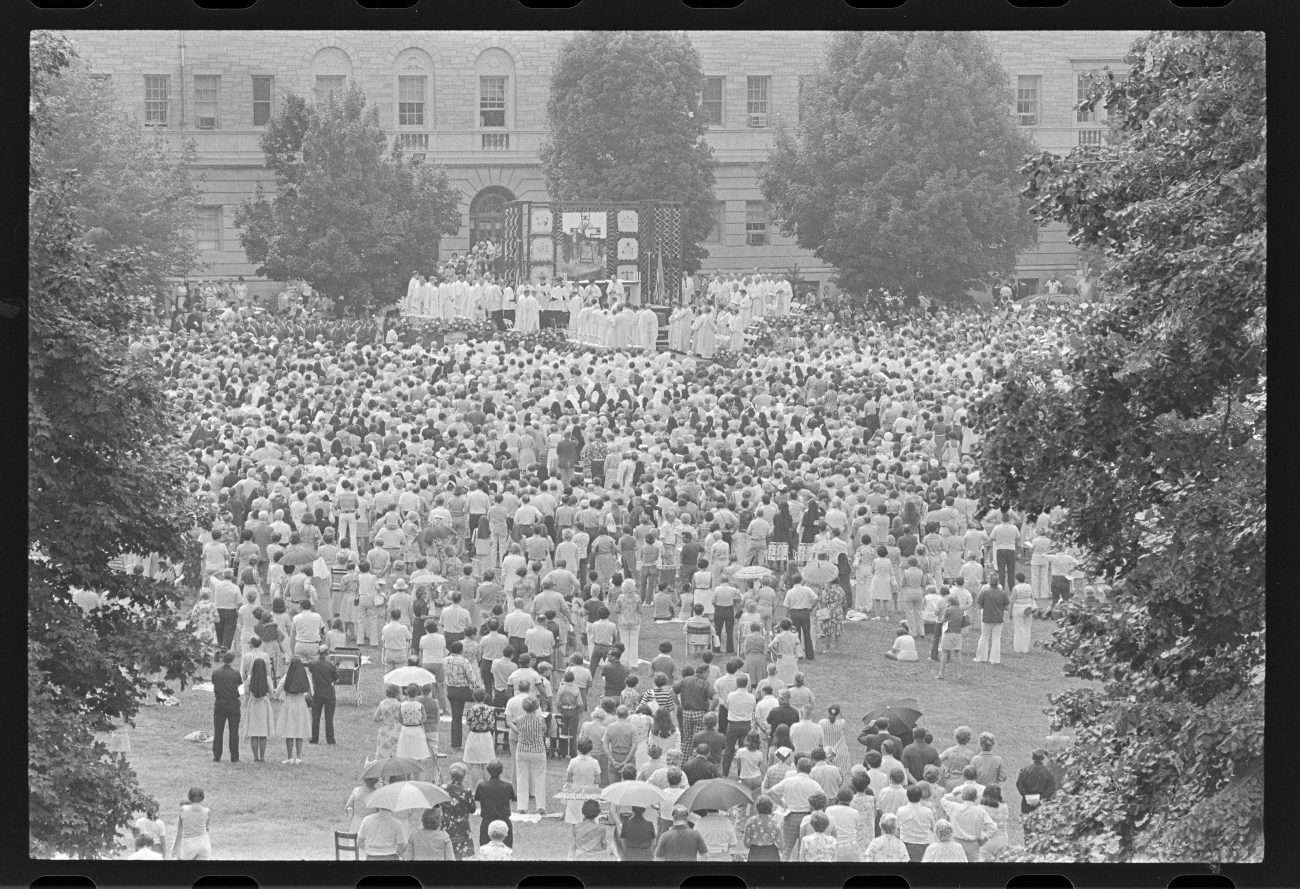
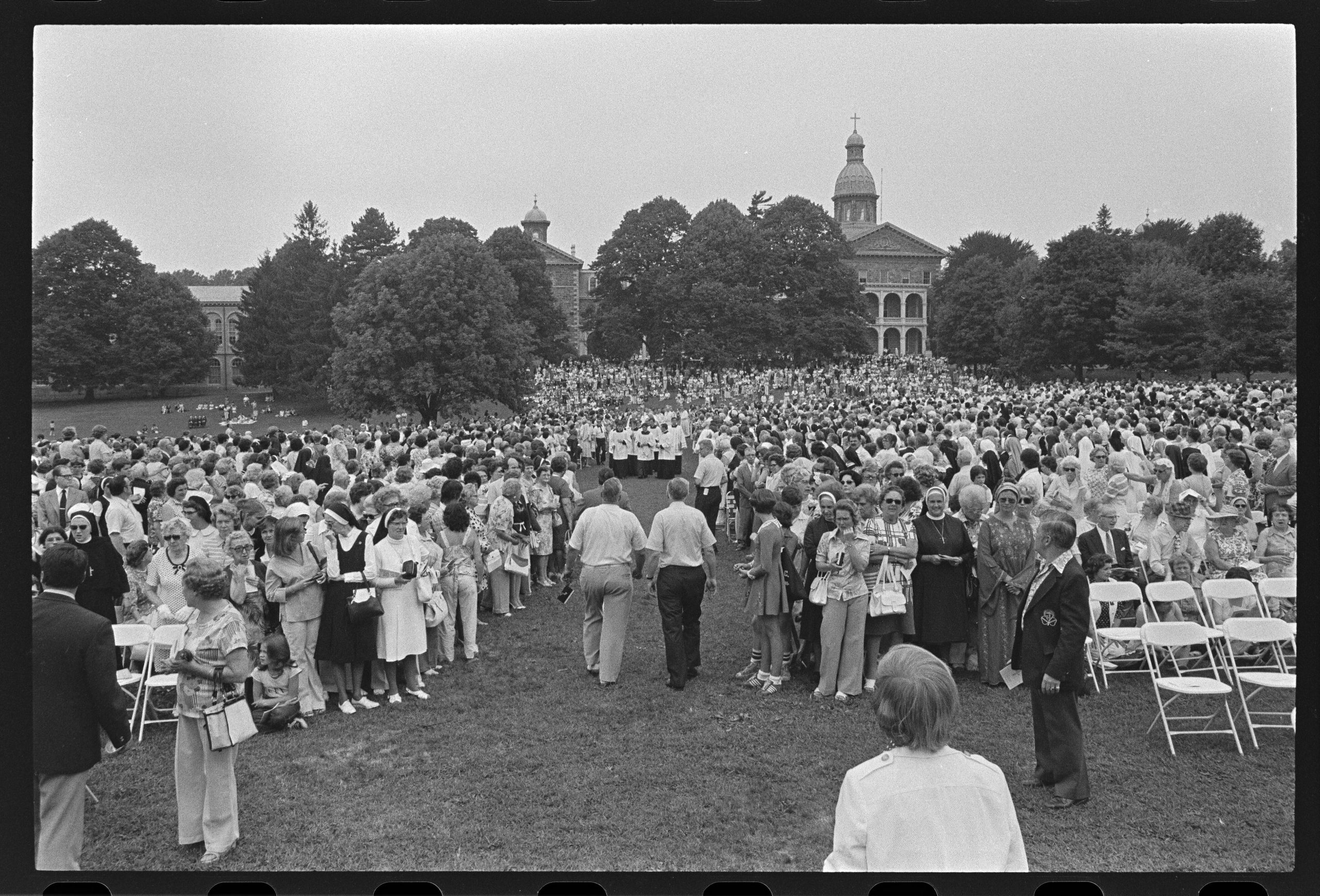
Many of the celebrations reflected the American Catholicism’s European roots and the ethnic diversity found among Philadelphia’s parishes at the time. The Irish Mass held on the grounds of St. Charles Borromeo Seminary attracted some 40,000 attendees and was followed by a festival of “Irish folk songs, dancing, and crafts.” Meanwhile, Germans assembled in Convention Hall, the Italians at the Spectrum, and the Poles at Veteran’s Stadium for their own services. There were also liturgies for smaller groups, including Croatians, French, Hungarians, Portuguese, Romanians, Slovaks, and Slovenians, as well as ones for Eastern Rite Catholics, including the Maronites, Melkites, Ruthenians, and Ukrainians.
The liturgies also highlighted more recent immigrant groups that contributed to the changing face of American Catholicism. There was a special liturgy for Hispanic Catholics at JFK Stadium on Saturday, August 7, with a homily offered by Cardinal Luis Aponte of San Juan, Puerto Rico – a reminder of that island’s ties to the United States and its people’s equal claims to American identity. There were also celebrations for Vietnamese Catholics at St. Martin of Tours Church in Northeast Philadelphia, for Korean Catholics at Most Blessed Sacrament Church in West Philadelphia, and for Filipino Catholics at St. Peter the Apostle in North Philadelphia.
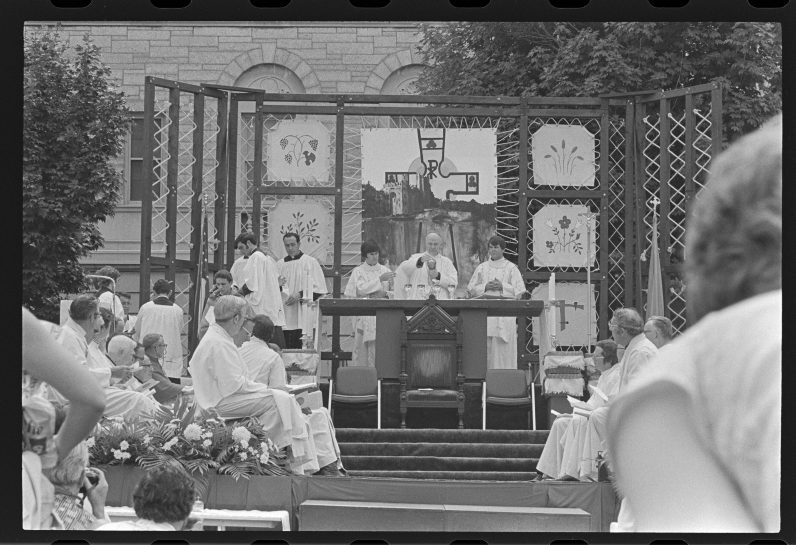
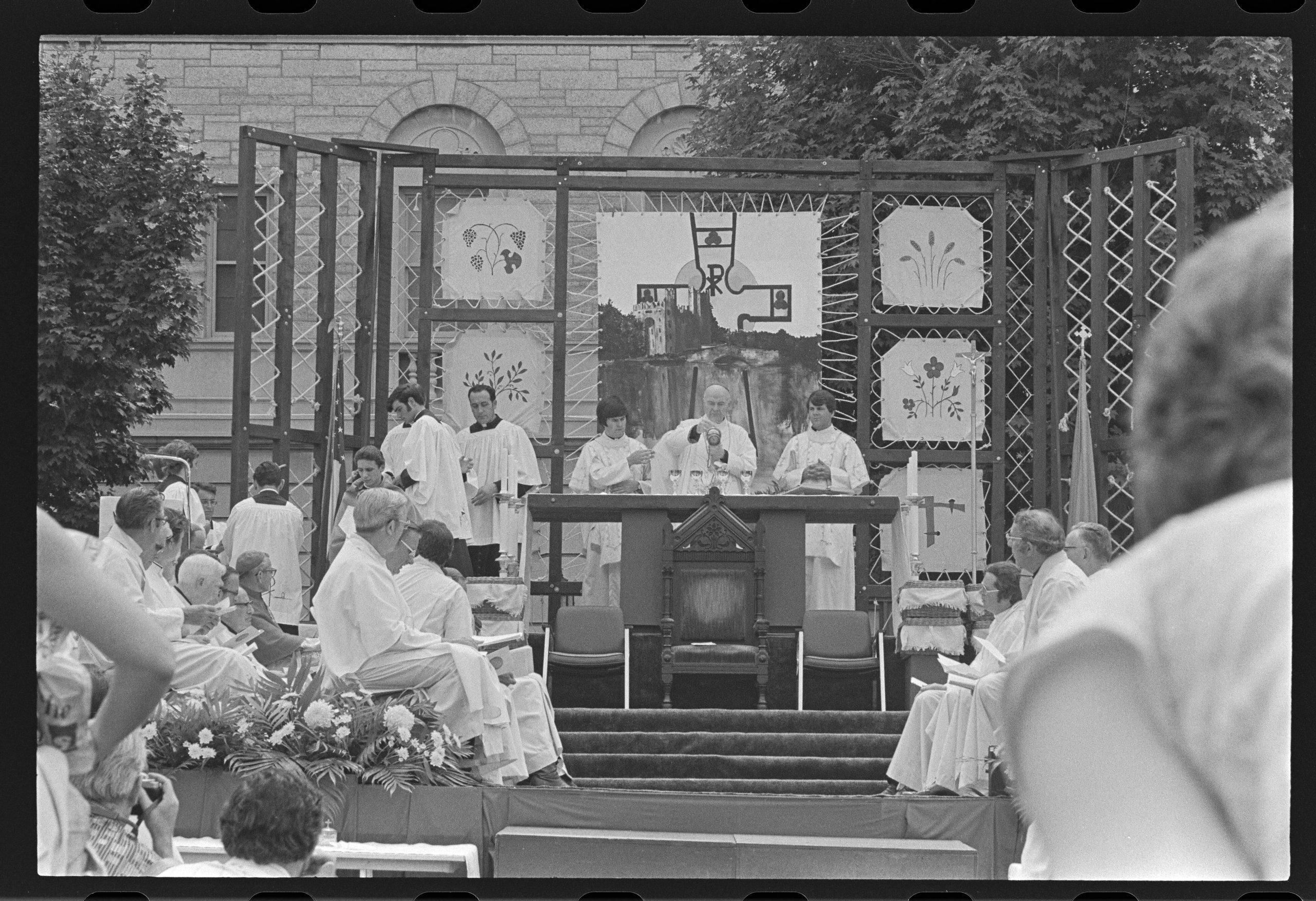
Clergy concelebrate the Irish Heritage Mass at an outdoor altar on the grounds of St. Charles Borromeo Seminary during the 41st International Eucharistic Congress in August 1976. (Photo: Catholic Historical Research Center of the Archdiocese of Philadelphia)
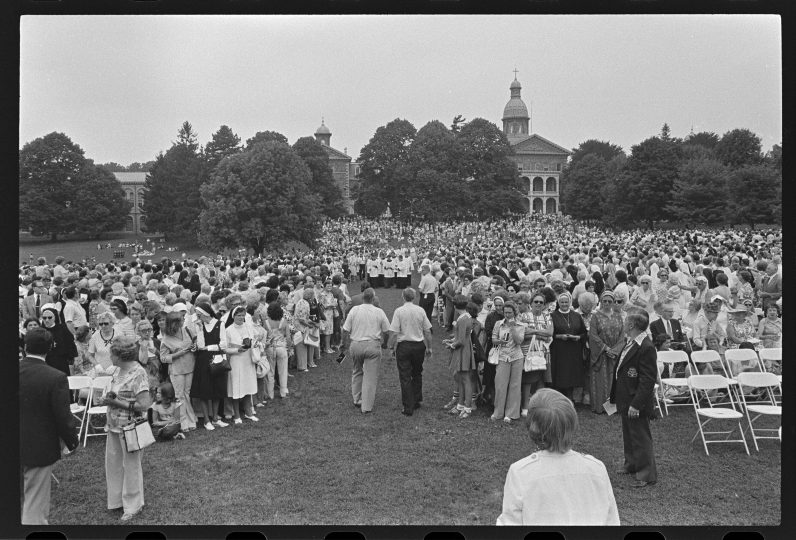
Thousands of worshippers fill the grounds of St. Charles Borromeo Seminary for the Irish Heritage Mass during the 1976 International Eucharistic Congress. (Photo: Catholic Historical Research Center of the Archdiocese of Philadelphia)
Just as significantly, the celebrations gave visibility to groups whose longstanding presence in the church was not always recognized or appreciated by their fellow Catholics. Black Catholics, whose enduring faith helped nurture the church in the United States from its earliest days, held a liturgy that included “a mixture of African drums and American Negro spirituals.” The Mass was part of three days of special programming for Black Catholics organized as part of the Congress. There was also a special Eucharistic celebration for Native Americans held on Independence Mall. The liturgy welcomed representatives of twenty-one different Indian nations and included expressions of Native culture, such as the performance of the Eagle Dance and the Buffalo Dance as part of the concluding rite.
These liturgies reflected both the theological and cultural transformations at work within American Catholicism that helped open the church to more diverse forms of expression. In earlier eras, church leaders in the United States had accommodated ethnic diversity by establishing an array of “national” parishes. Yet at the same time, they worked to impose order and uniformity upon their diverse flock, insisting on adherence to “Roman” authority and actively cultivating a shared Catholic subculture that tended to privilege the dominant Irish American vision for the church.
By the 1970s, American Catholics had come to see their diversity not as an obstacle to overcome, but a blessing to embrace. The reforms of the Second Vatican Council, enacted just a decade earlier, had opened the door to the celebration of the Eucharist in the vernacular. New texts and translations prompted greater appreciation of various forms of cultural and linguistic expression. Scholars had also begun to emphasize how Catholicism in the United States was shaped by its roots in the “immigrant church.”
Americans more broadly had similarly come to embrace ethnic diversity as an integral part of the nation’s history. In the postwar decades, they began to think of the United States in pluralistic terms and emphasize that we are a “nation of immigrants.” That vision helped build support for the immigration reform of the 1960s that eliminated the restrictive quotas that had been in place since the 1920s. In contrast to earlier waves of nativism that sought to exclude foreigners and define American identity narrowly, the postwar years witnessed a newfound appreciation for how the nation accommodates the many yet remains united as one.
The display of ethnic diversity at the Eucharistic Congress also reflects what historians have described as the American “ethnic revival” of the era led by the children and grandchildren of earlier immigrants. While those who immigrated often shed their old identities in order to assimilate, their American-born descendants reclaimed language, culture, and customs as a point of pride. Religious life became one avenue of renewed ethnic expression.
Reflecting on the legacy of the 1976 Eucharistic Congress, the “heritage” liturgies speak to broader changes taking place within American Catholic life and reveal a new embrace of diversity within the church. They served as a visible reminder of how all are part of the Body of Christ.
***
This article was written in partnership with the American Catholic Historical Society and the Catholic Historical Research Center of the Archdiocese of Philadelphia.
Thomas F. Rzeznik is professor of history at Seton Hall University and co-editor of the quarterly journal, American Catholic Studies. His most recent book is A Monument of Charity: St. Vincent’s Hospital and Catholic Health Care in New York City (NYU Press, 2026).
PREVIOUS: Handmaids of the Sacred Heart Mark 100 Years of Sharing ‘Joyful Love’
NEXT: Archbishop Pérez Asks for Prayers Ahead of Days for Educators
Share this story