

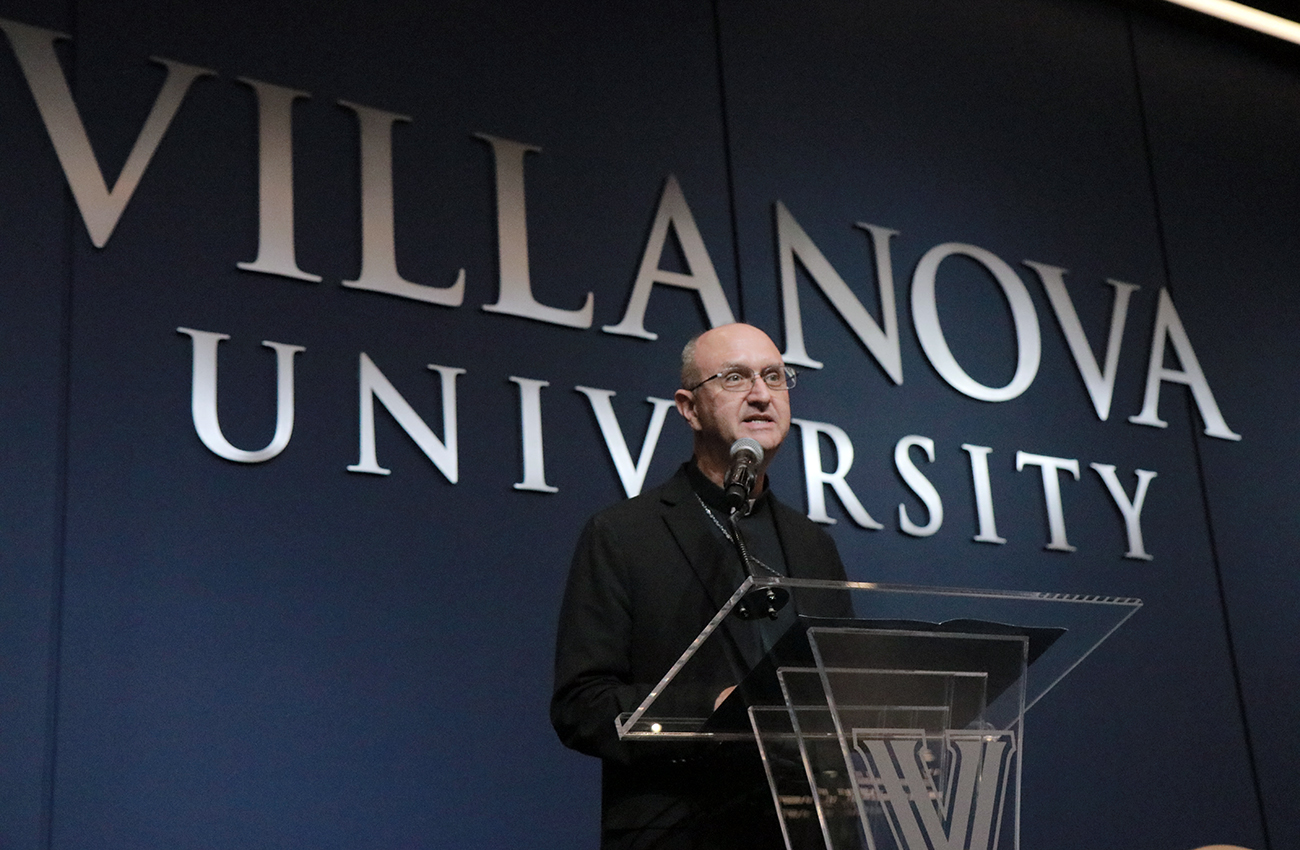
The plight of the immigrant is one that many native-born Americans don’t know from personal experience. Philadelphia Archbishop Nelson J. Pérez knows firsthand.
“What does it actually feel like to be an immigrant? If I had to single out a word, I would say singled out. That’s what it feels like to be an immigrant. To be singled out,” he said, informed by his own life journey.
Archbishop Pérez was one of many who shared powerful personal journeys as an immigrant during a Mass he celebrated Thursday night, Sept. 17 at St. Thomas of Villanova Church on the Villanova University campus.
It highlighted the two-day conference titled “Witness to Hope: Pastoral Care for Immigrant Communities,” led jointly by the Archdiocese of Philadelphia, the Catholic Immigrant Prophetic Action Project (Catholic IMMpact), the Sisters of St. Joseph of Philadelphia and the Villanova University Mother Cabrini Institute on Immigration, which hosted the conference.
>>>Photos: ‘Witness to Hope’ Conference Focuses on Accompanying Immigrant Communities
Michele Pistone, a professor of law at Villanova University and the founding faculty director of the Mother Cabrini Institute on Immigration, sees this conference as a chance to activate the 130 attendees to walk beside those who are “singled out.”
That is because migrants in the United States, she said, live constantly within today’s deeply fearful climate of dehumanization and immigration enforcement, including mass deportations.
“The Catholic community is ready to take action and get some leadership and get some ideas,” said Pistone, who was personally inspired by an encounter with Pope Francis to become more deeply involved in advocacy and pastoral care for immigrants.
“The goal is to have parishes (and) dioceses create action plans so that they are ready in the face of immigration enforcement. The energy that’s coming out of these two days is really going to mobilize them and have them be in a position where they’re not reacting, but they are planning ahead.”
The conference’s first day gave the attendees the chance to listen to stories such as the Archbishop’s own pathway. He joked that he was created in Cuba but “unpackaged” in the United States when his parents immigrated from Cuba to escape the regime of Fidel Castro with the Archbishop inside his mother’s womb before his birth in America.
The experiences he underwent were no joke, from childhood to his time in the seminary facing racist jokes and sometimes demeaning treatment.
Nevertheless those experiences helped him to understand vulnerability among others and motivated him to take action for himself and others.
“I turned around to someone sitting behind me. I was like, ‘Wait, did he say this happened in the seminary?’” Pistone said after Mass. “You are singled out, you’re being discriminated against in that environment. What I loved is that it gave him power.”
Even after his ordination, the pastor at his first priestly assignment asked him in the first minute of their initial conversation if he spoke English, a language he was very clearly conveying to the pastor at that moment. A couple sentences later, the pastor made it clear that he would not allow a Spanish-speaking Mass at the parish.
“Singled out,” the Archbishop said, reflecting on the conversation that deeply informed his ministry from that point forward. “Singled out.”
Michael Gambone, chair of the Religious Studies Department at St. Joseph’s Preparatory School in Philadelphia, said that hearing from an archbishop who has endured racism and anti-immigrant sentiment reminds people of how real those issues remain.
“Knowing that somebody who is the Archbishop of Philadelphia has lived through some of the things that we ourselves are trying to change” is important, Gambone said, “whether because we’ve experienced them like other people, or whether those of us of privilege are leveraging our privilege to help change things.”
The conference spotlighted other immigrants who have lived a life of being “singled out” during the Thursday session.
It infused the pastoral views of many Archbishop Pérez’s fellow bishops, including remarks and keynotes given by Auxiliary Bishop Christopher Cooke of Philadelphia and Bishop Bruce Lewandowski of Providence, Rhode Island.
Those pastoral talks included practical stories of ways dioceses, parishes and Catholic organizations can inspire the prayer life that Archbishop Pérez called immigration leaders to live, and have it lead to concrete actions of pastoral witness for immigrants.
Experts showcased the relationship between Catholic social teaching, immigration enforcement and ways to help immigrants understand their rights.
Attendees then discussed how dioceses and parishes can build a practical Catholic response, including materials from the USCCB’s “You Are Not Alone” campaign to building a communications strategy. Diocesan and parish leaders began developing their plans before the end of the conference.
“Witness to Hope” also highlighted ways that Catholic Charities of Philadelphia is providing services to communities who face the current immigration crisis.
“The Church calls us to connect with one another, meet people, journey along with them, but also to know your rights,” said Kathleen Bevenour, Catholic Charities’ director of family and community services. “It’s OK to stand with each other, have the information, and accompany each other through hard times.”
Pistone hoped the lessons from the conference will animate people in the Archdiocese of Philadelphia and far beyond to live the Gospel in effectively walking beside immigrants in their struggles.
“We as baptized Catholics can take action and can do something,” she said. “We don’t have to wait for other people to tell us what to do. We can actually organize and do it.”
Gambone said the practice of living Catholic social teaching acts as a means of evangelization, presenting the Catholic faith to those who have stepped away from the Church and can be invited back since they see Christ’s love in action.
“It’s good to be reminded that standing up for those on the margins, the preferential option for the poor, solidarity with those who are singled out, is a form of evangelization,” he said. “That witness can bring people to join the work, and God can do anything with that.”
Share this story