

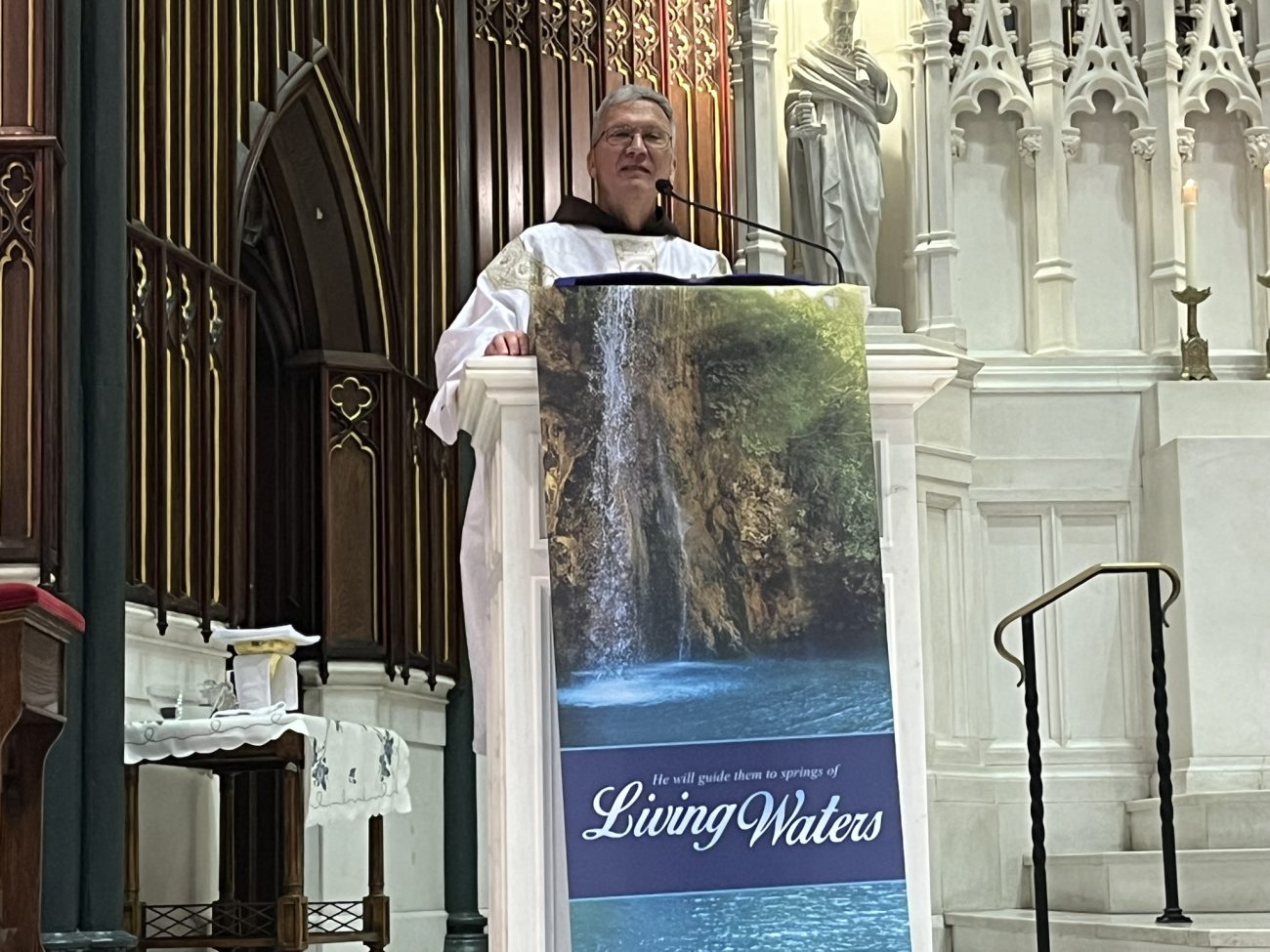
A midday Mass in the bustle of Center City Philadelphia last Wednesday, Sept. 2 invited Catholics to renew their understanding of God’s presence in creation and the call to protect the environment in our common home.
Attendees experienced St. John the Evangelist Church’s “Mass for the Care of Creation,” one that the Church across the world is engaging in over the next few weeks during the Season of Creation.
The season also celebrates of the Year of St. Francis of Assisi, the 800th year since the saint’s passing.
Carolyn Murray, OFS, a secular Franciscan who organized the Mass, said it’s the first time the Mass has been offered in a parish of the Archdiocese of Philadelphia.
“The emphasis, I believe, is to put us in better touch with creation and to do that through our spirituality,” Murray said. “Last Lent, Pope Leo spoke about ecological connection and ecological spirituality. He began to emphasize at that juncture the need to listen to the Spirit and let the Spirit guide us.”
The specially chosen readings and prayers of the Mass, approved for the Roman Missal by Pope Leo XIV last year, reflected and focused on God as the creator of the wonders of Earth, and the need to foster the ecology that the Lord made.
As the first reading from the Book of Wisdom (Wis 13:1-9) proclaimed, God was “the very source of beauty that created” the elements of nature. “If struck by their power and energy, let (people) consider from these how much mightier is He that formed them.”
St. Paul, in a passage from his Letter to the Colossians in the second reading of the Mass (Col 1:15-20), taught that “Christ Jesus is the image of the unseen God, the firstborn of all creation. For in him were created all things in heaven, and everything invisible, thrones, sovereignties, rulers, authorities, all things were created through him, for him.”
Capuchin Franciscan Father Tom Betz, the pastor of St. John the Evangelist, further illuminated the call for greater gratitude for the environment the Lord has created for us.
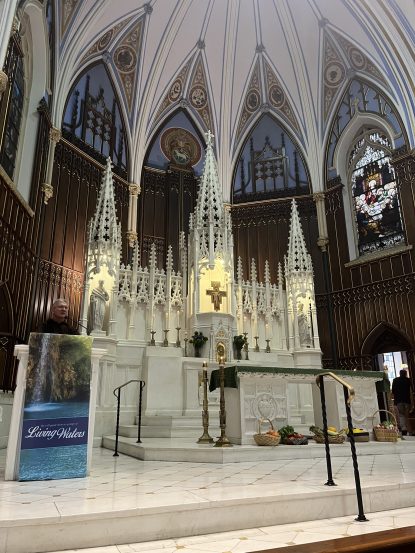
(Photo by Jay Sorgi)
“Today, it’s thanks for creation,” Father Betz said. “You’re part of creation. You’re so alive. So is the food we eat, the air we breathe, the water we drink, the water we bathe in, the sky and the moon and the stars. It’s all worth praising God for all that.”
He gave an example of God’s regenerative power through nature, recalling the site of a former limestone mine alongside a stream near his Long Island hometown. Nature itself helped restore the ecology of the area.
“They never restored the strip mining, but Mother Earth healed herself. It’s no longer ugly. It’s a beautiful valley,” Father Betz said. “Even the place where the stripping had happened, Mother Earth took care of it once they left her alone.”
Pope Leo’s focus on creation and the inspiration of St. Francis to protect it comes to the Catholic Church in multiple ways this season.
The pope declared a five-week Season of Creation, focusing Catholics on praying and committing to fostering greater “care for our common home,” and is calling for the Mass to be celebrated throughout the universal Church. The season concludes with the celebration of the Feast of St. Francis on Oct. 4.
“Let us set aside a few moments to pause from the frenzy of our daily lives, in order to savor the profound harmony of which we ourselves are a part,” said the Holy Father, a Villanova University graduate, “so that we may hear the melodious voice of creation, through which God, the Author of all things, speaks to us.”
“The fact that Pope Leo chose to make this Mass happen worldwide says that this is a priority for him. It was a priority for his predecessor, Pope Francis,” said Murray.
The Season of Creation first began with Pope Francis in 2019, four years after his landmark document “Laudato Si’,” which connects to the mission of St. Francis to honor God’s works with care for creation in the current time.
“St. Francis was the inspiration for our dear Pope Francis, who did the original encyclical,” said Murray, who also works with EcoPhilly, a Philadelphia-based Catholic organization empowering parishes and communities to better foster the environment through the ministry of the Church.
She added that both Popes Francis and Leo XIV join in the call for greater care for God’s creation and the need for stronger solidarity among people to overcome the obstacles to that mission.
“I think Pope Leo’s emphasis moves from care for creation in terms of God’s creatures and puts more emphasis on care for one another, as Francis talked about, in “Fratelli Tutti,” which is the other side of “Laudato Si’.”
The congregation at St. John the Evangelist did exactly what “Laudato Si’” literally means, praising God, and they received encouragement to go out from the Mass with a deeper appreciation and care for what God has created on the only Earth we have.
“We give praise to God for the gift and the beauty of our own, and the beauty of all creation,” Father Betz said.
“We ask God to help us (so) we don’t deplete everything, so there’s nothing left for our children and grandchildren. We treasure what God did for us, what God did for His Son, and what He did for us as children.”
PREVIOUS: Lansdale Catholic Alumni Share Gifts in Jamaica Service Trip
NEXT: New Jersey Catholic Artist Records 1,000-Year-Old Gregorian Chant
Share this story