

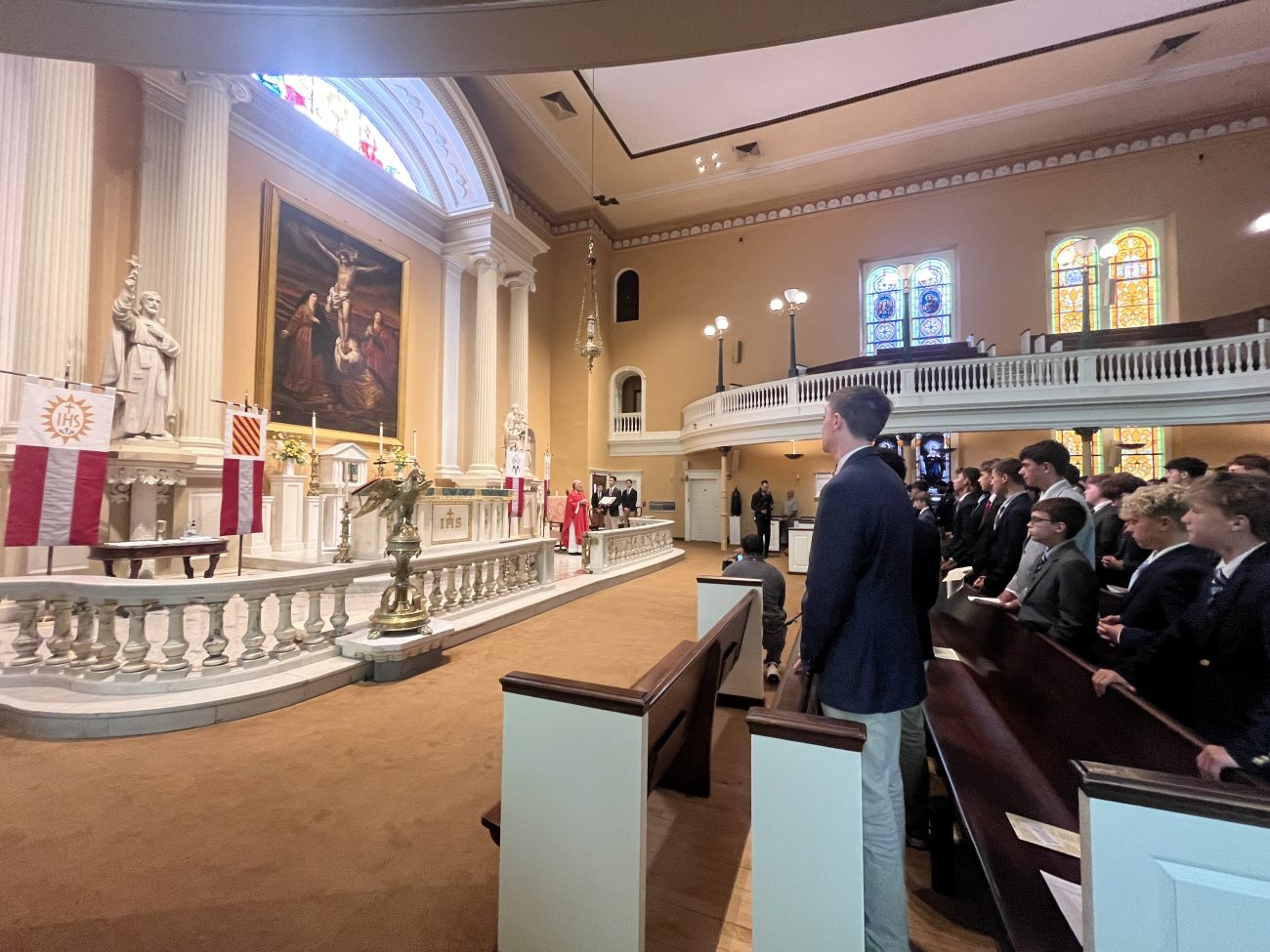
A group of 95 students walked through doors in a hallway next to St. Joseph’s Church on Willings Alley in Philadelphia’s Old City on Sept. 15, 1851. They stepped to the left, walked a few feet down the hallway into the church and began their tenure at St. Joseph’s College and Preparatory School with the Mass of the Holy Spirit that morning.
A new group of 95 current St. Joseph’s Preparatory School students walked through the same doors and hallway to mark the school’s 175th anniversary Tuesday, Sept. 15 with their now-annual Mass of the Holy Spirit.
It was celebrated inside the same church that was constructed in 1839, a century after the original Jesuit church was built on the site in 1733.
“They’ll walk through those doors, they’ll process into the church, and just as (Jesuit) Father (Felix) Barbelin’s students did, we’ll celebrate just as, for almost 500 years, Jesuit schools have been doing,” Jesuit Father Richard McCouch, a religious studies teacher at St. Joe’s Prep, said before the Mass.
“The Jesuits didn’t invent the Holy Spirit, but they did more or less bring about the idea of celebrating a Mass of the Holy Spirit, and we’ve been doing that at all of our schools for almost 500 years.”
Assistant Principal for Academics Daniel Ranalli met the young men upon arrival in the courtyard of the 294-year-old parish grounds, and showed them the importance of the historic footsteps of faith they would be taking while their fellow Prep classmates shared in the same Mass on the school’s campus at 17th and Girard streets in North Philadelphia.
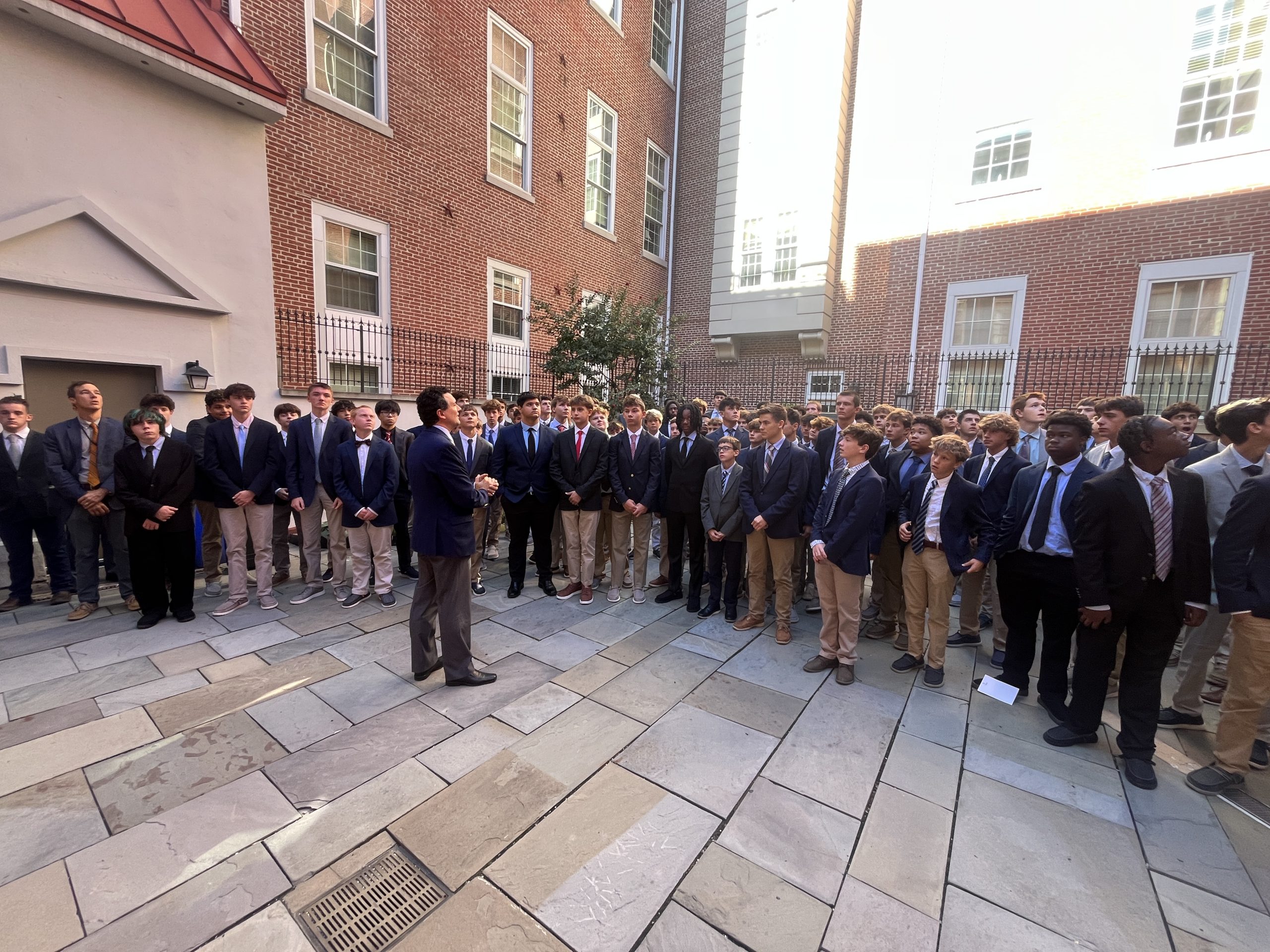
St. Joseph’s Prep students gather in the courtyard of Old St. Joseph’s Church before entering the historic church for the Mass of the Holy Spirit. (Photo by Jay Sorgi)
“At one point in the English-speaking world, this was the only place they could have Mass,” Ranalli said, reflecting colonial history and the struggle for Catholicism to gain a foothold. “They could actually have a sanctioned Mass.”
The 95 students filed into the central pews of Old St. Joseph’s Church and experienced A typical Catholic Mass of today, with the hymns and prayers sung and recited in English.
The sound of the pipe organ and the colonial American two-floor church design, however, transported the students to the 19th century when their brethren began secondary schooling under the auspices of the Jesuits.
The young men listened to Scripture readings often shared during Pentecost. One came from the Acts of the Apostles, in which the Holy Spirit enabled people to speak of the Lord in native tongues that each person could understand. The second reading from St. Paul’s First Letter to the Corinthians taught how in one Spirit both Jew and Greek were baptized into the same body of Christ.
Father McCouch proclaimed the Gospel passage from St. John, in which Christ enters the upper room despite its locked doors where the Apostles hid in fear, and breathed the Holy Spirit upon them to empower their ministry.
In his homily, the priest recalled those readings and pointed out that the apostles “had already heard of the Spirit of God” through Jesus, “but the Spirit scrutinizes everything, even the depths of God.”
Father McCouch taught the young men a lesson about scrutinizing, discerning, and understanding themselves and the world where they live, and showed examples of how Christ and his mother pondered to understand God’s working within them through the Holy Spirit.
“Mary, the Scripture tells us, was overshadowed by the Holy Spirit when she said yes to God. Jesus, after his baptism, was driven by the Spirit to listen, to pray, and to be tempted,” he said.
“If you ask God to scrutinize you, to look deep into your own eyes … how might the Spirit of God overshadow you if you were to say yes?”
Father McCouch shared many historical lessons of how Jesuits said yes to God’s prompting in turning education into a major aspect of the Jesuit mission as far back as 1548, when the first Jesuit school was launched in Messina, Sicily.
303 years later it was Father Barbelin’s turn to innovate Catholic education in Philadelphia, one year before St. John Neumann created the Catholic school system in 1852 as bishop of Philadelphia.
“Father Barberlin … not only founded our high school and our university. He also founded the first school for African American students, the first night school for adults, Sunday schools for those who could not come to the Prep, the first congregation for Italian immigrants, and founded St. Joseph’s Hospital,” Father McCouch said.
He then challenged the 95 students to scrutinize their callings for the academic year.
“Here, at the dawn of this new school year, what can you dream of doing yourself? What would you like to accomplish together?” he said. “How might we serve in ways that are old and new, as Augustine said?”
PREVIOUS: 125 Religious Celebrate their ‘Yes’ to Christ With Jubilees
NEXT: 2 Phila. Catholics Named Officers for Key USCCB Council
Share this story