

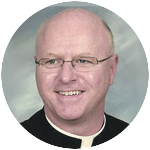
Msgr. Joseph Prior
(See the readings for the 11th Sunday in Ordinary Time)
The house sat at the top of a large hill just outside of Ardara in County Donegal, Ireland. A friend and I were visiting his family. Sitting in front of the house, we looked down the road and could see how it cut through the large hills. All around us were brilliant green grassy hills, and the sky was blue with streaks of grey clouds.
On the hills all about the house were sheep grazing. The ones farthest away looked like little balls of cotton moving across the green field. As we sat there in the early evening, the shepherd started to corral his sheep. Not with a rod and staff as in Psalm 23 but on a four-wheeled vehicle. He would ride out to one sheep and start coaxing it toward the others of his flock, interestingly marked by a bright fluorescent yellow paint spot.
Patiently the shepherd would ride around and slowly but surely the flock came together. Once ready he guided them gently into the safety of the pen for the evening.
The shepherd is extremely important for the sheep and the flock. As long as the sheep are with the flock and its shepherd, it has a relatively good and safe life. Food, water and security are all provided. A sheep that gets separated from the flock and becomes lost is in peril. If it wanders to an area where there is little food or water, it runs the risk of starvation.
Perhaps the more immediate danger, however, comes from the wolves who seek to kill it. Sheep without a shepherd are not in a good way because it is the shepherd who cares for, provides for, leads and protects the flock.
In the life of Israel, God is seen as the shepherd of Israel (cf. Psalm 23). Psalm 100, which serves as the responsorial for this Sunday’s liturgy, witnesses to the great joy that Israel proclaims as God’s flock.
The psalmist writes, “Sing joyfully to the Lord, all you lands; serve the Lord with gladness; come before him with joyful song; know that the Lord is God; he made us, his we are; his people, the flock he tends.” God’s shepherding takes on new intimacy with Jesus, the Good Shepherd (John 10:11ff). In Sunday’s Gospel, when Jesus notices the vast number of people who are gathered to see Him, the image of sheep without a shepherd comes to mind. He is moved with compassion because of this situation and instructs his followers saying: “The harvest is abundant but the laborers are few; so ask the master of the harvest to send out laborers for his harvest.”
In different places and times the needs vary, but the call to prayer remains the same. He then appoints the Twelve, the first apostles who He forms and sends to continue His mission proclaiming God’s reign.
The ministry of the apostles continues to live in the bishops who lead the Church. Priests and deacons share in the ministry of shepherding. Praying for vocations is a wonderful responsibility for all of us. Encouraging young men to consider a vocation is also a good way to help them hear the call.
Jesus never leaves the flock untended. He provides ministers to help shepherd the communion of the Church. In a particular way, all the baptized share in the ministry as we all strive to live like Christ by proclaiming the Kingdom in word and deed; in caring for the sick, the dying, the hungry, the thirsty, the immigrant, the lonely, the isolated, the imprisoned, the ignorant and those who are in need of healing.
This role is alluded to in the first reading when the Lord tells Moses to speak these words to the Israelites, his flock: “Therefore, if you hearken to my voice and keep my covenant, you shall be my special possession, dearer to me than all other people, though all the earth is mine. You shall be to me a kingdom of priests, a holy nation.”
The second reading reminds us of the greatness of God’s shepherding love. St. Paul, reflecting on this love, writes that “God proves his love for us in that while we were still sinners Christ died for us.” Justified by His blood, the flock is now reconciled to God and is saved by His life. He leads us through death to life.
In the Fourth Gospel, Jesus associates the role of shepherd with self-sacrificial love saying: “I am the good shepherd, and I know mine and mine know me, just as the Father knows me and I know the Father; and I will lay down my life for the sheep” (John 10:14-15). The life-giving love of the shepherd continues in the sacrificial love of His appointed shepherds along with His flock.
God leads his Church like a shepherd his flock. In Christ Jesus, we see in concrete terms what that shepherding looks like. In Christ Jesus, we see the shepherd who gives His life in order that the flock might live.
In Christ Jesus, the Church with all her various ministries continues this mission today. So we hear His words and we follow His way: “The harvest is abundant but the laborers are few; so ask the master of the harvest to send out laborers for his harvest.”
***
Msgr. Joseph Prior is pastor of Our Lady of Grace Parish in Penndel and a former professor of Sacred Scripture and rector of St. Charles Borromeo Seminary. Read more reflections by Msgr. Prior here.
PREVIOUS: Grace Transforms Us When We Open Our Hearts to Eucharist
NEXT: Our Honors for Good Fathers Reflect God’s Intimate Love
Share this story