

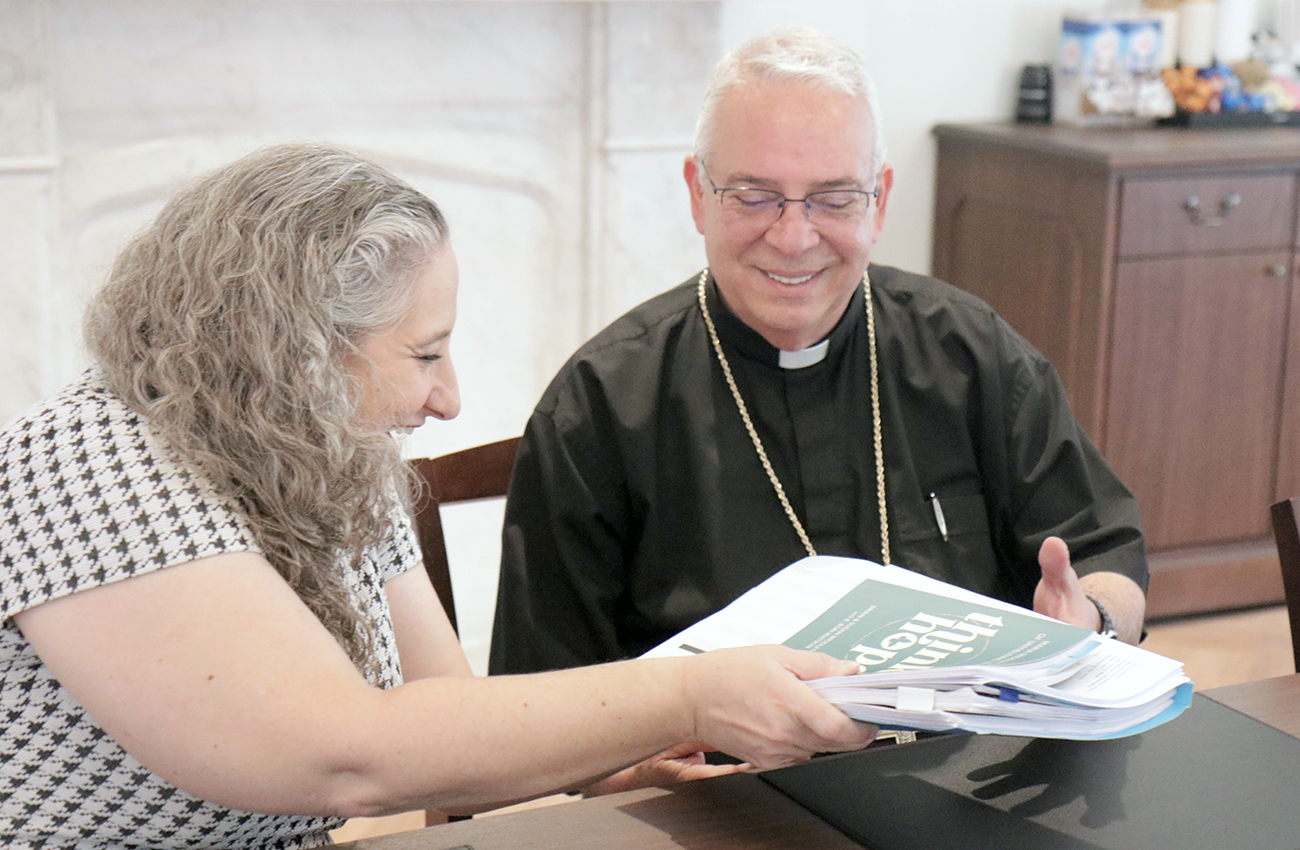
On behalf of the Think Hope Foundation, Jeannine Marino, a canon lawyer with expertise in the Church’s process of naming saints, formally presented to Archbishop Nelson J. Pérez a petition to introduce the cause for canonization of Maria Middleton in the Archdiocese of Philadelphia.
The petition tells the story of the Bucks County teenager who died in 2020 at age 18 and provides documentation in support of her virtuous life and saintly reputation.
The archbishop received the documents during a meeting June 22 attended by Maria’s parents, Brian and Susan Middleton, plus canon lawyers and advisers at the Archdiocesan Pastoral Center in Philadelphia.
(See a related photo gallery of the June 22 meeting here.)
He will consider advancing Maria’s possible beatification and canonization as a saint in the Catholic Church in consultation with the bishops of Pennsylvania and by a vote of the United States Conference of Catholic Bishops. The petition will also be submitted to the Holy See’s Dicastery for the Causes of Saints.
If the consultations support moving forward, the archbishop can then formally accept the petition and publicly open the archdiocesan phase of the cause.
The process of recognizing a person’s holiness of life can typically span many years. Archdiocesan officials will undertake research into Maria’s life and writings and conduct depositions with relatives, friends, and associates.
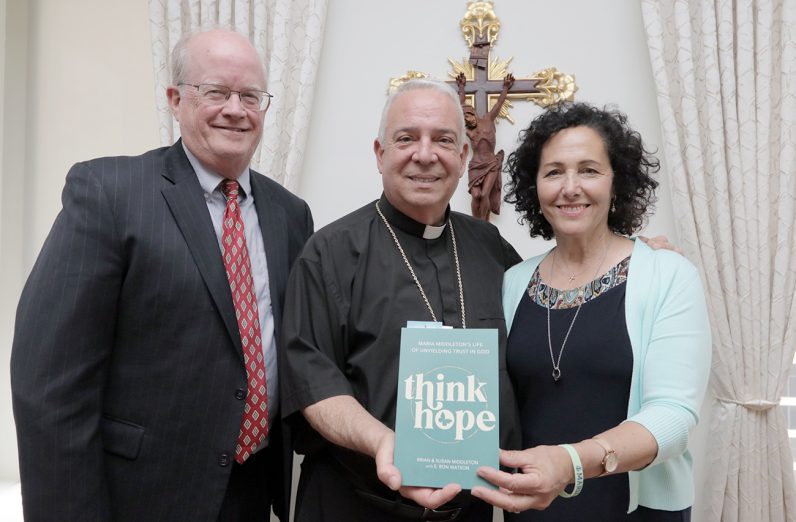
Archbishop Pérez and Brian and Susan Middleton hold a copy of “Think Hope,” which traces the journey of Maria’s “life of unyielding trust in God.” (Photo by Sarah Webb)
The documents presented Monday to Archbishop Pérez included the book titled “Think Hope” (Ascension, 2025, 174 pp., $19.99), which traces the journey of Maria’s “life of unyielding trust in God.”
Born Sept. 10, 2002 and baptized two months later at St. Agnes Parish in Sellersville, Maria Middleton grew into childhood and attended the Regina Academy at St. John the Baptist in Ottsville then Villa Joseph Marie High School in Holland.
She excelled as a student and an athlete, possessed a witty personality, and prayed with deep piety. Her own loving relationship with God and her deep sense of responsibility to serve others were capped by an overarching trust in God’s will.
She recorded her spiritual insights in personal journal entries beginning at age 11 with the words “God is merciful.” Her final written words, just months before her death on Oct. 8, 2020 from complications of an inoperable brain tumor, were “Think hope.”
“She had so many gifts,” said Maria’s mother, Susan. “She realized these gifts were given to her by God. She developed them with commitment, but she knew where they came from, and they came from God.”
Even in Maria’s earliest writings as a child, she described her intention to use her gifts to serve God. “One of the messages Maria leaves, especially with the youth trying to figure out ‘What do I do with my life?’ she gives us a beautiful message: Take the gifts you were given and use them to serve (God),” Susan said.
Maria received the diagnosis on Jan. 30, 2019 that she had an incurable illness that would lead to much suffering. In the face of the bleak prognosis that she might only live another nine months, Maria wrote that it “was the best year of her life” because she understood that “joy and pain coexist,” Susan said.
For the next twenty months, “Maria focused on the joy amidst her pain. She didn’t dwell on the suffering but on the present moment where God lives and God’s grace is there to help. That’s how she navigated it.”
Maria’s father, Brian, describes his family’s experience and the subsequent interest in his daughter’s possible sainthood as “surreal.” From the moment of Maria’s diagnosis, he said, “we began to experience things that were not explainable. We began to realize, as Maria said, this (illness) wasn’t a punishment, it was the purpose of her life. We’re comforted by the fact that Maria is in heaven. If the Church thinks that Maria can be a role model to spread God even further, we want to help in any way we can.”
People from all over the world have contacted the Middleton family with stories of deepening their own faith and commitment as a result of Maria’s example. “People are asking for her intercession, people who are impacted by her life, how she is very present and active in their life,” Susan said.
When people discover Maria’s writings, especially through the book “Think Hope,” she becomes for them “a model of hope,” Susan said. “I struggle because I want her here, but God had a different plan for her, and I can see now that is the greater plan. She doesn’t belong to me or Brian, she belongs to (God) and to the world.”
Reflecting on his daughter’s reputation for holiness, Brian believes her ability to live with cancer heroically until the natural end of her life can be synthesized into four messages.
Maria was assured of her identity as a child of almighty God. “That could never be stripped from her, and she knew it,” her father said.
Maria understood that with our freedom we can control our attitude about things beyond our control. “She chose gratitude over anger, she chose meaning over victimhood, and she chose hope over despair.”
Maria appreciated her calling in this world. “Her purpose was, is and always will be to know, love and serve God by serving others in this world and, ultimately to be eternally happy with Him in heaven in the next. Her purpose never changed even with a terminal diagnosis.”
Lastly, Maria cherished ultimate things. “She valued truth, beauty and goodness.”
Those four pillars of spirituality, Brian said, helped Maria navigate through the months of suffering she endured “with hope, with joy, with trust and with peace.”
For the Catholic Church of Philadelphia, and beyond, recognition of Maria’s virtuous life may one day serve as a model of holiness for all, especially young people searching for meaning and purpose in life.
PREVIOUS: Formed by Home and Parish, New Priests Now Sharing Faith With All
NEXT: Pope Leo to Offer Video Message at the Close of National Eucharistic Pilgrimage in Philadelphia
Share this story