

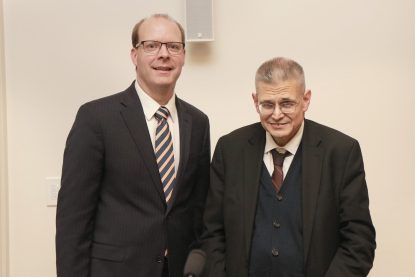
Dr. Nathan Knutson (left), Francesco Chair of Sacred Music at St. Charles Borromeo Seminary, and James Monti pose for a photo. (Photo: Sarah Webb)
The hour, or hours, that we spend worshipping God at Mass are among the most important of the 168 hours in every week.
James Monti, a New York-based Catholic author and historian, shared centuries-old wisdom on how nearly every sound, object, and action of the Mass, eucharistic adoration and other Catholic devotions represent sacred moments of worship.
He gave his talk “Treasuring the Sacred: The Preservation of the Church’s Patrimony of Sacred Liturgy, Music, and Holiness,” this spring at St. Charles Borromeo Seminary in Ambler. It was presented by the seminary’s Lucille M. Francesco Chair of Sacred Music.
Monti’s focus came straight from the commandment of Jesus in the Gospel of Matthew (Mt. 22:37-38): “You shall love the Lord, your God, with all your heart, with all your soul, and with all your mind. This is the greatest and the first commandment.”
He argues that the elements of the liturgy should reflect one’s absolute best efforts, both in worship itself and in calling the assembled to worship.
Monti first talked about Catholics entering a church for Mass each Sunday.
“St. Thomas Aquinas considers the interior disposition of the person receiving the sacrament as crucial to just how efficacious the person’s reception of the sacrament will be,” he said. “A person who is well disposed will be far more open to deeply receive God’s grace than one who is not.”
Concerning how worship is conducted, Monti asked “whether the manner of celebrating the sacred liturgy and the physical setting within which it is celebrated should be conducive to devotion.”
“It must evoke a certain gravitas, a dignity that aspires to reflect and respond to the magnitude of the divine act occurring in our midst,” St. Thomas Aquinas said, as quoted by Monti.
He then showcased how order and formality express that gravitas.
“Why is there so much formality in the sacred liturgy? Why so much ceremonial detail? Because it is a matter of love. Reverence is a response of love to love,” he said.
That reverence includes nonverbal actions as well as the spoken and sung words of worship.
“Gestures and actions of reverence form a sacral language all its own, a sort of silent universal language with which we speak to God, a wordless profession of faith in our unseen God,” he said.
“When we kneel to pray before the Blessed Sacrament or kneel to pray anywhere else, we predispose ourselves to receptivity, to receiving from God in prayer, his graces, his words to us, his inspirations, his teachings.”
Monti then touched on the importance of liturgical beauty, in its sonic and visual forms.
“It is about spiritually, mentally, visually, audibly enthroning God again in the manner of our worship and how we speak of God, think of Him, how we depict Him in sacred art, how we sing of Him, and where we place His sacramental presence in our churches,” he said.
“As Dietrich von Hildebrand so succinctly affirmed, the aim of the sacred liturgy is to ‘render the adequate answer to God’s majesty and holiness.’”
As far back as the sixth and seventh centuries, Monti said, churches used gold and precious jewels in the chalices that held the Precious Blood of Christ.
“Those chalices, born from precious metal to hold the most precious treasure on the face of the earth, stand as vivid proof of the Church’s continual belief in the real presence of our Lord in the Blessed Sacrament,” he said.
“God has provided in His creation precious stones and metals, fragrant substances (and the) ability to produce beautiful music, so that first and foremost we should employ these things in divine worship.”
Sacred music offers the most intimate sensory relationship with liturgy, Monti added.
“In the chanting of the parts of the Mass and the Divine Office, music forms the very fabric of the chanted words of the liturgy,” he said.
He cited what he called the “amazing renaissance in the realm of sacred music over the past 20 years,” both in using Renaissance-era sacred polyphony and in “contemporary repertoires that are in reverent harmony with the sacrality befitting divine worship.”
“Alice von Hildebrand stressed to me that sacred music must by its very mission and purpose summon the heart to reverence. Such music in turn inspires a response of reverence in the listener, the worshiper,” Monti said.
“The beauty of the work of sacred music directs our gaze toward love and contemplation of the beautiful face of Christ, as Pope Benedict XVI pointed out, unveiled in the sacred liturgy.”
While the Church encourages full and active participation in the sacred liturgy, Monti believes the Church has the freedom to invite the talents of sacred musicians – regardless of instrumentation or the style of song — to fill the space of the church. The faithful then may be invited to listen fully to the music as a form of participation.
“In the shared prayers of the sacred liturgy, it is by no means wrong to rely upon the special skills of those more artistically gifted than ourselves to impart the splendor of beauty to our supplications,” Monti said, even comparing a church singer or musician to a prayerful intercessor such as the Blessed Virgin Mary.
“Is there not also a certain likeness here to how Our Lady brings our petitions to God on our behalf? Our petitions to God are no less our own when we entrust them to the lips of the Blessed Virgin Mary. So too, our active participation in the liturgy is no less diminished.”
Monti cited the late Pope Benedict XVI in relating a philosophy of sacred worship spanning more than a thousand years, desiring to make it truly timeless.
“The Church must not settle down with what is merely comfortable and serviceable at the parish level,” Pope Benedict XVI said. “She must arouse the voice of the cosmos by glorifying its Creator, elicit the glory of the cosmos itself, making it also glorious, beautiful, habitable, and beloved.”
PREVIOUS: Summer Choir Camp at Cathedral Helps Kids Grow in Faith, Confidence in Fun Way
NEXT: Cathedral Basilica to ‘Let Freedom Sing’ in June 28 Concert, July 5 Mass
Share this story