

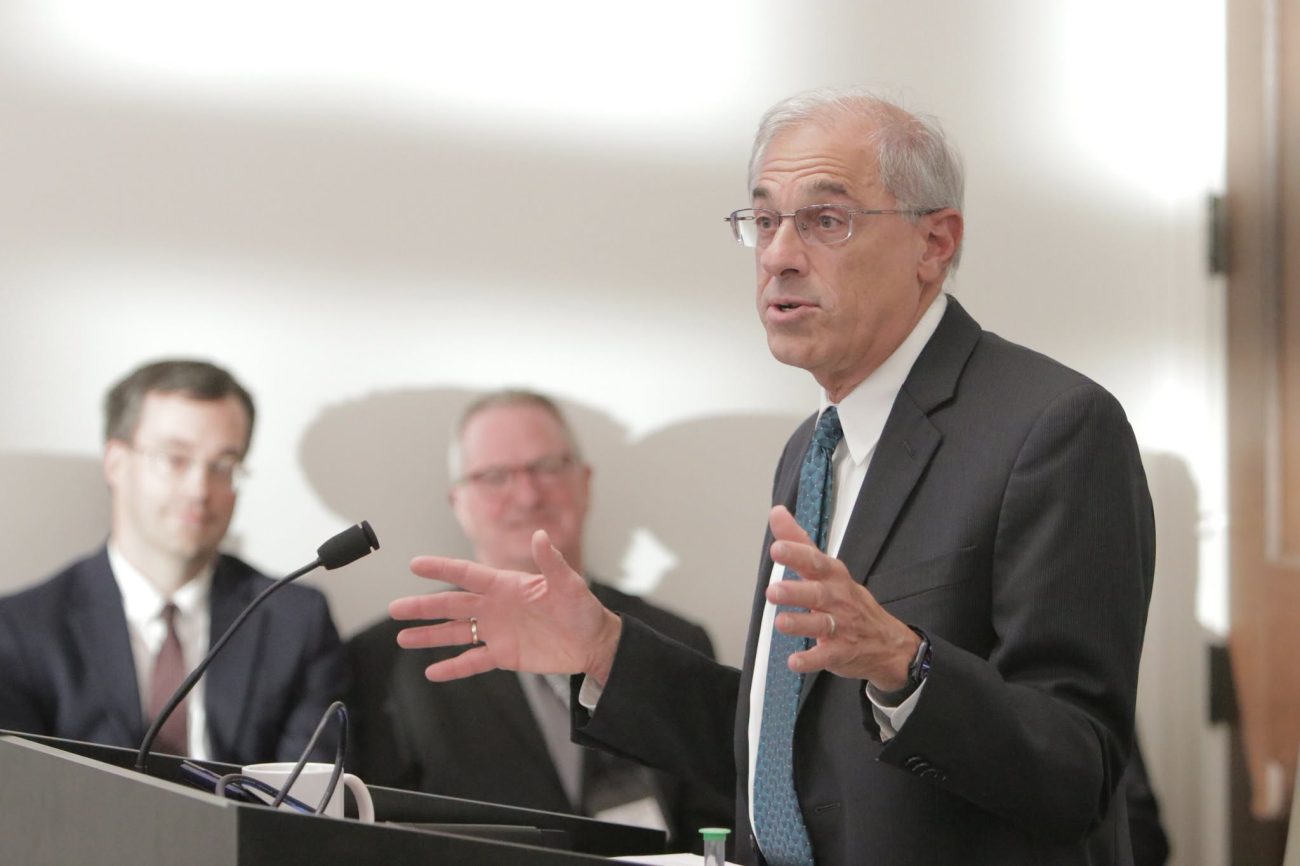
The Villanova University-educated Pope Leo XIV has chosen one of his alma mater’s own leading historians, who is also a professor at St. Charles Borromeo Seminary, to join a Vatican commission on history.
Dr. Francesco Cesareo has been appointed to the Pontifical Committee for Historical Sciences, a key advisory group to the pope and Roman Curia. Dr. Cesareo is currently an adjunct professor at the seminary and in Villanova’s history department.
“It’s very much a research-oriented commission that helps to advise the Holy Father and the Curia when it comes to questions of historical importance,” Cesareo said.
The president emeritus of Assumption University in Worcester, Massachusetts is the only American among members of the Vatican committee.
The Aug. 13 appointment came as “a complete surprise, total surprise. I had no clue,” Cesareo said. “I got a notification from the Vatican that the Holy Father was making this appointment and that I was to tell no one until it became public. At first I thought it was a joke, but then I realized that no, this is not a joke. This is true.”
His new position was announced at the Cardinals’ Forum Aug. 25 at St. Charles Borromeo Seminary.
Pope Pius XII established the committee in 1954, yet the committee follows in the footsteps of Pope Leo XIII who established the Commission of Cardinals for Historical Studies in 1883. That came after the opening of the Vatican secret archives in 1880.
The call for greater historical understanding through the eyes of faith came through what the committee calls the “perspective radically renewed by the progress made in the historical sciences” in the mid-20th century following World War II.
The committee also focuses on continual understanding of historical fact and perspective by the Catholic Church through continual reexamination of the Vatican’s archives, helping seminaries share that information with its students, and facilitating greater ecumenical conversation over Church and world history.
Part of Cesareo’s focus, one of particular importance in the age of artificial intelligence and its ability to alter people’s understanding of history, is to ensure access to objective historical fact in a way that doesn’t distort through the lens of ideology.
“The work of the commission is to preserve and to nurture historical truth and then to pass it on to the next generation,” he said.
“The Church has a rich treasury of historical data and evidence that goes back centuries. To be able to ensure that that patrimony is available to scholars and to future generations is critical to continuing to delve into historical truth and the importance of historical truth.”
Cesareo’s background in higher education began with his bachelor’s degree from the now-closed Cathedral College of the Immaculate Conception in New York, followed by master’s and doctoral degrees at nearby Fordham University.
His later academic resume spans Catholic institutions of higher learning in multiple continents and at least six U.S. states, ranging from his time as a Fulbright Scholar at the Pontifical Gregorian University in Rome to his tenure leading Assumption University, including the establishment of their campus in the same city.
“I’m hopeful that I will bring my years of experience as a historian, as a scholar who has worked at the Vatican Library and has worked in Vatican archives for my own research. I’m hoping that that will assist the Church in the carrying out of her intellectual life because the Church has such a rich intellectual heritage and tradition,” he said.
In between, he served as a chair or dean at John Carroll University in Cleveland and Duquesne University in Pittsburgh, while also teaching at Albertus Magnus College in New Haven, Connecticut, St. John’s University in New York City, and his current roles at St. Charles Borromeo Seminary and Villanova University.
His resume of launching new academic programs spans from Catholic studies and history to health sciences and sports management.
Cesareo’s expertise in Catholic history ranges from study of the Catholic Reformation in the 16th century to the modern day, reflective of his current tenure as board president of the Sister Thea Bowman Black Catholic Educational Foundation.
“I’m hoping that my experience as a scholar, my experiences as a teacher, and my experience as an administrator at Catholic institutions will help to advance the work of the (pontifical) commission in ways that will be beneficial to the Church and to the teachings of the Church, which is an important part of the life of this commission,” he said.
PREVIOUS: ‘American Idol’ Finalist to Headline 12th Annual AbbeyFest
NEXT: St. Charles Seminary Releases Annual Report
Share this story