

Throughout the years, Catholics have sought to have a place in the commemorations of America’s founding. In Philadelphia, Catholics left their mark on the Centennial, Sesquicentennial, and Bicentennial celebrations.
The International Exhibition of Arts, Manufactures, and Products of the Soil and Mine was held from May to November 1876 in Fairmount Park to mark the 100th anniversary of the United States. Called the Centennial Exposition for short, it was a world’s fair featuring national and international displays.
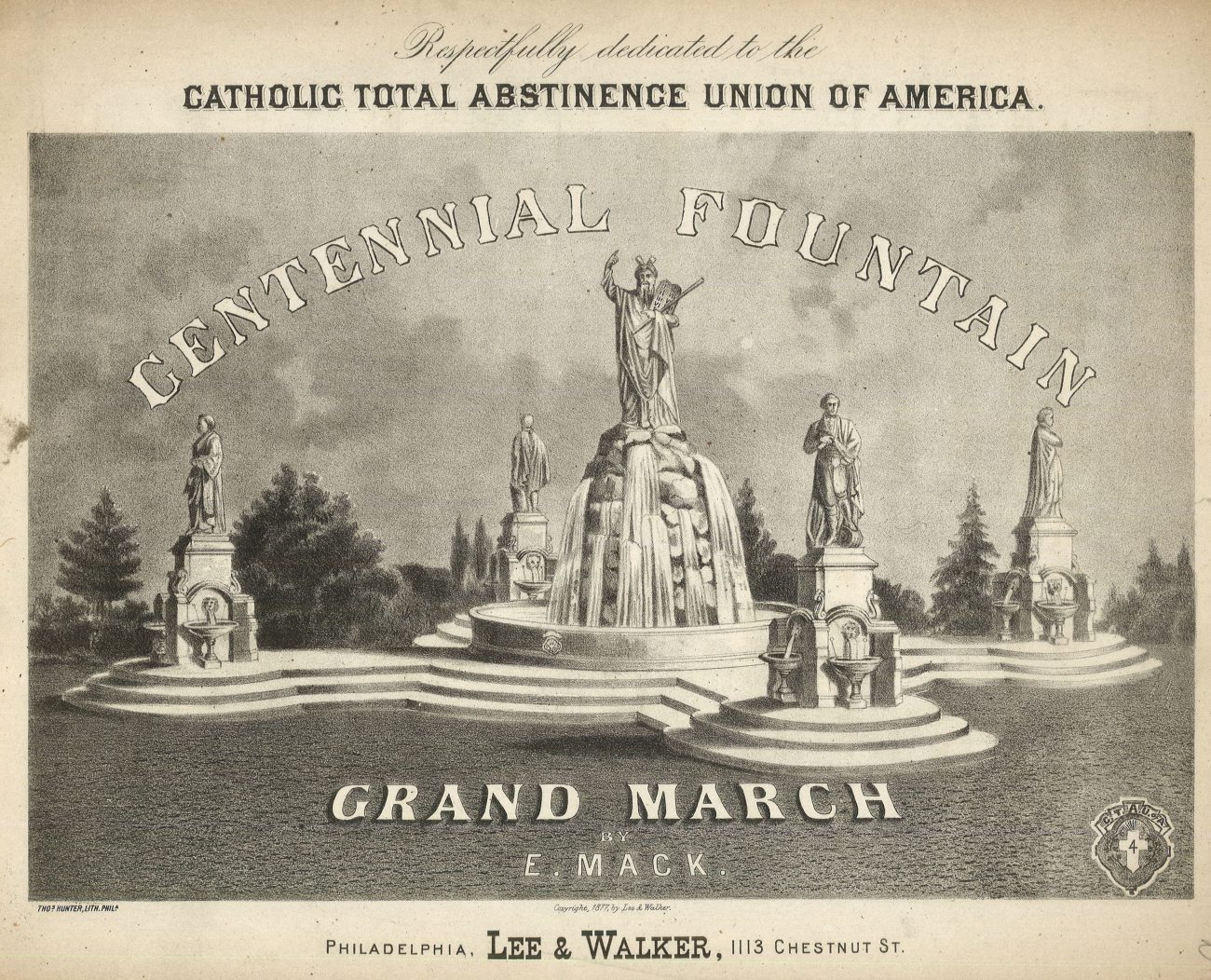
The centerpiece of Catholic involvement was the building of the Centennial Fountain located at the intersection of Avenue of the Republic and States Drive. It was constructed by the Catholic Total Abstinence Union to provide clean drinking water for the cause of temperance as well as to highlight the patriotic feelings of Catholics.
The fountain’s central theme of Moses striking the rock to give water to the Israelites was chosen to serve as an allegory for life-giving water turning people away from alcohol. The design also featured four corner statues, only one of which referenced temperance: that of Father Theobald Matthew, founder of the total abstinence movement. The remaining three statues featured Catholics involved in the Revolution: Commodore John Barry, Archbishop John Carroll, and Charles Carroll.
The official dedication occurred on July 4, 1876. While only the statue of Barry was installed, the rest of the fountain was completed. Governor John Carroll of Maryland, great-grandson of Charles Carroll, had the honor of turning the water on, which flowed into sixteen drinking basins. It would not be until March of 1877 that the other three corner statues were finished, while the statue of Moses would not be installed until July 4, 1877.
Nevertheless, the fountain was considered a huge success with one newspaper stating that it was an “expression of the sterling patriotism which has ever characterized the Catholic Church in America.”
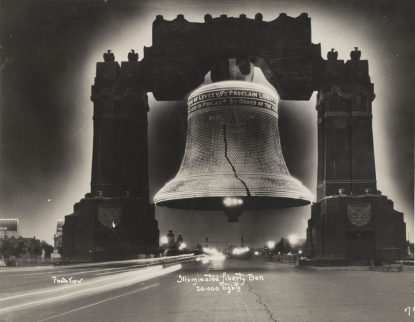
An illuminated Sesquicentennial Liberty Bell at night, 1926. (John D.Cardinell/Free Library of Philadelphia)
To mark the 150th anniversary of the signing of the Declaration of Independence, the city hosted the Sesquicentennial International Exposition, a massive world’s fair intended to celebrate American progress, industry, and culture. Like the Centennial before it, the Sesquicentennial Exposition ran from May to November. However, it was not as successful because of poor planning and weather.
The fairgrounds were built in South Philadelphia with the entrance at what is now Marconi Plaza. Upon entering, visitors were greeted by a replica of the Liberty Bell that stood 80 feet tall and illuminated by 26,000 light bulbs. The exposition featured large display halls, amusement rides, and pavilions sponsored by foreign countries and national industries.
The marquee Catholic event of the Sesquicentennial also was one of the largest events for the entire 150th celebration. The Archdiocese of Philadelphia organized a Solemn Pontifical Mass at the newly constructed Sesquicentennial Stadium (later renamed JFK Stadium). Preceding the Mass was a large parade down Broad Street, whose marchers included various parish organizations including Holy Name Societies and the Knights of Columbus.
Arriving at the stadium, attendees saw an altar modeled on that of St. Peter’s Basilica in Rome. Cardinal Dennis Dougherty presided over the Mass with Msgr. Joseph Whitaker of Our Lady of Mercy Parish giving the homily.
About 300,000 Catholics attended the Mass, making it of the largest religious events in the city’s history. It was even necessary to set up additional altars outside the stadium to accommodate the large crowds.
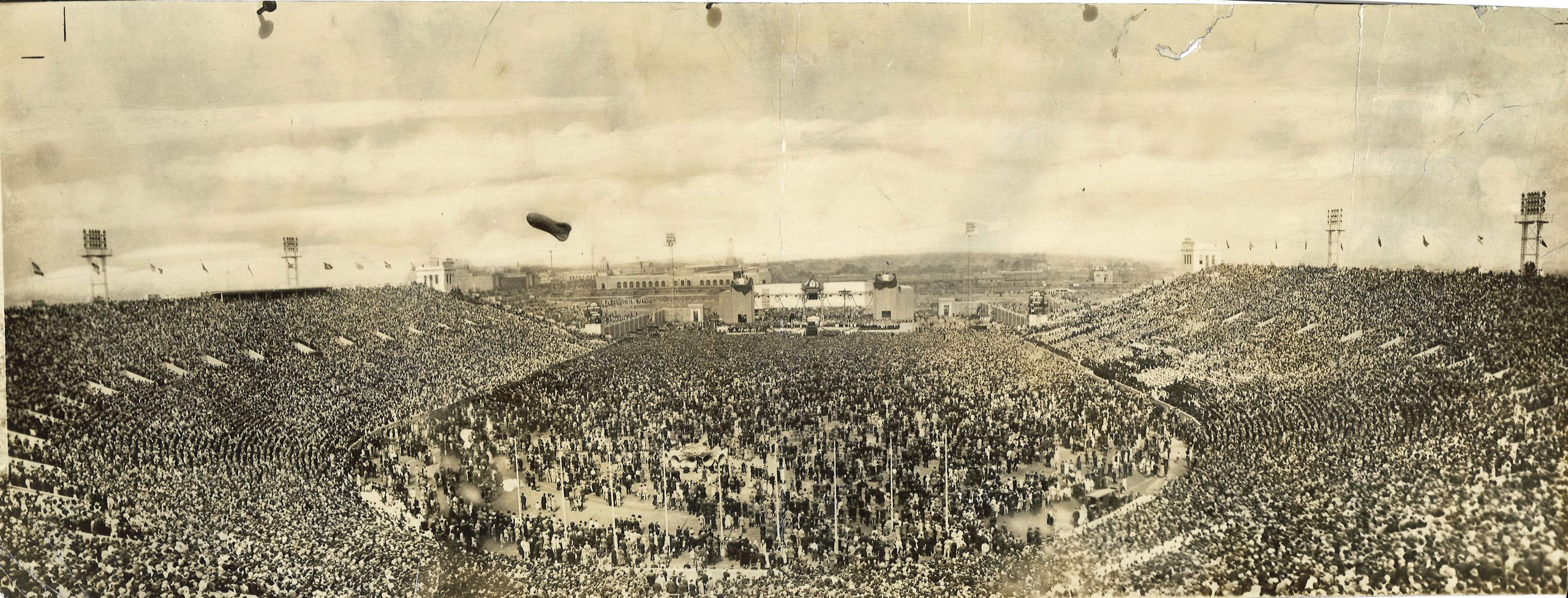
Attendees at the Sesquicentennial Stadium, Philadelphia, for the Solemn Pontifical Mass, 1926. (Photo courtesy of the Catholic Historical Research Center of the Archdiocese of Philadelphia.)
Unlike the Centennial and the Sesquicentennial celebrations, the Bicentennial did not feature a world’s fair. There were plans for one in the early stages, but it’s more than $1 billion price tag led to its cancellation. Without the world’s fair as the feature, smaller events were planned throughout the year.
Many parish schools organized bicentennial pageants in which the students dressed in colonial costumes, performed historical plays, and held concerts. Many churches also featured displays and colonial crafts for the children and the parishioners. Old St. Mary’s hosted a series of lectures from February to April on different themes, such as one on Archbishop John Carroll by Father James Hennesey, S.J., and another on the Declaration of Independence and the right to life by Dr. Mildred Jefferson.
July 4th saw a wide range of activities throughout the city, beginning with an interfaith service at 8 a.m. on Independence Mall. The service brought together Catholics, Orthodox Christians, Protestants, and Jews, and featured an address by Rev. Jesse Jackson and a closing benediction by Cardinal John Krol.
After the service, at the foot of Independence Hall, Cardinal Krol gave the opening blessing before President Gerald Ford addressed the crowds.
Old St. Mary’s was chosen to host the official Bicentennial Mass because of its historical significance in the Revolution, as Washington, Adams, and other Founding Fathers attended services there on a number of occasions. Cardinal Krol’s homily spoke of the role religion played in unifying America but also highlighted where the country had fallen short of its religious aims, such as abortion and the arms race.
Catholics have been influential in past celebrations of America’s birthday and will continue to do so for the 250th and beyond.
***
This article was written in partnership with the American Catholic Historical Society and the Catholic Historical Research Center of the Archdiocese of Philadelphia.
PREVIOUS: George Meade’s Catholic Faith Made Him a Merchant of the Revolution
NEXT: Not All Were Patriots: Remembering American Catholics Loyal to the British Crown
Share this story