

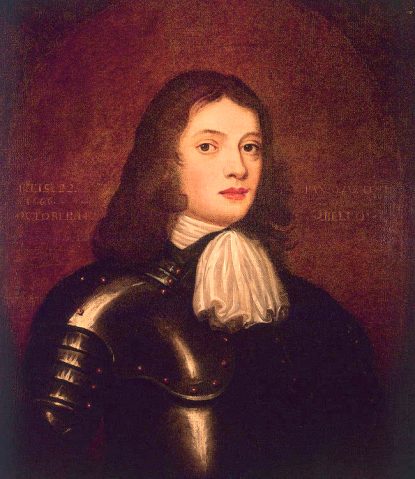
Oil on canvas portrait of William Penn at age 22 in 1666, portrayed in suit of armor. (Public Domain)
One of the astonishing things about colonial Philadelphia was its religious diversity. Visitors to the city in the mid-1700s marveled at the array of churches, meetinghouses, and assemblies that dotted the city’s landscape.
That vitality was the result of William Penn’s “Holy Experiment,” his vision for a colony rooted in Quaker principles of religious toleration and peaceable relations. His plan gave birth to a religious pluralism that was unmatched anywhere else in British North America and made Philadelphia the cradle of religious liberty in the United States.
Penn’s willingness to accept members of all faiths would have revolutionary consequences, especially for Catholics. Even though they were just a small minority in colonial America, they had built up a noticeable presence in Philadelphia. That visibility not only helped them secure respect and recognition, but it also transformed how Catholics were viewed by their fellow Americans.
The religious liberty that Catholics enjoyed in Pennsylvania was a rare privilege in the colonies. Elsewhere in British North America, from Puritan New England to the Southern colonies, anti-Catholic sentiment was deeply entrenched. In Massachusetts, the law banned Catholic priests from residing in the colony, while Virginia and other colonies denied Catholics the right to vote.
Even in Maryland, the colony founded as a haven for Catholics, religious liberty proved elusive. During the late 1600s, the colony’s Protestant majority gained power and imposed harsh restrictions on the Catholic minority. They affirmed Anglicanism as the established church and instituted penal laws that banned Catholics from voting or holding public office.
As a result, Catholicism in Maryland was limited to the private sphere. Catholic practices were tolerated only if kept from public view. Masses could only be celebrated on Jesuit estates or in private chapels in the homes of the Catholic gentry. Devotional practices and religious education became domestic affairs, reserved to the home.
But Pennsylvania offered a different vision. William Penn’s Charter of Privileges extended religious liberty to individuals of all denominations and sects. All persons willing “to live quietly under Civill Governement” were promised that they would not be “molested or prejudiced” for their beliefs. The charter also stated that all Christians were eligible to hold public office.
Catholics were among the beneficiaries of those privileges. In 1729, Father Joseph Greaton, a Jesuit from Maryland, took up residence in Philadelphia. He soon set to work on the construction of a chapel, laying the foundation of what is today’s Old St. Joseph’s Church.
Completed in 1733, the simple, shed-like structure was the first place in the British colonies where Catholics could worship openly. As the Jesuits would later report with astonishment, “We have at present all liberty imaginable in the exercise of our business, and are not only esteemed, but reverenced … by the better sort of people.”
Not all welcomed the presence of the new “Romish chappell” on the city’s religious landscape, of course. Some residents raised concern with the Pennsylvania provincial council, arguing that public celebrations of the Mass were “contrary to the Laws of England.” But the council determined that the church was protected by the colony’s charter, which took precedence over English laws that banned Catholic worship.
That favorable ruling preserved a Catholic presence in the city and made Philadelphia the first urban Catholic center in the colonies. It served as home base for circuit-riding missionary priests who crisscrossed the region ministering to a scattered Catholic population. The mission stations they served helped extend Catholic influence throughout the Delaware Valley and westward into central Pennsylvania.
Catholic presence in Philadelphia was further strengthened in 1763 with the construction of St. Mary’s Church. Located on South 4th Street just a short distance from Old St. Joseph’s, the new and spacious sanctuary demonstrated the growing size and influence of the city’s Catholic flock.
It also showed that Catholicism was not something threatening or foreign, but part of the fabric of colonial society whose members contributed to social, economic, and political life.
By the eve of the Revolution, those in Philadelphia and the surrounding region had grown accustomed to the Catholic presence in their midst. But for others who came to the city to discuss the political future of the colonies, the encounter with Catholicism would prove transformative.
That was very much true for John Adams, who, as a delegate to the first Continental Congress in 1774, attended Mass at Old St. Mary’s in the company of George Washington and Charles Carroll, a member of a prominent Maryland Catholic family and one of the richest men in the colonies.
Reflecting on his experience in his diary, Adams described Carroll as a “very sensible Gentleman” and spoke of those gathered at St. Mary’s as a “respectable Congregation.” His words suggest both surprise and a sincere change of heart. Having been raised to view Catholicism as a religious and political threat, he now came to see Catholics as honorable citizens and fellow patriots.
Visitors to Philadelphia during the upcoming semiquincentennial should take a moment to wander by the city’s historic Catholic sites and appreciate how Quaker religious toleration helped pave the way for Catholic acceptance within the new nation. These are the places that helped Catholics secure their place in America.
***
This article was written in partnership with the American Catholic Historical Society and the Catholic Historical Research Center of the Archdiocese of Philadelphia.
Thomas F. Rzeznik is professor of history at Seton Hall University and co-editor of the quarterly journal, American Catholic Studies. His most recent book is “A Monument of Charity: St. Vincent’s Hospital and Catholic Health Care in New York City” (NYU Press, 2026).
Share this story