

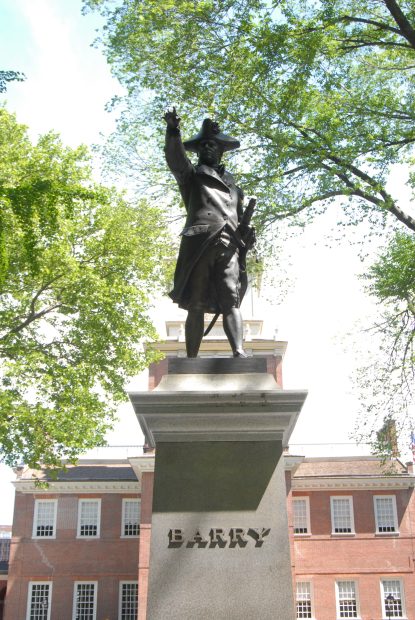
Statue of Commodore John Barry on Independence Square, south of Independence Hall in Philadelphia. (Photo: National Park Service)
Two locations in Center City Philadelphia spotlight a devout Catholic who stands tall as the father of the United States Navy.
Commodore John Barry’s bronze statue, sculpted by Samuel Murray, rises from a granite platform just south of Independence Hall, between Chestnut and Walnut, Fifth and Sixth Streets in Old City. It directs people to memorialize the six-foot, four-inch Barry for his role in the American Revolution and in U.S. military history.
Yet those who come to worship inside the Cathedral Basilica of SS. Peter and Paul, or even just to explore the historic church, will find his name on a mosaic wall with other noteworthy Catholics of Philadelphia above the resting place of St. Katharine Drexel in the basilica’s northwest corner.
The commodore’s witness to God’s impact on his life parallels his own impact on United States history.
Barry was born on March 25, 1745 in Ballysampson, a small town in the parish of Tacumshane, close to the Republic of Ireland’s southeastern coast in County Wexford. A U.S. Navy recounting of his life said his father worked on the sea and taught him many seafaring skills.
Numerous biographies say that the British monarchy’s penal laws which were placed upon Ireland at the time stripped his Catholic family of many rights including land ownership. When landlords evicted them, the family emigrated to the colony of Pennsylvania, and to Philadelphia, in 1760. He came due to the religious freedom the colony offered.
“”Because I am a Catholic, all I have known are poverty and oppression,” read a cartoon at the Catholic University of America depicting Barry. “I hope things are better here.”
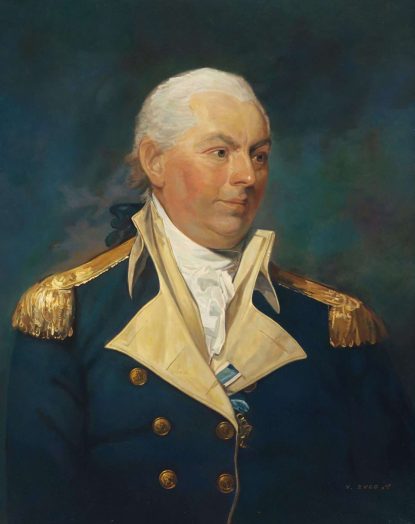
A portrait of Commodore John Barry. (Public Domain)
Barry took command of his own ship, the Barbados, at the age of 21. He was often found starting his day at sea reading the Bible. Two years later in 1768, he married Mary Cleary at Old St. Joseph’s Church, the Jesuit-founded house of worship and the oldest Catholic church in Philadelphia. She passed away in 1774.
Around that time, Barry built a working relationship with Robert Morris, a businessman who eventually helped finance the American Revolution. Barry worked for Morris, captaining the Black Prince when he returned to shore in October 1775 after the Revolutionary War began.
Barry took command of the Lexington, which according to one historical record, was the first American ship to win a battle with the British during the war.
“Barry was as valiant on land as on sea, and on the gloomy Christmas eve of 1776 rendered valiant service in transporting the Continental Army across the ice-blocked Delaware, and served with honor and distinction in the victories of Trenton and Princeton,” the record said.
As the war continued in 1777, Barry married Sarah Austin. Numerous reports say both Austin and Cleary converted to Catholicism. Austin and Barry raised his nephews Michael and Patrick Hayes after they were orphaned.
Barry also commanded the last American naval victory before the British surrender in 1783. After the war, he used personal influence to help Pennsylvania ratify the U.S. Constitution in 1787.
Commissioned by President George Washington upon the ratification, Commodore Barry led U.S. ships in an undeclared Quasi-War against France in the final years of the 18th century. He continued serving the Navy until his death on Sept. 13, 1803.
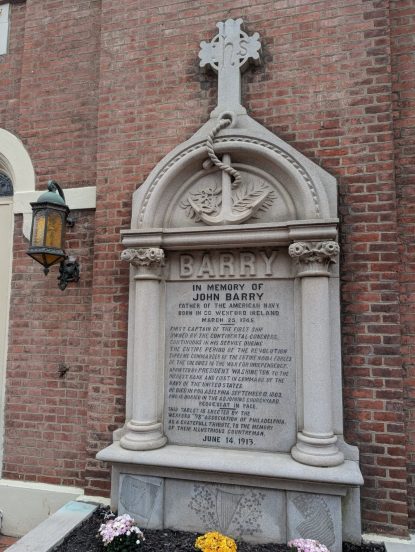
A historical marker and burial site of the “Father of the American Navy” John Barry is located in the cemetery of Old St. Mary’s Church in Philadelphia. (Photo: Catholic Historical Research Center of the Archdiocese of Philadelphia)
Barry is buried at Old Saint Mary’s Churchyard at the corner of Fourth and Spruce Streets. Each of Barry’s spouses rest next to him.
His grave is the site of an annual autumn memorial Mass in the church, followed by a ceremony in the churchyard led by groups honoring their Irish heritage, such as the Friendly Sons of St. Patrick and Ancient Order of Hibernians, among Commodore Barry clubs.
An award named for Barry is given annually to an outstanding civic leader, including Archbishop Nelson Pérez, by the American Catholic Historical Society.
The Commodore Barry Bridge linking Delaware County and New Jersey memorializes him, as does the statue at Independence Hall which was unveiled in 1907.
Perhaps his epitaph written by Dr. Benjamin Rush, a signer of the Declaration of Independence, most states Commodore Barry’s legacy as it was understood at the end of his life:
“His habits of war did not lessen his virtues as a man nor his piety as a Christian,” it says.
“He was gentle, kind, and just in private life, and was not less beloved by his family and friends than by his grateful country. The number and objects of his charities will be known only at that time when his dust shall be reanimated, and when He who sees in secret shall reward openly. In the full belief of the doctrines of the Gospel he peacefully resigned his soul into the arms of his Redeemer.”
Share this story