

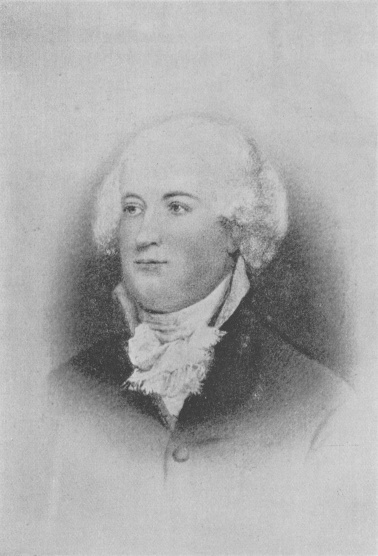
A portrait of merchant George Meade. (Public Domain)
The British colony of Pennsylvania was one of few places in colonial America where Catholics were encouraged to practice their faith.
The Catholic faith of Philadelphia merchant George Meade called him to become a renowned philanthropist and patriot during the American Revolution, and to take a role in building the United States in its infancy.
Meade was also the grandfather of Civil War General George Gordon Meade who is known as the “Hero of Gettysburg” for his role in that legendary battle.
Historical records say that the elder Meade was born Feb. 27, 1741, and was mainly educated by his uncle Thomas Stretcher, a major patron of Pennsylvania Hospital. He grew up Catholic in a city that had few of the faith at the time.
Meade followed in his brother Garrett’s footsteps in the maritime business that was located on Chestnut Street. Both of them joined the movement in 1765 to repeal the Stamp Act, a tax the British crown placed upon printed materials in the colonies. They joined a boycott of all British goods until the act’s repeal.
Many historians see the protest against the Stamp Act as one of the of the first major developments in a string of events that would eventually lead to the Declaration of Independence.
He could not play any internal role in changing colonial government because everyone who worked for the colony had to submit to an oath to King George III that, according to the American Catholic Historical Society, was an oath that “no true Catholic could take.”
Meade married Henrietta Worsam in 1768. The American Catholic Historical Society says they had 10 children. There are records of six children being baptized into the Catholic faith, and historians infer the other children were as well.
He eventually joined the Society of the Friendly Sons of St. Patrick when it began in 1771 to assist immigrants to Philadelphia from Ireland who had been oppressed by the British government, along with victims of starvation during the famine in Ireland. The society eventually inducted George Washington, its first non-Catholic member, in 1782.
As the Revolutionary War commenced in 1775, Meade remained with the family business while other members of the firm went to battle. Meade assisted the families of coworkers who fought in the war.
“Meade appears to have been on various relief committees, committees of correspondence, and sub-committees to superintend food and supplies brought to the city, and he served continuously as a member of the Public Defence Association, a noble band of patriots,” ACHS records say.
An 1896 article from the Catholic Universe says that Meade played major roles in forming organizations that led to the formation of the First Continental Congress, the body that spawned the Declaration of Independence.
He played a major role in the reconstruction of major parts of the city that were damaged during the war, and created funding for clothing to help colonial forces during the hardest times of the war.
His total donations to revolutionary causes equaled millions of today’s dollars when factoring inflation.
No available records specifically give a date, but Meade was a member of the Board of Trustees at Old St. Mary’s Catholic Parish, which is entering its 263rd year of existence this year.
Bishop John Carroll, the nation’s first bishop, turned to Meade in raising key funds for the founding of Georgetown University in Washington, D.C.
Yellow fever struck Philadelphia in 1793, and Meade led an interfaith effort that included three area priests in tending to the sick. During the same year, he served as vice president of an interfaith effort to coordinate Sunday school education for Christians of various denominations, including Catholic.
Meade’s philanthropy for Catholic causes continued in 1796, when he helped raise money for the founding of St. Augustine Catholic Church on North Lawrence Street in Old City.
Like many revolutionary heroes from the time, Meade carries a mixed legacy, as he enslaved a Black man named Newton.
He also endured deep sadness in his adult life, as eight of his 10 children died during his lifetime, and his other two children relocated to Europe.
Meade died on Nov. 9, 1808. His body rests in the family vault at Old St. Mary’s Cemetery at the corner of Fourth and Spruce streets in Old City. Worsam, whose family were loyalists to King George, moved after her husband’s death to England, where she died in 1822.
A memorial address to Congress in 1827 said that Meade “was distinguished among us as a merchant of undoubted integrity.”
“Though the waters of the broad Atlantic divide the resting places of this devoted husband and a wife, the barrier is yet not so great,” said the ACHS in an 1891 publication.
“May the husband and wife be finally reunited, for when that blessed day does come, ‘God will wipe away all tears from their eyes.’”
PREVIOUS: Catholic Faith Shaped Commodore John Barry’s Life, Service in American Revolution
NEXT: Catholics Had Prominent Roles in Last 3 Milestone Celebrations of America’s Founding
Share this story