

In 1876, Catholic historian Dr. John Gilmary Shea stated that of the Catholics during the American Revolution “there were no Tories, no falterers and final deserters among the Catholics. The Catholics were to a man, with the clergy, staunch and true.”
Such a claim, however, does not hold up to the historical record. While there are many noted Catholics who sided with the patriot cause such as Commodore John Barry, founder of the American Navy, or Charles Carroll, the only Catholic signer of the Declaration of Independence, there were numerous lesser-known Catholics who supported the Crown.
When the British took Philadelphia in 1777, they attempted to raise loyalist regiments. One of those was organized by Albert Clifton, a Philadelphia businessman and member of Old St. Joseph’s Parish. His regiment, the Roman Catholic Volunteers, noted 331 on its muster rolls at its peak strength. A number of the regiment’s officers such as Major John Lynch and Quartermaster John Nowland were also members of Old St. Joseph’s.
It was through this connection to the parish that Clifton and British General William Howe tried to recruit Father Ferdinand Farmer to act as the company chaplain. The priest turned down the role, writing to a friend that he was embarrassed by the offer because of his age and several other unspecified reasons.
Once the British left Philadelphia, the regiment’s strength was racked by desertions and a number of soldiers faced courts martial. Within about a year, the regiment was a shadow of its former self and the Roman Catholic Volunteers were disbanded. Yet at least 80 members were absorbed by the Volunteers of Ireland, another mainly Catholic loyalist regiment.
The most successful Catholic loyalist regiment was composed largely of Scottish Catholics in the Mohawk Valley in New York. These colonists were exiles from the failed Jacobite uprising of 1745 against the British. Their issue was with the passing over of the Catholic Stuart line to the throne, not the throne itself. So this group of over 300 men found themselves on the side of their former enemy during the Revolution.
Due to their presence and the risk they posed, the Continental Army confiscated all their weapons in 1776. Within the year, the group was forced to leave New York and settled in Canada. Soon after, they formed the King’s Royal Regiment of New York and fought throughout the rest of the war.
No clearer divide between loyalist and patriot Catholics can be seen than that of the Cauffmans. The father, Joseph Sr., was a prominent Catholic originally from Strasburg who settled in Philadelphia and sided with the British. His son, Joseph Jr., was a doctor who served as the surgeon on the Continental Navy’s frigate USS Randolph. He and the rest of the crew were killed when the ship exploded during a naval battle against the British ship HMS Yarmouth on March 7, 1778.
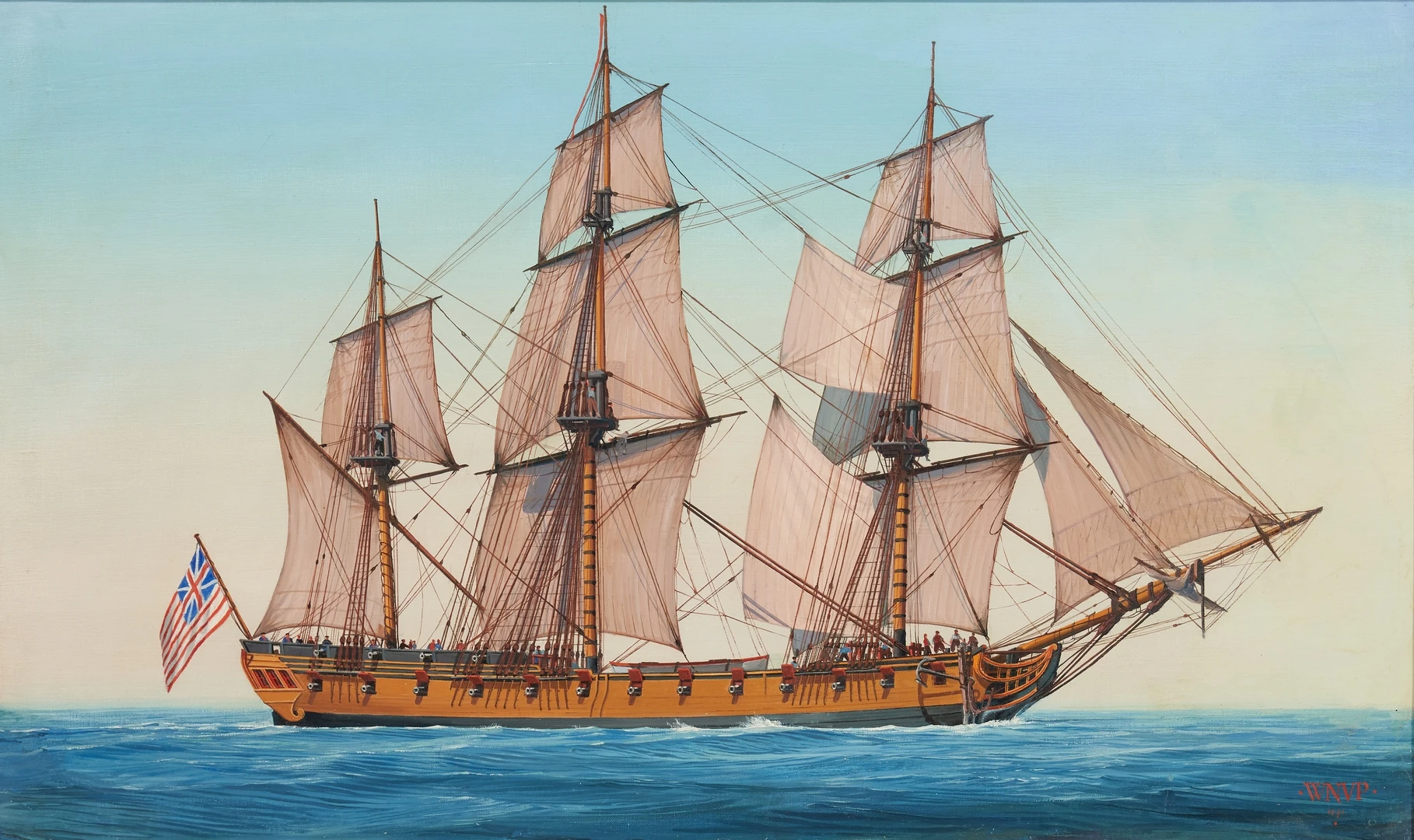
Painting of USS Randolph by William Nowland Van Powell (Public Domain)
Historian Martin Griffin, in the second volume of his “Catholics and the American Revolution,” was able to identify roughly 50 Catholics in the city of Philadelphia who were active loyalists. Many fled the city after the British left. Some, like Michael Connor and John Bray, were convicted of treason by the colonial government and had their estates confiscated.
Those who stayed in the city faced arrest. For instance, Joseph Greswold of Old St. Joseph’s was a distiller who was imprisoned in 1780 for continuing to trade illicitly with English forces. Then there was the case of George Spangler who was married at Old St. Joseph Church in 1775 and had two children baptized by Father Farmer. He had done work for the Continental government but on July 18, 1778, he was court-martialed and found guilty of acting as a spy and guide to the British army. He was then executed in August of that year and buried in Old St Joseph’s cemetery.
Of the 25 or so priests in the colonies at the time of the Revolution, only two had any documented involvement in the Revolution. Father John Carroll (later the first bishop of the United States) was a member of the Continental Congress’ envoy mission to Canada.
The only other evidence of a priest officially supporting with the colonies was Father Farmer in 1779, when as a founding trustee of the University of the State of Pennsylvania, he was required to take the oath of allegiance to the Continental government. It should be noted that Father Molyneux, as the senior priest in Philadelphia, should have been the trustee but elected not to sign on.
For the rest of the clergy, their focus was on administering the sacraments to the roughly 25,000 Catholics in the colonies and any involvement in the war is difficult to determine.
Like most in the colonies, Catholics were not a monolithic group. Each individual Catholic made the decision to support the Revolution or the Crown based on what he or she thought best.
***
This article was written in partnership with the American Catholic Historical Society and the Catholic Historical Research Center of the Archdiocese of Philadelphia.
PREVIOUS: Catholics Had Prominent Roles in Last 3 Milestone Celebrations of America’s Founding
NEXT: Quakers’ Toleration Led Skeptical Young Nation to Accept Catholics as Americans
Share this story