

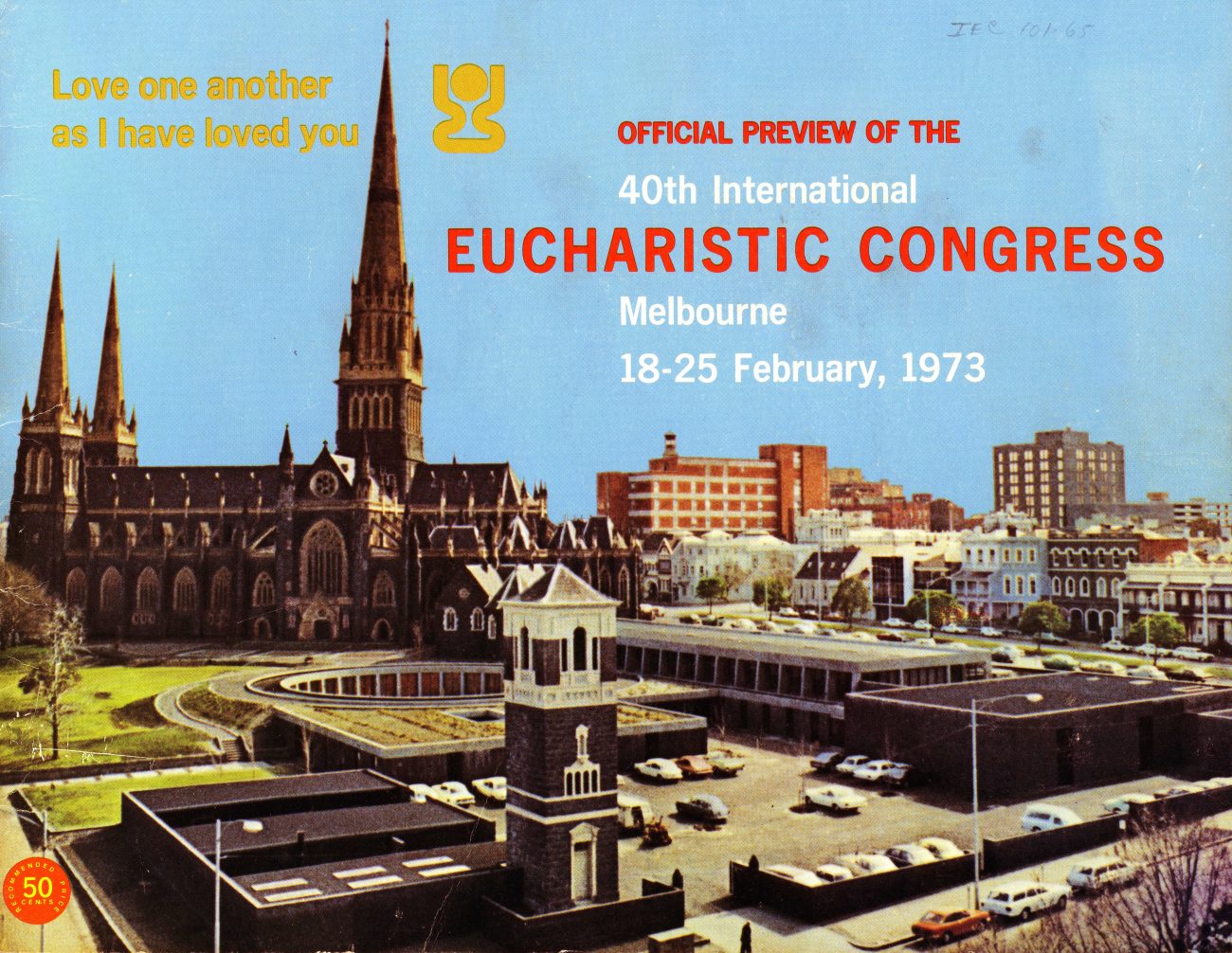
The International Eucharistic Congress (IEC) dates back to 1881 when a one-day congress was held in Lille, France and attended by 800 people. The idea behind the event came from Marian Tarriser, a French woman who developed the congress to study and honor the Eucharist.
With the support of the Vatican, the IEC grew in size and scope. By the 7th Congress in 1890 in Antwerp, 150,000 people attended the closing benediction. The majority of the early congresses were held in Europe with the exception of the 8th in Jerusalem in 1893 and the 21st in Montreal in 1910.
In 1926, the 28th IEC was held in Chicago, the first to be held in the United States. The Chicago IEC was an immense success, with over 1 million people attending the various programs. The highlight was a eucharistic procession around Mundelein Seminary in which an estimated 600,000 participated.
Following the Chicago IEC, the the international scope came more into focus with countries like the Philippines, Argentina, India, and Australia all hosting.
As the congresses grew in size, they moved from being held every year or two to normally a lead time of three to five years between congresses.
At the end of the 1973 IEC in Melbourne, the Permanent Committee recommended the next IEC be held in the United States in either 1976 or 1977. One of the leading contenders was Philadelphia for 1976. However, there was some concern that the IEC would be overshowed by the bicentennial celebrations happening that summer.
Despite the concerns, both the Vatican and the bishops of the United States agreed with the Permanent Committee, so Philadelphia was selected to host in August 1976.
Planning for the 41st IEC began in 1974. The main discussion at that point was on what theme to choose for the focus of the congress. Proposed themes included “Jesus Our Food for All Life,” “Jesus, Our Life Now and Forever,” and “The Human Family, God’s Family.”
After discussions, a new theme was submitted to Pope Paul VI and approved in April 1975. The theme of “The Eucharist and the Hungers of the Human Family” was to examine both physical and spiritual hungers.
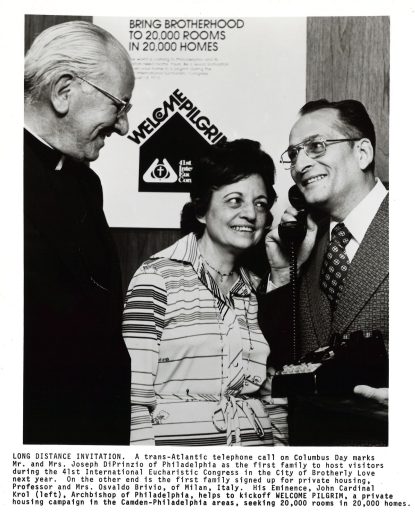
John Cardinal Krol, right, joins Mr. and Mrs. Joseph DiPrinzio of Philadelphia during a trans-Atlantic telephone call with an Italian family on Columbus Day 1975. The DiPrinzios were the first family to volunteer housing for pilgrims attending the 41st International Eucharistic Congress in Philadelphia in 1976. The call helped launch the “Welcome Pilgrim” campaign, which sought housing for congress attendees throughout the Philadelphia-Camden area. (Catholic Historical Research Center of the Archdiocese of Philadelphia)
One of the biggest issues for planners was finding lodging for all the pilgrims from around the world. The IEC secured around 50,000 hotel rooms and 5,000 college dormitories in the greater Philadelphia area, with some as far as Atlantic City.
This was still not enough so a program encouraged local residents to host visitors in their private homes, which added close to 19,000 rooms.
As the congress approached, planners stressed that the 41st was not an event hosted by the Archdiocese of Philadelphia or the city but rather hosted by the entire Catholic Church in the United States. The hope was that doing so would encourage greater participation in local programming from Catholics around the country and to provide financial support for the congress.
In order to make sure the congress ran smoothly, the planning committee worked closely with the City of Philadelphia. The city quickly placed all public facilities on a standing reservation for the IEC and promised to make sure the sports teams were accommodating to the IEC’s schedule and need of the stadiums.
Over the course of eight days, there would be liturgies, lectures, and art exploring the understanding of the Eucharist. Each day of the congress focused on a different kind of hunger. Organizers discussed different types of hungers including spiritual, social, emotional, psychological, and physical.
As the congress would last eight days, eight different hungers were chosen, with each one being the focus of that day’s programming.
***
Patrick Shank is archivist of the Catholic Historical Research Center of the Archdiocese of Philadelphia and serves on the board of the American Catholic Historical Society.
PREVIOUS: Global Catholic Dignitaries, Unique Arts Shined at Eucharistic Congress
NEXT: New Villanova Cabrini Campus Extends Legacy of Faith, Education in Radnor
Share this story